Showing posts sorted by date for query 1978 mars. Sort by relevance Show all posts

Viking on the Moons of Mars (1972)

Phobos, the inner moon of Mars, as imaged by the Viking 1 Orbiter. Viking images of Deimos, Mars's outer moon, can be found at the bottom of this post. Image credit: NASA.
In June 1972, NASA Langley Research Center (LaRC) in Hampton, Virginia, contracted with Martin Marietta Corporation to look at using spacecraft based on the planned Viking Mars Lander and Orbiter designs to explore the martian moons Phobos and Deimos. NASA LaRC managed Project Viking, which aimed to launch two Lander/Orbiter combinations toward Mars in 1975, while Martin Marietta was prime contractor for the Viking Lander. The Jet Propulsion Laboratory (JPL) in Pasadena, California, built the Mariner-derived Viking Orbiter.

Viking was the stepchild of the Voyager Program, first proposed by JPL in 1960. Voyager, which had as its major goal the discovery and detailed study of life on Mars, had suffered from management ineptitude, turf battles, schedule slips, and a comprehensive redesign (and attendant cost increase) resulting from new Mars data gathered during the Mariner IV Mars flyby (July 1965).
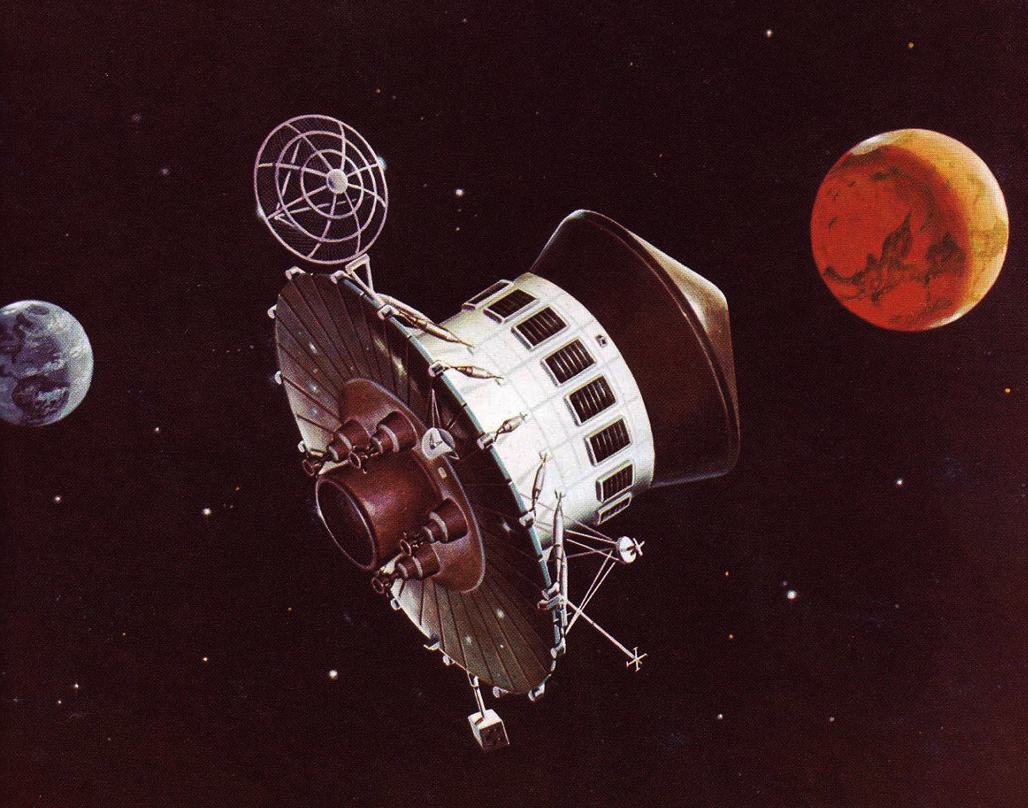
The Voyager spacecraft as envisioned at the time of its cancellation in 1967. The lander is packaged in the dark-colored aeroshell at upper right. Image credit: NASA.
In an unusual move, top NASA officials met with leaders of Congress shortly after Voyager's cancellation in August 1967 to seek funding for a replacement. The latter agreed to fund Viking starting in Fiscal Year 1969, which began on 1 October 1968. Like Voyager, Viking would seek life on Mars. Congressional leaders also agreed to fund a pair of Mariner Mars orbiters that would launch in 1971.

Mariner Mars 1971, Viking, and the proposed Viking-based Phobos/Deimos missions were all in part a response to declared Soviet space plans. As NASA astronauts explored Earth's Moon, the Soviet Union proclaimed to the world that they had never meant to accomplish the same feat; that they had in fact opted to explore space using robots because they would not place human lives at risk. They pointed to their robotic Luna lunar sample-returners and Lunokhod 1 lunar rover when they claimed that they would soon dispatch robot orbiters, landers, sample-returners, and rovers throughout the Solar System. 

The Mariner VII spacecraft glimpsed Phobos during its fast Mars flyby in 1969, and the Mariner 9 orbiter returned the first clear images of both martian moons in November 1971, while Martin Marietta's study was underway. Mariner 8, Mariner 9's twin and planned fellow traveler, had fallen into the Atlantic Ocean north of Puerto Rico after the failure of its Centaur upper stage on 9 May 1971. 

Phobos and Deimos were the first non-spherical Solar System bodies humankind examined close up. They revolve about Mars in circular equatorial orbits. Phobos completes one orbit in about 7.5 hours at an altitude of about 5980 kilometers (3715 miles), while Deimos orbits in about 30 hours at 20,070 kilometers (12,470 miles). 

Phobos measures 21 by 25 kilometers (13 by 16 miles) and Deimos is about half as large. Small size means low gravity; Phobos has only about 0.1% as much surface gravity as Earth. Because of this, setting down on Phobos or Deimos would be more like docking than landing.

Viking Orbiter (top) shortly after release of the aeroshell containing the Viking Lander. Image credit: NASA/Don Davis.
A Viking Lander samples the surface of Mars in this artist's concept from March 1974. Image credit: U.S. Geological Survey/Don Davis.
NASA LaRC directed Martin Marietta to assume that its Viking-based Phobos/Deimos missions would depart Earth in the 1979 and 1981 Earth-Mars minimum-energy transfer opportunities. The study report described several Phobos/Deimos spacecraft designs. 

The first, the baseline Phobos/Deimos landing spacecraft, would comprise a heavily modified Viking Lander and a Viking Orbiter with tanks carrying 38% more propellants than the Viking 1975 design (Martin Marietta called this a "38% Stretch Orbiter"). Mass at Earth-orbit departure would total about 3600 kilograms (7940 pounds) during the 1979 minimum-energy Earth-Mars transfer opportunity. The Lander would account for 482 kilograms (1063 pounds) of that mass. 

Upon arrival at Mars, the Orbiter would fire its rocket motor to slow down and place itself and the attached Mars moon Lander into an elliptical, equatorial "capture orbit" about the planet. The spacecraft would then maneuver into an elliptical, 15-hour "observation orbit." The apoapsis (high point) of this orbit would reach the orbit of Deimos, while its periapsis (low point) would dip inside the orbit of Phobos. 

The spacecraft would repeatedly fly past both moons, gathering data at each encounter so that scientists on Earth could decide which moon most warranted in-depth exploration. Controllers would then command the spacecraft to match orbits with the moon selected. 

The Lander would separate from the Orbiter and move toward its target using Viking Lander attitude-control thrusters. It would set down gently on three spidery legs and deploy 82 kilograms (181 pounds) of instruments, including a seismometer, a surface sample auger, and a boom-mounted camera. The Lander would be able to hop across the surface in the weak gravity by briefly firing its thrusters; an alternate mobility scheme would employ spindly umbrella-shaped wheels at the ends of the landing legs. 

Viking Lander-derived Phobos/Deimos rover. Image credit: Martin Marietta/NASA.
Martin Marietta proposed an alternate baseline mission in which the Viking Orbiter would land on the target moon. This more efficient "landed orbiter" scenario could land about 500 kilograms (1100 pounds) of science instruments, the company estimated. Total cost for a baseline Phobos/Deimos landing mission would come to $324 million.

The company targeted its second design, the baseline Phobos/Deimos sample-return spacecraft, for launch in 1981 "to allow more time for additional mission design and hardware development." The sample-return mission would build on experience gained in the 1979 landing mission. Its 3374-kilogram (7438-pound) spacecraft would consist of a 38% Stretch Viking Orbiter with four legs and a 260-kilogram (573-pound) drum-shaped Earth-return vehicle based on a proposed Venus Pioneer spacecraft design. 

The Orbiter would land on the target moon, collect a two-kilogram (4.4-pound) sample, and transfer it to a sample-return capsule inside the Earth-return vehicle. The Earth-return vehicle would then fire its rocket to separate from the landed Orbiter and maneuver into a 1500-by-95,000-kilometer (930-by-59,000-mile) Mars orbit. There it would trim its orbital plane so that the subsequent Mars departure maneuver could place it on course for Earth. 

Near Earth, the saucer-shaped sample-return capsule would separate from the Earth-return vehicle. It would enter Earth's atmosphere at up to 12.8 kilometers (8 miles) per second, slow to subsonic speed, deploy a parachute, and lower to a soft landing. The baseline sample-return mission would cost a total of $446 million. 

Martin Marietta's third design, the baseline combined Phobos/Deimos landing and Mars landing spacecraft, would comprise a minimally modified Viking Lander and a 26% Stretch Viking Orbiter. Total weight at Earth-orbit departure would come to 4150 kilograms (9150 pounds) in 1979. 

For this "Mars + Phobos/Deimos landing" mission, the Orbiter would fire its rocket to place itself and the Viking Lander into an elliptical equatorial capture orbit about Mars requiring 97 hours to complete, then would release the lander. De-orbiting from the capture orbit would impose restrictions on the Lander — it would be able to set down only within a latitude band extending 12° north and 12° south of Mars's equator and would need a beefed-up heat shield to withstand a greater Mars atmosphere entry velocity. 

The Orbiter would then maneuver to a 15-hour observation orbit, match orbits with either Phobos or Deimos, and land bearing 62 kilograms (137 pounds) of science instruments. The baseline combined mission would cost $441 million. 

Martin Marietta also considered "Mars + Phobos/Deimos observation orbit," "Mars + Phobos/Deimos rendezvous," and "Mars + Phobos/Deimos sample-return" missions. Its "Mars +" missions would, the company estimated, be more cost-effective than Phobos/Deimos missions without Mars landings. A separate Phobos/Deimos landing mission would, for example, cost 80% as much as a Mars landing mission, while a "Mars + Phobos/Deimos landing" mission would cost only 14% more than a Mars landing mission. 

Martin Marietta then looked at whether sufficient interest existed in the planetary science community to justify missions to the martian moons. The company found that there were "no active and forceful champions" of Phobos/Deimos exploration. It added, however, that it had 
repeatedly found easily excited curiosity and conjecturing among space scientists about the origin and nature of these tiny bodies. This undercurrent of scientific interest, which has been given impetus by the recent returns of Mariner 9, may be the forerunner of well defined and enthusiastically supported recommendations for exploring the moons of Mars. If this is the case, NASA's decision to conduct this study may prove to be a very timely one. 
Viking 1 left Earth atop a Titan III-E rocket with a Centaur upper stage on 20 August 1975. Viking 2 launched on 9 September 1975. The twin two-part spacecraft entered Mars orbit on 19 June 1976, and 7 August 1976, respectively. The Viking 1 Lander separated from its Orbiter and touched down successfully on 20 July 1976; Viking 2's Lander followed on 3 September 1976. 

While the Landers operated on the surface, the Orbiters imaged Mars and its satellites. On 15 October 1977, the Viking 2 Orbiter passed just 30 kilometers (19 miles) from Deimos (images at bottom of post). 

NASA supported studies of a Viking-derived Moon lander, a Viking 1979 Mars rover mission, and other Viking derivatives, but the U.S. opted not to fund new missions based on Viking technology. Much like the $25-billion Apollo Program, Project Viking — which had cost over $1 billion in 1975 dollars (about $5 billion in 2023 dollars) — ended with its potential barely exploited. 

This occurred because the Soviet Union did not keep its promise to explore the Solar System, because NASA's budget shrank to half its Apollo-era value, and because public interest slumped after the Viking search for life on Mars returned equivocal results. The U.S. would launch no new spacecraft toward Mars until 1992, two decades after Martin Marietta completed its study. 

Deimos as imaged by the Viking 2 Orbiter. Image credit: NASA.
Individual house-sized boulders and craters submerged in dust are visible in this Viking 2 Orbiter close-up of Deimos. Image credit: NASA.

Sources

A Study of System Requirements for Phobos/Deimos Mission, Final Report, Volume I, Summary, Martin Marietta Corporation, June 1972.

On Mars: Exploration of the Red Planet, 1958-1978, NASA SP-4212, Edward Clinton Ezell and Linda Neumann Ezell, NASA, 1984, pp. 83-153.

More Information


Project Hyreus (1993)

The Project Hyreus mission emblem. Image credit: University of Washington Department of Aeronautics and Astronautics.

In Greek mythology Hyreus (pronounced "HY-ree-us") is Orion's father. Students in the University of Washington (UW) Department of Aeronautics and Astronautics had a different take on this obscure figure, however. The end of the Cold War and efforts to rein in a galloping U.S. Federal deficit yielded a decline in aerospace spending in the late 1980s/early 1990s. This led to "downsizing" and corporate mergers in aerospace industry. New hires slumped, confronting aerospace engineering students with an uncertain future.

According to the 28 UW students who contributed to the 1993 Project Hyreus report, Hyreus (pronounced "HIRE-us") was a mortal who succeeded in living off the land in the barren underworld, and for that achievement was made the God of Gainful Employment. The students performed the Project Hyreus Mars Sample Return (MSR) study in UW's Space Systems Design course as part of the NASA/Universities Space Research Association (USRA) Advanced Design Program (ADP). Dr. Adam Bruckner was their instructor. 

Hyreus was a follow-on to UW's 1992 Project Minerva NASA/USRA ADP study, which proposed a piloted Mars expedition based on the 1990 Martin Marietta Mars Direct plan. The Minerva study had found feasible Mars Direct's reliance on Earth-return rocket propellants manufactured from martian resources, a technique called In Situ Propellant Production (ISPP). In the Mars Direct, Minerva, and Hyreus plans, ISPP relied on carbon dioxide gas in the martian atmosphere because it is readily available all over the planet. Carbon dioxide makes up about 95% of the martian atmosphere, which is only about 1% as dense as Earth's atmosphere. 

The UW students emphasized a Sabatier/Reverse Water-Gas Shift (RWGS) ISPP system, which would produce liquid methane fuel and liquid oxygen oxidizer, though they also examined a carbon monoxide ISPP system. The UW students explained that Hyreus aimed to demonstrate ISPP technology in a critical mission role at a relatively low cost ahead of a piloted ISPP Mars mission. 

Assuming that Hyreus succeeded, the mission would exploit the mission-enhancement potential of ISPP by returning to Earth a Mars surface sample with a mass of from 25 to 30 kilograms — that is, one more than 10 times larger than in most other MSR proposals. Analysis of such a large sample would enable scientists to locate water deposits and seek life on Mars, the students contended.

Hyreus Sabatier/Reverse Water-Gas Shift (RWGS) In Situ Propellant Production (ISPP) system. Image credit: University of Washington Department of Aeronautics and Astronautics.

The 400-kilogram Sabatier/RWGS ISPP plant would need a total 122 kilograms of cryogenic liquid hydrogen feedstock brought from Earth. The hydrogen would gradually boil and escape, so Hyreus would depart Earth with an extra 88 kilograms on board to make up for losses. 

The Sabatier/RWGS plant would take in dust-laden martian air at a rate of 9.6 kilograms per day. The air would pass through a hydrocyclone dust filter to a compressor, then to a condenser that would liquify its carbon dioxide. Residual trace gases (nitrogen and argon) would be vented overboard, and the carbon dioxide would be pumped to the ISPP unit. There it would be combined with 0.24 kilograms of liquid hydrogen feedstock per day to produce carbon monoxide gas and water. 

The plant would vent the carbon monoxide overboard and pump the water to an electrolyzer, which would split it into gaseous hydrogen and oxygen. The oxygen, produced at a rate of 4.62 kilograms per day, would go to a liquifier, then to its final destination in the Earth Return Vehicle (ERV) oxidizer tank. 

The hydrogen, meanwhile, would go to the Sabatier reactor, where it would be joined with martian carbon dioxide in the presence of a nickel or ruthenium catalyst to yield water and methane gas at a rate of 1.15 kilograms per day. The methane would go to a liquifier, then to the ERV's twin fuel tanks. The water, meanwhile, would return to the electrolyzer. Over 1.4 years the Sabatier/RWGS ISPP system would produce 480 kilograms of methane and 1921 kilograms of oxygen for the ERV's single rocket engine. 

The students found that the carbon monoxide ISPP system had two advantages over the Sabatier/RWGS system: it would need no Earth-supplied feedstock and would be smaller, simpler, and less massive (just 300 kilograms). On the other hand, the carbon monoxide and oxygen it produced constituted a propellant combination less efficient than methane/oxygen. This meant that the carbon monoxide ISPP plant would need to manufacture 3440 kilograms of carbon monoxide and 1960 kilograms of oxygen to make up for the reduced performance.

Both ISPP systems would rely for electricity on a nuclear-fueled Dynamic Isotope Power System (DIPS) attached to the ERV. The DIPS would also power other MLV systems. The Sabatier/RWGS and carbon monoxide ISPP systems would draw from the DIPS 1.2 and 1.1 kilowatts of electricity, respectively. 

Landing its hydrogen feedstock and heavy ISPP unit on Mars would mean the Sabatier/RWGS Hyreus spacecraft would need a sturdier lander structure, a larger aerobrake, larger parachutes, and more landing propellant than the carbon monoxide Hyreus spacecraft. The carbon monoxide Hyreus would, on the other hand, need a larger ERV to enable it to hold enough carbon monoxide/oxygen propellants to reach Earth. The students calculated that the Sabatier/RWGS Hyreus would have a mass of 4495 kilograms at launch from Earth; the carbon monoxide Hyreus mass would total 4030 kilograms. 

Hyreus "raked sphere-cone" aerobrake. Image credit: University of Washington Department of Aeronautics and Astronautics.

At launch, the Hyreus spacecraft would comprise an aerobrake and a Mars Landing Vehicle (MLV) bearing the Satellite Observation and Communication at Mars (SOCM) orbiter, Special Planetary Observation Transport (SPOT) rover, and the ERV. Hyreus would leave Earth between 22 May and 20 June 2003 on a $400-million, 940-metric-ton Titan IV/Centaur rocket, the most powerful U.S. launcher expected to be available. 

Two solid-propellant rocket motors would boost the Titan IV off the launch pad, then the first stage would kick in a little more than two minutes after liftoff. During first-stage operation, the 7.5-meter-diameter launch shroud would split and fall away, exposing Hyreus atop the Centaur upper stage. After Titan IV second stage separation, the Centaur would fire to place itself and the Hyreus spacecraft into parking orbit 300 kilometers above Earth. 

The Hyreus aerobrake would include two folding "flaps" so that it could fit within the confines of the Titan IV launch shroud. After arrival in parking orbit, the flaps would hinge into place and lock to give the 11.3-meter-long aerobrake its full 9.4-meter width. The students chose a "raked sphere-cone" aerobrake over one with a biconic shape because it would be 20% lighter and have an open back that would offer more options for deploying the SOCM orbiter. 

A second Centaur burn would push Hyreus out of parking orbit toward Mars, then the Centaur would detach and fire its engine a final time to avoid striking and contaminating the planet. Depending on the exact Earth launch date, Earth-Mars transfer would last from 188 to 217 days. Hyreus would perform course corrections during the transfer using the MLV's four descent rocket motors. 

On 25 December 2003, Hyreus would enter the atmosphere of Mars traveling at 5.69 kilometers per second. Aerodynamic drag would slow the spacecraft so Mars's gravity could capture it into the desired near-polar orbit. Hyreus would descend to an altitude of 55 kilometers, then would skip out of the atmosphere and climb to apoapsis (the high point of its orbit) 2470 kilometers above Mars. There the MLV descent rockets would ignite briefly to lift the spacecraft's periapsis (the low point of its orbit) out of the atmosphere to an altitude of 250 kilometers. 

Mars would rotate beneath the orbiting Hyreus spacecraft, gradually positioning the selected landing site so that descent could begin. A second apoapsis burn would put Hyreus on course for its second aerobraking maneuver, which would place it into an orbit with a 580-kilometer-high apoapsis and a periapsis beneath the martian surface near the planned landing site. 

Following the second apoapsis burn, Hyreus would deploy the 282-kilogram SOCM orbiter. After deployment, SOCM would fire thrusters to raise its periapsis to 580 kilometers and circularize its orbit. The solar-powered SOCM would carry a Ground-Penetrating Radar to seek subsurface water and a wide-angle camera for monitoring weather at the MLV landing site. The orbiter would transmit its data to the MLV for relay to Earth. 

After the second apopasis burn, the Hyreus spacecraft would fall toward its landing site. The students proposed three candidate sites within 15° of the martian equator. Near-equatorial sites were preferred, they argued, because the planet's rotation would give the ERV an extra boost when the time came for it to lift off from the planet. All of the landing sites included smooth areas large enough to permit a safe off-target landing, as well as a variety of sampling sites within rover range (~20 kilometers) of the MLV. 

The UW students' prime Hyreus landing site was at 148.1° W, 13.8° S in Mangala Valles, a 350-kilometer-long outflow channel. In addition to the channel itself, Mangala included young volcanoes, ancient rocks, and young and old impact craters. The first backup Hyreus site was at 63° W, 16° N in Valles Marineris, a system of wide, deep canyons with horizontally layered walls. The second backup, at 45° W, 20° N, was in Chryse Planitia, an ancient flood plain near the site where Viking 1 set down on 20 July 1976. The students noted that a visit to the derelict Viking 1 lander "would offer the chance to get first hand analysis of the aeolian and other weather effects on the lander over the 20 years it has been there." 


Hyreus Mars Landing Vehicle (MLV) entry, descent, and landing. Image credit: University of Washington Department of Aeronautics and Astronautics.
Hyreus MLV in Mars landing configuration. The drawing is somewhat inaccurate; by the time the MLV rested on its deployed landing gear on the surface of Mars the SOCM orbiter and parachute canister would be absent. Image credit: University of Washington Department of Aeronautics and Astronautics.

The aerobrake would slow the Hyreus MLV to a speed of 220 meters per second 10 kilometers above Mars, then a tractor rocket would deploy the lander's first parachute. As it unfurled, explosive bolts would fire to jettison the aerobrake. 

Two more parachutes would deploy eight kilometers above Mars. The parachute cluster would slow the MLV to 40 meters per second 500 meters above the landing site. Explosive bolts would then fire to jettison the MLV's upper structural frame and the attached parachute cluster, exposing the ERV. Four throttleable landing rockets would ignite a moment later. 

The MLV would feel a maximum deceleration of 6.5 times Earth's gravity as its four footpads contacted Mars. At touchdown, the MLV would have a mass of 2650 kilograms.

Mars surface operations would last from 547 to 574 days. The Hyreus mission would focus on the three Mars surface activities. The first, ERV propellant loading, would begin immediately after landing. Controllers on Earth would check out and activate the Sabatier/RWGS ISPP plant. Valves would open to admit martian air into the hydrocyclone filter and release hydrogen feedstock. The electrolyzer would switch on after it filled with water, then the Sabatier reactor would activate after it received sufficient hydrogen from the electrolyzer. Unless a malfunction occurred, the ISPP plant would fill the ERV's propellant tanks without human intervention after it was switched on.

The second major Mars surface activity, sample acquisition, would be the primary task of the 185-kilogram SPOT rover. SPOT would comprise three sections one meter wide by 0.44 meters long joined by ball-and-socket joints. Each section would include one pair of 0.5-meter-diameter wire wheels. Hub-mounted electric motors would independently power the wheels on the front and middle sections, while the wheels on the rear ("trailer") section would be passive rollers.

Hyreus Special Planetary Observation Transport (SPOT) rover. Image credit: University of Washington Department of Aeronautics and Astronautics.

SPOT's front section would carry a pair of cameras for science and navigation and a Remote Manipulator Arm (RMA) with four interchangeable sampling tools. These would include a scoop/grabber ("scoobber"). The trailer section would include a large drill for subsurface sampling. After SPOT collected a sample, it would seal it within a Cylindrical Sample Collection Cell (CSCC) and place it into a sample storage bay in its front section. 

Upon return to the MLV, the SPOT RMA would hand the CSCCs one at a time to an RMA on the MLV for transfer to the ERV. The ERV would maintain the samples at martian ambient temperature to help keep them pristine. 

The third area of Mars surface activity would be MLV science. The MLV would carry 57.1 kilograms of science equipment, including three exobiology experiments, a seismometer (to be deployed by SPOT at least 200 meters from the MLV so that vibration from the ISPP system would not interfere with it), a camera, a weather station, a mass spectrometer, and an RMA with 18 interchangeable tools.

After 1.4 years of operation, the Sabatier/RWGS ISPP plant would run out of hydrogen and shut down. Controllers on Earth would then prepare the ERV for liftoff. The primary launch window for Mars departure would span from 25 June to 21 July 2005. In the event of difficulties (for example, if ISPP needed more time than expected), then launch from Mars would be postponed until the 19 June-22 August 2007 launch window opened. 

Explosive bolts would sever connections linking the ERV to the MLV, then the ERV's RL-10-derived engine would ignite to launch it into a 300-kilometer circular parking orbit about Mars. The ERV would orbit Mars until it reached the correct point in its orbit for Mars-Earth transfer orbit injection, then would ignite its engine again to put itself on course for Earth. During Mars-Earth transfer, it would position itself so that the Apollo-style bowl-shaped aerobrake on its Earth Return Capsule (ERC) would shade the samples from the Sun. 

Assuming an on-time launch from Mars, the Hyreus ERV would reach Earth's vicinity on 31 March 2006. If launch were delayed to 2007, Earth arrival would occur on 29 April 2008. The battery-powered ERC would separate from the ERV, then the latter would fire its engine a final time to bend its course away from Earth. This Contamination and Collision Avoidance Maneuver would, the students wrote, prevent Mars dust and possible microbes on the ERV's exterior from reaching the homeworld. 

Shielded by its aerobrake, the Hyreus ERC would enter Earth's upper atmosphere at a speed of 11.2 kilometers per second. Atmospheric drag would slow it to 7.8 kilometers per second so that Earth's gravity could capture it, then a brief rocket burn would circularize its orbit at 340 kilometers of altitude for recovery by a Space Shuttle orbiter. 

The students acknowledged that direct ERC entry into Earth's atmosphere followed by a parachute descent to the surface would cost less than orbital recovery by a Shuttle, but opted for the latter because it would permit astronauts to safely study the Mars samples outside of Earth's biosphere. If their preliminary analysis indicated that the Mars samples posed a hazard to life on Earth, the Shuttle crew could attach the ERC to a Payload Assist Module solid-propellant rocket motor and dispose of it in deep space. 

The UW students presented their Hyreus study in July 1993 at the 8th NASA/USRA ADP summer conference near NASA's Johnson Space Center (JSC) in Houston, Texas. Not coincidentally, NASA JSC and contractor engineers were also studying ISPP MSR mission designs at this time. They found the UW students' work sufficiently impressive to ask for a briefing at NASA JSC. NASA engineers subsequently cited the Hyreus report in NASA ISPP MSR documents. The God of Gainful Employment smiled upon the Hyreus students; several subsequently found jobs at NASA centers and with aerospace contractors. 

Sources

"Mars Rover Sample Return Mission Utilizing In Situ Production of the Return Propellants," AIAA 93-2242, A. P. Bruckner, L. Nill, H. Schubert, B. Thill, and R. Warwick; paper presented at the AIAA/SAE/ASME/ASEE 29th Joint Propulsion Conference and Exhibit in Monterey, California, 28-30 June 1993. 

Project Hyreus: Mars Sample Return Mission Utilizing In Situ Propellant Production Final Report, NASA/USRA Advanced Design Program, Department of Aeronautics and Astronautics, University of Washington, 31 July 1993.

More Information


A Robotic and Piloted Planetary Exploration Program for the 1970s and Early 1980s (1968)

Leaving home: Earth as viewed from Apollo 4 on 9 November 1967. Image credit: NASA.
It was the best of times. It was the worst of times. (With apologies to Charles Dickens.)

For NASA, the year 1967 began with the promise of a bold start for the Apollo Applications Program (AAP), the planned successor to the Apollo lunar program, which would see space station missions in low-Earth orbit and advanced lunar exploration missions. Top NASA officials briefed the press on their ambitious AAP plans on 26 January 1967 (see "More Information" below). 

Barely a day later, fire raged through the crew cabin of the Apollo 1 Command and Service Module (CSM) spacecraft during a test on the launch pad, killing astronauts Gus Grissom, Ed White, and Roger Chaffee. The resulting investigation angered Congress — NASA had failed to report persistent problems in its relations with North American Aviation (NAA), the CSM prime contractor. Affronted legislators, already eager to cut government expenditures because of the soaring cost of U.S. military involvement in Indochina, responded in August-September 1967 by slashing President Lyndon Baines Johnson's Fiscal Year (FY) 1968 NASA budget request by nearly half a billion dollars. 

The cuts mostly affected projects aimed at giving NASA a post-Apollo future; AAP, of course, but also the Voyager robotic Venus/Mars exploration program (see "More Information" below) and advance planning for piloted missions beyond the Moon, including piloted Mars/Venus flybys. Members of the NASA Office of Manned Space Flight (OMSF) Planetary Joint Action Group (JAG) had hoped that major funding for piloted flybys could begin in FY 1969, with the first in a series of piloted flybys — a Mars flyby with sample return — leaving Earth in late 1975 (see "More Information" below).

Even as OMSF had sought piloted flybys, the scientific community had continued its perennial quest for an expanded robotic program. In a February 1967 report to the Johnson White House, the President's Science Advisory Council (PSAC) disparaged piloted flybys and urged a 1970s program that would see robotic spacecraft begin a wide-ranging reconnaissance of the entire Solar System. Scientists were outraged when instead the FY 1968 budget cuts threatened to end U.S. robotic exploration entirely after the twin Mariner '69 Mars flybys.

In October and November 1967, NASA Administrator James Webb spoke out in favor of new robotic planetary missions in the 1970s. He urged members of Congress to take note of Soviet plans for robotic exploration beyond the Moon. Talks began with White House budget officials and Congressional leaders aimed at salvaging a 1970s planetary program from the wreckage of the FY 1968 budget process.

Meanwhile, in Florida, components of AS-501, the first flight-ready Saturn V rocket, came together with an Apollo CSM in the giant Vertical Assembly Building (VAB) at NASA Kennedy Space Center (KSC). Without the three-stage behemoth an Apollo Moon landing was impossible.  The testing and assembly process had begun months before the Apollo 1 fire with the aim of a launch in the first quarter of 1967, but preparation for the automated test mission — which NASA designated Apollo 4 — hit one snag after another. 

Following the fire, NASA subjected the CSM NAA had delivered to KSC for the Apollo 4 mission to enhanced scrutiny. The spacecraft, designated CSM-017, was found to contain more than 1400 wiring errors. Fixing them required months. Welding errors in the NAA-built Saturn V S-II second stage also needed correction. 

Troubled assembly: the Apollo 4 CSM and Saturn V rocket in the Vertical Assembly Building at NASA Kennedy Space Center, Florida. Image credit: NASA.
The giant rocket was at last rolled out to Launch Pad 39A on 26 August 1967, but its troubles were not over, for Apollo 4 was also a test of launch pad hardware and pre-launch procedures. As the launch team struggled to make pad and rocket function together, the press, the public, and the Congress became increasingly impatient.

Apollo 4 lifted off at last on 9 November 1967. Rocket, spacecraft, launch facilities, and world-wide tracking & communications network operated together almost flawlessly.

The Apollo 4 Saturn V and CSM climb toward orbit. Image credit: NASA.
About three hours after insertion into a 190-kilometer-high (118-mile-high) low-Earth orbit, the AS-501 Saturn V S-IVB third stage restarted to boost CSM-017 into an elliptical orbit. It was the first orbital restart of the stage, which would boost Apollo missions out of Earth orbit to the Moon. 

Near orbital apogee CSM-017 separated from the S-IVB. The spacecraft fired its Service Propulsion System (SPS) main engine to increase its altitude to 18,092 kilometers (11,242 miles), then fired it again for 4 minutes and 30 seconds to hurl itself at Earth at a lunar-return speed of 24,911 miles (40,090 kilometers) per hour. 

CSM-017 split into its component modules — Command Module (CM) and Service Module (SM) — then the former reoriented itself with its bowl-shaped heat shield forward so that it could withstand fiery atmosphere reentry. The SM burned up as planned. The CM's heat shield, meanwhile, reached a temperature of nearly 2760 C (5000° F). Crew cabin temperature did not exceed 21 C (70° F). Just eight and a half hours after liftoff, the Apollo 4 CM deployed three parachutes and lowered to a splashdown in the Pacific. 

The unmanned Apollo 4 Command Module (right) bobs in the Pacific Ocean near Hawaii at the end of its eight-and-a-half-hour test flight. One of its three main parachutes remains attached; it would be retrieved for analysis along with the spacecraft. Image credit: NASA.
The trade magazine Aviation Week & Space Technology reported that, ironically, on the very day of NASA's Apollo 4 triumph, NASA Marshall Space Flight Center (MSFC) in Huntsville, Alabama, had laid off workers as a result of the FY 1968 budget cuts. NASA MSFC was the home of the Saturn family of rockets. 

On 12 December 1967, a little more than a month after Apollo 4, President Lyndon Baines Johnson toured NASA's Michoud Assembly Facility near New Orleans, Louisiana, where Saturn rockets were assembled and tested. His visit was meant to reassure local and state officials and to raise worker morale. Whether he succeeded is open to interpretation. Standing before a partially complete Saturn V S-IC first stage, Johnson told the workers

. . .that man will make space his domain is inevitable. Whether America will lead mankind to that destiny does not depend on your ability, but depends on our vision, our willingness, and our national will and determination. This great pilgrimage of man — like all his adventures — costs money. Christopher Columbus spent more years trying to find money for his voyage than he spent discovering the New World. In the modern world, we can no longer depend on Queen Isabella pawning her jewels. We have to depend on taxes. We must have revenues that only Congress can grant. . . So we will advance in space to the extent that our people and their representatives are prepared for us to advance and are prepared to pay the cost of that advance. We may not always proceed at the pace we desire. I regret — I deeply regret — that there have been reductions and there will be more. There have been interruptions. . . But I do have faith and confidence in the American people.

This background may help to explain why two engineers at Bellcomm, NASA's Washington, DC-based advance planning contractor, responded as they did when NASA invited them in late November-early December 1967, to state their opinions on the course U.S. planetary exploration should take in the 1970s and early 1980s. In a report completed and distributed to relevant NASA facilities on 26 February 1968, J. P. Downs and W. B. Thompson were cautiously optimistic. 

Downs and Thompson explained that their report reflected "the authors' thinking at. . . [a] particular time" and that it was "a reflection of a long term point of view." They assumed that the deep FY 1968 budget cuts were a short-term, temporary setback, not a sign of a long-term trend. In fact, they anticipated an annual NASA budget of between $5 billion and $6 billion by FY 1971 or FY 1972, when, they expected, NASA would start development of a piloted planetary program.

At the same time, the Bellcomm engineers cautioned that "[a]s more information becomes available on technical details and resources, the program may change." They added, however, that "the rationale expressed. . . is expected to remain much as it is now."

Downs and Thompson described a NASA planetary program containing 21 missions to 11 Solar System bodies between the years 1969 and 1984. Missions would occur in three "branches." The first branch would comprise missions to Venus and Mars that would serve as precursors to at least three piloted Mars and Venus missions. Missions in the second branch would explore Mercury, Jupiter, and the other "major planets" (Saturn, Uranus, and Neptune), a task they called "the major challenge to the unmanned program." The third branch would include missions to explore two comets and two asteroids. 

Their program would begin with the twin Mariner '69 Mars flybys already on NASA's schedule and continue in 1970 with a Mariner Venus/Mercury dual flyby mission launched on an Atlas/Centaur rocket. The Atlas/Centaur was already in early 1968 the workhorse of the NASA robotic lunar and planetary program. 

The Venus/Mercury mission, which would form part of both the first and second of Downs and Thompson's three branches, would seek gaps in Venus's cloud cover in the hope of glimpsing its mysterious surface. In addition, as the spacecraft flew past the planet, it would transmit radio signals to Earth through the Venusian atmosphere in an attempt to chart its structure.

Mariner Mars '69 engineering model. Note the large steerable camera "pod" mounted below the hexagonal bus body, the high-gain dish antenna on top, and the four solar arrays. Image credit: NASA.

Space workhorse: an Atlas-Centaur rocket launches the Surveyor 1 lunar lander on 30 May 1966. Image credit: NASA.
During the flyby, Venus would give the spacecraft a gravity assist that would reduce by between 50% and 75% the amount of propulsive energy it would need to reach Mercury. Downs and Thompson explained that the innermost planet is, by dint of its proximity to the Sun, often lost in glare when viewed from Earth and hence mysterious; orbiting close to the Sun also means that its orbital speed is high, making it difficult for spacecraft to reach.

In 1971, NASA would launch on a Titan III-C rocket its first new-design Mars orbiter and surface probe. Downs and Thompson suggested that the new orbiter might be based on the Boeing Lunar Orbiter design. The Titan III-C, a U.S. Air Force rocket, was meant to replace the Saturn IB-Centaur rocket formerly emphasized in NASA planetary mission plans. Use of the Titan III-C in the Downs and Thompson program was a response to a statement by NASA Administrator James Webb that the Saturn IB would be phased out to save money. 

18 June 1965: the first Titan III-C rocket stands on the pad at Launch Complex 40, Cape Canaveral Air Force Station, Florida. Image credit: U.S. Air Force.

Boeing-built Lunar Orbiter spacecraft. Image credit: NASA.
The 159-kilogram (350-pound) battery-powered survivable surface impactor probe would include an atmosphere entry shell, a parachute, a protective impact shell carved from soft, lightweight balsa wood, and 13 pounds of science instruments. These might include a life detection device. Instruments on the entry shell would  chart atmospheric structure as it plummeted toward the surface after separation from the impactor. These data would enable engineers to design heavier, more sophisticated Mars landers. 

NASA would launch in 1972 its first new-design Venus orbiter and atmospheric probe on a Titan III-C. In addition to "a concentrated search over the entire planet for visible access to the surface," the orbiter would employ an imaging radar to chart surface topography. The probe would measure the thermodynamic properties of the atmosphere to enable design of meteorological balloon probes suited to Venusian conditions.

In 1973, NASA would ramp up the pace by launching on three Titan III-Cs a pair of Mars orbiter/impactor probe missions and a second Mariner-derived Venus/Mercury flyby spacecraft. The latter would resemble that launched in 1970 but would add a Venus survivable surface impactor probe. The prime objective of the Mars impactor probes would be to search for life. 

The 600-pound Venus impactor probe would attempt to return data on the planet's harsh surface conditions for at least an hour. The dense Venusian atmosphere would, Downs and Thompson wrote, enable a survivable landing without a parachute.

The following year, NASA would launch its first flyby mission to Jupiter on a Titan III-C augmented with a Centaur upper stage. Dubbed a "galactic Jupiter probe," it would be the first NASA spacecraft designed for an operational lifetime of up to 10 years. It would survey interplanetary particles and fields and aid future spacecraft designers by surveying the interplanetary meteoroid environment with particular emphasis on the Asteroid Belt between Mars and Jupiter. A Jupiter gravity-assist would make it the first spacecraft to escape the gravitational grip of the Sun.

NASA would ramp up the planetary exploration pace in 1975 by launching four rockets — probably Titan III-Cs with Centaur upper stages. An orbiter and surface probe would leave Earth for Mars. Two orbiters with impact lander probes would launch to Venus. The space agency would also launch a clone of the 1974 galactic Jupiter probe mission.

The year 1976 would see NASA's first mission to a comet. After launch on an Atlas/Centaur, a Mariner-derived spacecraft would race past Comet d'Arrest. Downs and Thompson explained that the small size of the comet nucleus and the rapid speed of the flyby would require NASA to develop a sophisticated new tracking system for its comet spacecraft cameras.

In 1977, the first Mariner-derived "Grand Tour" spacecraft would depart Earth on a Titan III-C/Centaur. A series of gravity-assist flybys would speed it across the outer Solar System, enabling it to explore all four planets beyond the Asteroid Belt in the space of a decade. That same year, NASA would launch on two Titan III-C/Centaur rockets a Mars orbiter with an impactor and a Venus orbiter with a pair of impactors. The Venus impactors might be targeted to land on high-elevation surface features; these might, Downs and Thompson suggested, have cooler temperatures than lower elevations, and thus be more likely to support life.

The year 1978 would see launch of NASA's first asteroid mission (a flyby of asteroid Icarus using a Mariner-derived spacecraft launched on a Atlas/Centaur) and the second "Grand Tour" mission (a clone of the 1977 mission). It would also see an significant shift in the character of the U.S. planetary program as astronauts joined the action. 

Thompson was a veteran of the NASA OMSF Planetary JAG piloted flyby studies. The NASA budget seemed unlikely to stretch far enough to support development in time to carry out the Planetary JAG's 1975 piloted Mars flyby mission, so the Bellcomm engineers opted instead to take advantage of an opportunity to launch a piloted Venus/Mars/Venus flyby mission in late 1978. 

The piloted flyby spacecraft and its Earth-orbit departure booster stack would be assembled in Earth orbit using components launched on two-stage Saturn V rockets. After leaving Earth orbit and discarding its boosters, it would follow a free-return heliocentric path that would end at Earth. Only minor course corrections would be required after Earth-orbit departure.

In 1979, the crew of the piloted flyby spacecraft would deploy automated meteorological balloons and impactor probes as they passed Venus for the first time and automated sample returners as they passed Mars. The balloons would drift the Venusian atmosphere for a long period. They would seek evidence of life in cool atmosphere layers. 

Astronauts would examine in a sealed lab the Mars dirt and air the sample returners launched to the flyby spacecraft to determine whether they could be safely returned to laboratories on Earth. The following year (1980) would see the mission carry out its second Venus flyby — a clone of the first — followed a few months later by a direct Earth-atmosphere reentry.

The years 1979 and 1980 would also see the last two Mariner-derived comet/asteroid flyby missions on the Downs and Thompson schedule. The first, the last mission launched on an Atlas/Centaur, would visit asteroid Eros, while the second, launched on a Titan III-C/Centaur, would race past Comet Encke.

A second piloted flyby mission would depart Earth in 1981. During its Venus flybys in that year and in 1983 it would deploy a pair of balloon-borne "several thousand pound" Buoyant Venus Stations of a type proposed by the Martin Company in 1967, as well as an unspecified number of long-duration Venus landers. All would look for life. The Mars flyby in 1982 would see more surface sample collection and observations tailored toward selecting sites for eventual piloted Mars landings.

Downs and Thompson expected that their 1984 piloted planetary mission, the last on their schedule, would probably take the form of a Venus orbiter. A piloted Venus mission would, they wrote, "serve to pace the development of a high energy space storable propulsion system." After proving that it could slow the piloted Venus spacecraft so that Venus's gravity could capture it into orbit and accelerate it out of Venus orbit back toward Earth, the compact, powerful, long-lived rocket stage would propel piloted Mars orbiter and landing missions and boost out of Earth orbit large new-design robotic outer planet and "deep space" spacecraft.

The Bellcomm engineers' report landed on desks across NASA in late February. Their timing could have been better — barely a month ahead of its distribution North Vietnam attacked South Vietnam on the eve of Tet, the Chinese New Year, leading to greatly expanded U.S. involvement in the Vietnam War. The Tet Offensive created new pressure on the Federal purse, helping to ensure (among other things) that NASA's budget slide would continue in FY 1969 and beyond.  

Despite the war and other national challenges, in the period covered by the Downs and Thompson plan NASA managed to fly a dozen planetary missions, of which 11 reached their targets. In large part, these were justified in terms of heading off new Soviet space victories and providing an avenue for the development of new technology with defense implications. 

All the flown missions were directed toward major planets; none would visit asteroids or comets and (of course) none would include astronauts. Italicized initial dates given below are launch years.

  • 1969: The Mariner '69 Mars flyby spacecraft were designated Mariner 6 and Mariner 7 after launch; they left Earth atop Atlas/Centaur rockets.
  • 1971: The Mariner '71 Mars orbiter spacecraft were designated Mariner 8 and Mariner 9 after launch; Mariner 8's Atlas/Centaur rocket malfunctioned but Mariner 9, the first planetary orbiter, was a great success, mapping all of Mars until late 1972.
  • 1972: Pioneer 10, launched on an Atlas/Centaur rocket with a solid-propellant kick stage, became the first spacecraft to traverse the Asteroid Belt;  in 1973, it became the first spacecraft to fly past Jupiter. The gravity-assist kick it received made it the first spacecraft placed on a path to escape the Solar System.
  • 1973: Pioneer 11 followed Pioneer 10 through the Asteroid Belt to Jupiter; in 1979 it became the first spacecraft to fly past Saturn.
  • 1973: Mariner 10 left Earth on an Atlas/Centaur rocket and flew past Venus in early 1974; later that year it became the first spacecraft to fly past Mercury. It flew past Mercury twice more in 1974-1975.
  • 1975: Viking 1 and Viking 2, each of which comprised a lander and a Mariner-derived orbiter, launched atop Titan III-E rockets, arriving in Mars orbit in June 1976 and August 1976, respectively. Viking 1, which touched down on 20 July 1976, was the first successful Mars lander; Viking 2 landed successfully on 3 September 1976. Their life detection experiments yielded equivocal results.
  • 1977: The Mariner Jupiter-Saturn '77 spacecraft were renamed Voyager 1 and Voyager 2. They left Earth atop Titan III-E rockets. Voyager 1 flew past Jupiter in 1979 and Saturn in 1980; Voyager 2 flew past Jupiter in 1979, Saturn in 1981, Uranus in 1986, and Neptune in 1989.
  • 1978: Pioneer Venus Orbiter and Pioneer Venus Multiprobe (PVM) launched atop Atlas/Centaur rockets. Though not designed to survive landing, one PVM small probe continued to operate after striking the surface, becoming the first (so far only) successful U.S. Venus lander.

The Pioneer Venus Multiprobe bus (lower right) is shown deploying three small probes (center) and one large probe (upper left). In reality the large probe was deployed on 16 November 1978 and the small probes were deployed on 20 November 1978. The bus and probes entered the Venusian atmosphere on 9 December 1978. Image credit: NASA.
In their report, Downs and Thompson anticipated that NASA would be given the go-ahead to start a new piloted planetary program in FY 1971 or  FY 1972, and after a fashion they were correct. In January 1972, President Richard Nixon called on Congress to fund the winged Earth-orbital Space Shuttle. 

Originally proposed as a low-cost fully reusable Space Station crew rotation and resupply vehicle, the Shuttle became instead a multi-purpose spacecraft after Nixon refused to fund a Space Station. It would be only semi-reusable, which lowered its development cost but dramatically increased its operations cost. Among its goals was to launch all U.S. robotic planetary spacecraft.

Downs and Thompson's NASA budget prediction — $5-6 billion annually by about FY 1972 — entirely missed the mark. In terms of buying power in an inflationary time, NASA's budget remained at about half that amount throughout the 1970s and early-to-mid 1980s. Funding scarcity adversely impacted both Shuttle development and planetary exploration. 

Shuttle development problems traceable to funding shortfalls, lack of successful new Soviet planetary missions, tight planetary science budgets, and the Challenger accident (28 January 1986) came together to create an 11-year hiatus in new U.S. planetary launches following the 1978 Pioneer launches. The stoppage ended at last with the launch of the Magellan Venus radar mapper on board the Shuttle Orbiter Atlantis on 4 May 1989. 

By the time Magellan flew, NASA had announced that it would cease Shuttle planetary launches after it launched the Galileo Jupiter orbiter and probe and Europe's Ulysses solar polar orbiter in favor of resuming planetary launches on expendable rockets. Galileo launched on board the Orbiter Atlantis on 18 October 1989 and Ulysses launched on board the Orbiter Discovery on 6 October 1990. 

Sources

The first two sentences of this post are based on the first sentence of Charles Dickens' 1859 novel A Tale of Two Cities.

The Space Program in the Post-Apollo Period: A Report of the President's Science Advisory Committee, "Prepared by the Joint Space Panels," The White House, February 1967.

"Science Advisers Urge Balanced Program," Aviation Week & Space Technology, 6 March 1967, pp. 133-137.

"Orbiters Studied for Planetary Missions," W. J. Normyle, Aviation Week & Space Technology, 23 October 1967, pp. 30-32.

"Washington Roundup: NASA Thanks You," Aviation Week & Space Technology, 20 November 1967, p. 25.

"Apollo 4 Closes Gaps to Lunar Mission," W. J. Normyle, Aviation Week & Space Technology, 20 November 1967, p. 26-27.

"NASA Pushes Planetary Program," W. J. Normyle, Aviation Week & Space Technology, 27 November 1967, pp. 16-17.

"Remarks Following an Inspection of NASA's Michoud Assembly Facility Near New Orleans," President Lyndon Baines Johnson, 12 December 1967 (https://www.presidency.ucsb.edu/documents/remarks-following-inspection-nasas-michoud-assembly-facility-near-new-orleans — accessed 30 August 2022).

"A Feasible Planetary Exploration Program Through 1980 — Case 710," J. P. Downs and W. B. Thompson, Bellcomm, Inc., 26 February 1968.

Astronautics & Aeronautics 1967, NASA SP-4008, 1968, pp. 43-45, 246, 248, 255-256, 282-284, 295-296, 314, 320, 323-324, 333, 336-343, 352-353, 373-375.

Stages to Saturn: A Technological History of the Apollo/Saturn Launch Vehicles, NASA SP-4206, Roger E. Bilstein, NASA, 1980, pp. 351-360.

More Information
"Essential Data": A 1963 Pitch to Expand NASA's Robotic Exploration Programs

NASA's Planetary Joint Action Group Piloted Mars Flyby Study (1966)

Missions to Comet d'Arrest & Asteroid Eros in the 1970s (1966)

"Assuming That Everything Goes Perfectly Well in the Apollo Program. . ." (1967)

The First Voyager (1967)

Triple Flyby: Venus-Mars-Venus Piloted Missions in the Late 1970s/Early 1980s (1967)

Things to Do During a Venus-Mars-Venus Piloted Flyby Mission (1968)

MSSR as MEM (1967-1968)

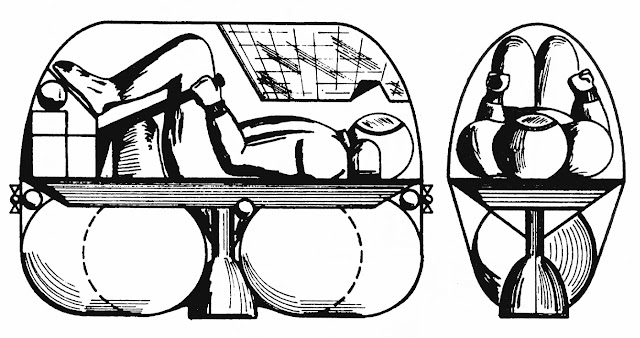
Scary ride: second stage and crew cabin of the Bellcomm minimum Mars Excursion Module (MEM) ascent vehicle. The unpressurized cabin would have included few displays and minimal communications. Image credit: Bellcomm/NASA.
The NASA Planetary Joint Action Group (JAG) saw the addition of the Mars Surface Sample Returner (MSSR) probe to the piloted Mars/Venus flyby mission scenarios it studied in 1966 as a pivotal innovation. Before the advent of the MSSR, the piloted flyby mission appeared to be increasingly threatened by successful robotic flyby missions. The MSSR, members of the Planetary JAG contended, gave the piloted flyby mission an added capability that could not be reproduced by a wholly robotic Mars mission.

The piloted flyby spacecraft would have released the MSSR perhaps 10 days before Mars close encounter. A rocket motor on the MSSR would have boosted it toward Mars, enabling it to reach the planet and land at a preselected site several hours before the piloted flyby spacecraft arrived. 

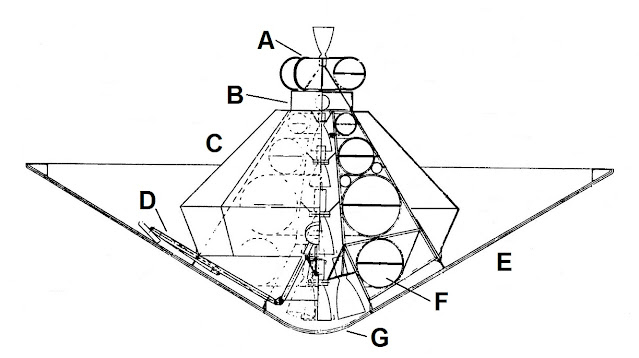
The crew on board the piloted flyby spacecraft would have used a variety of sample collectors on board the MSSR to gather about two pounds of Mars surface material and air by remote control as the planet grew ever larger in their viewports. These would have been packed into a three-stage ascent vehicle and launched to the piloted flyby spacecraft. 

Partial cutaway of Mars Surface Sample Returner (MSSR) probe. A = Mars intersect trajectory injection stage with toroidal propellant tank; B = sample canister; C = ascent stage with three stages, each with a toroidal propellant tank; D = folded landing leg (one of four); E = aeroshell heat shield; F = toroidal descent stage propellant tank; G = descent stage engine heat shield cap. Image credit: NASA/DSFPortree.
The astronauts on board the piloted flyby spacecraft would have captured the sample canister and ascent vehicle third stage using a boom-mounted docking ring and linked them to a port leading into a hermetically sealed biological laboratory. The MSSR probe would, it was expected, enable analysis of Mars samples within an hour of their collection, helping to ensure that any martian organisms they contained would still be alive. 

Phase 1 of the Planetary JAG piloted flyby study ended with distribution of an NASA report on 3 October 1966. The group then began work on Phase 2 of its piloted flyby study. Some members of the Planetary JAG foresaw a rosy future for the concept — they anticipated that MSSR study contracts might be awarded in Fiscal Year 1968 and the piloted flyby mission might become a NASA new start project in Fiscal Year 1969.

Even before the AS-204/Apollo 1 fire (27 January 1967), however, NASA planning for missions beyond Apollo was on shaky ground. Neither the Administration of President Lyndon Baines Johnson nor the Congress supported ambitious plans for post-Apollo spaceflight — for example, a long-term lunar base or humans on Mars. By the summer months of 1967, the fire, racial and anti-war tensions across the country, concerns about the Federal budget deficit, and military setbacks in Indochina had provided opponents of an expansive U.S. future off the Earth with ample justification for curtailing NASA efforts to define its future.

Not all advance planning halted, however. Bellcomm, NASA's Washington, DC-based planning contractor, continued its work as a matter of course. Most Bellcomm studies in the 1967-1969 period aimed to define the shape of the Apollo Program after the first successful piloted lunar landing, as well as that of Apollo's planned successor, the Earth-orbital and lunar Apollo Applications Program (AAP). A modicum of work toward more ambitious goals beyond Earth orbit and the Moon also continued.

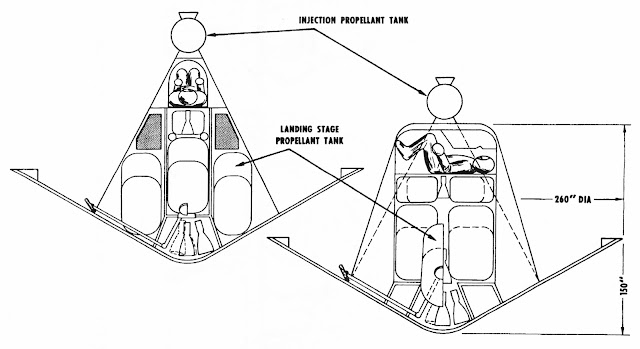
In July 1967, for example, Bellcomm planners D. Cassidy and H. London completed a short technical memorandum in which they explored how the MSSR probe might form the basis for a piloted Mars Excursion Module (MEM) lander. Their study kicked off a series of related studies at Bellcomm in the year that followed. 

Cassidy and London assumed a 15,000-pound MSSR with a two-stage ascent vehicle capable of launching 80 pounds to a passing piloted flyby spacecraft launched in 1975, 1977, or 1979 on a Mars Twilight flyby path. The "Twilight" mission owed its name to the geometry of its Mars flyby — closest approach to Mars took place over the planet's night hemisphere near the dawn terminator, the line dividing pre-dawn darkness from daylight. 

The Bellcomm engineers calculated that MSSR Mars atmosphere entry velocity would reach 32,500 feet per second (fps) in 1975, 34,500 fps in 1977, and 39,000 fps in 1979. As it passed at a shallow angle through the thin martian atmosphere, the automated MSSR would undergo deceleration equal to up to 40 times the pull of gravity on Earth's surface (that is, 40 Gs). To accomplish rendezvous with the passing piloted Mars flyby spacecraft, the MSSR ascent vehicle would have to boost an 80-pound third stage and sample container to 36,000 fps in 1975, 38,000 fps in 1977, and 42,500 fps in 1979. 

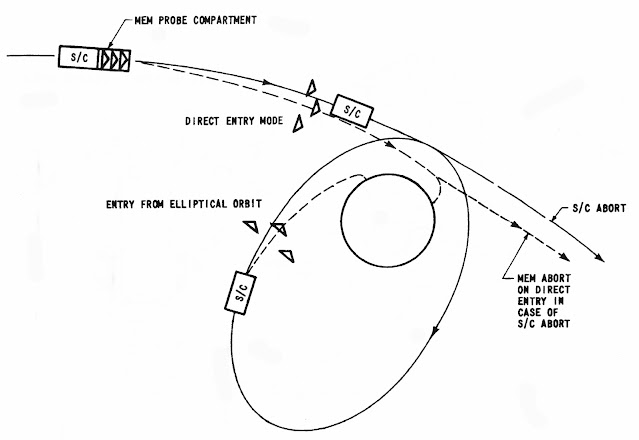
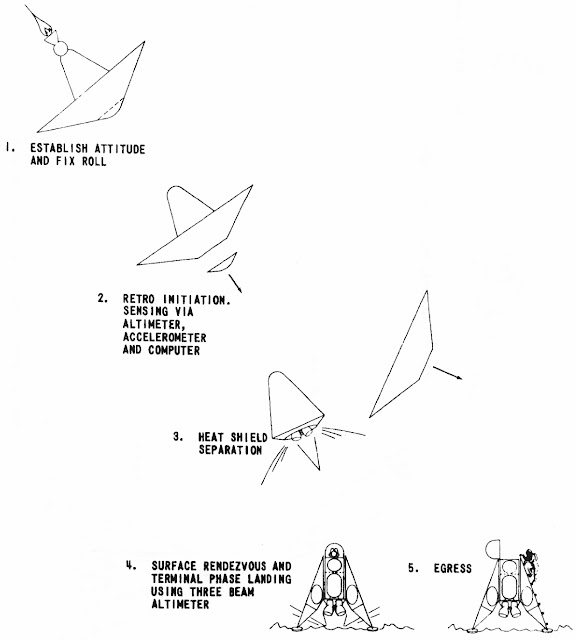
An MSSR-derived MEM released during piloted Mars orbiter approach to Mars — that is, before the orbiter fired its rocket motors to slow down so that Mars's gravity could capture it into an elliptical orbit with a one-day period — would, on the other hand, in 1978, 1982, 1984, 1985, and 1986 enter the martian atmosphere moving at between 20,000 fps and 25,000 fps. It would decelerate at about 10 Gs, which Cassidy and London judged to be acceptable for an astronaut. 

MSSR-derived minimum MEM. Image credit: Bellcomm/NASA.
Two ways of landing on Mars: Direct Entry Mode would see a pair of minimum Mars Excursion Modules (MEMs) and a shelter deployed from a Mars orbiter (labelled "S/C") during approach to Mars. The orbiter would then fire rocket motors to capture into an elliptical Mars orbit. If the orbiter could not capture into orbit, the twin MEMs would abort their landing, fly past Mars, and rendezvous with the orbiter. Entry from Elliptical Orbit would see minimum MEM and shelter separation after the Mars orbiter captured successfully into Mars orbit. Image credit: Bellcomm/NASA.
An equivalent MEM released in Mars orbit would enter more slowly and subject its occupant to a reduced G load while also enabling more precise landing site targeting. The MSSR-derived MEM ascent stage could boost a 900-pound third stage and crew capsule containing a single astronaut to a velocity of 18,000 fps to a rendezvous with the piloted orbiter in an elliptical Mars orbit with a period of one day. 

Cassidy and London explained that a separate Bellcomm study, not yet completed when they finished their July 1967 memorandum, had determined that a minimum one-person MEM with a crew capsule weighing as little as 600 pounds without an astronaut on board might be possible. Such a MEM would carry only enough life support consumables to remain on Mars for a short time and no scientific exploration equipment. 

Anticipating that a mission so limited might not enjoy much support, they briefly examined one that employed three MSSR-derived landers: a pair of minimum MEMs carrying one astronaut each and an automated one-way cargo lander for delivering 5,500 pounds of life support supplies and science gear. The three landers would touch down near each other so that the two astronauts could meet up and make use of the cargo.

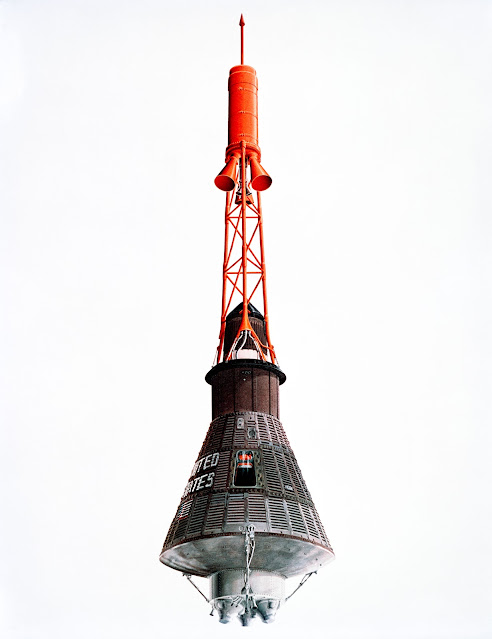
Compared with the MSSR-derived MEM ascent vehicle, the single-seat Mercury spacecraft — shown here with its retrograde propulsion system (bottom, strapped to bowl-shaped heat shield) and red launch escape tower — was large, heavy, and complex. Image credit: NASA.
The study of a 600-pound MEM crew capsule Cassidy and London referenced was performed by M. Skeer in consultation with Cassidy and unnamed McDonnell Aircraft engineers. Skeer, a newcomer to Bellcomm in 1966, summed up results of his study in a technical memo dated two months after the Cassidy and London study. 

Skeer explored whether the design of the one-man McDonnell-built Mercury capsule, which carried six astronauts on suborbital and orbital missions in 1961-1963, might contain weight-saving lessons for designers of an MSSR-derived MEM ascent vehicle. The 4600-pound Mercury capsule, he explained, was a good choice for his study because, like the minimum-mass MEM ascent vehicle, it had relatively simple mission objectives compared with the Gemini or Apollo Command and Service Module (CSM) and Lunar Module (LM) spacecraft.

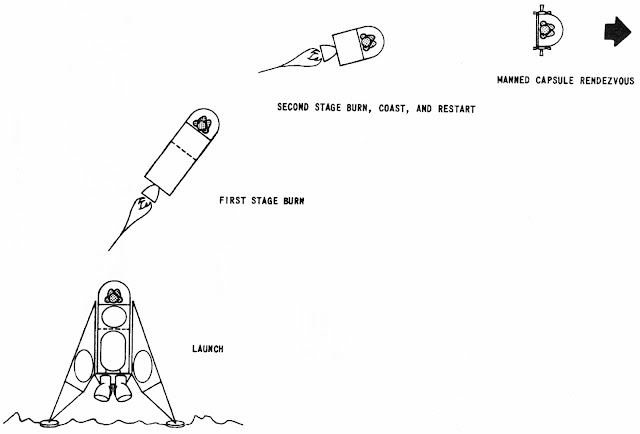
The minimum MEM would descend from a spacecraft in a highly elliptical Mars orbit with a period of from 24 to 48 hours. A spacecraft in such an orbit would be bound loosely by Mars's gravity, so would require minimal propellant expenditure to depart the planet when the time came to return to Earth. Descent from the highly elliptical orbit to the surface of Mars would last about six hours and return from the surface of Mars to highly elliptical orbit would require about two hours. 

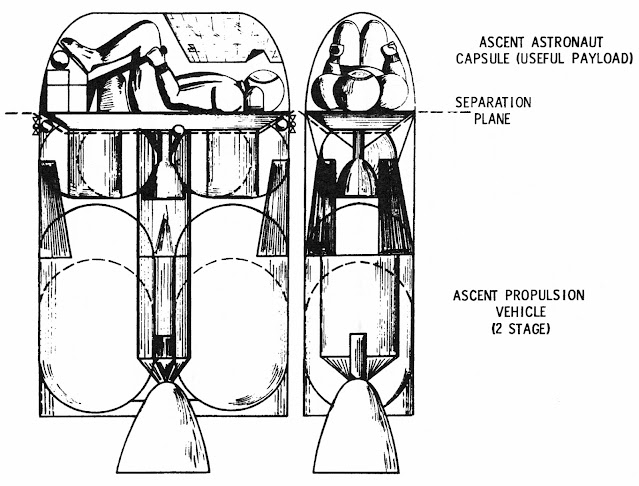
Skeer eliminated 47% of Mercury's weight immediately by deleting the 1119-pound launch escape tower, 315-pound heat shield, 317-pound retrograde propulsion system (used to deorbit the Mercury capsule), landing systems and recovery gear together weighing 343 pounds, and 51 pounds of experiments. He then treated remaining Mercury systems in detail. He wrote, for example, that McDonnell engineers had told him that the 75-pound Mercury couch could be trimmed to 15 pounds. Skeer arrived at a total MEM ascent stage weight of 738 pounds including a 170-pound astronaut. 

Minimum MEM entry and landing. Image credit: Bellcomm/NASA.
Useful payload: two-stage minimum MEM ascent vehicle. Image credit: Bellcomm/NASA.
Minimum MEM liftoff, ascent, and orbital insertion. After rendezvous in Mars orbit the single astronaut would fly the capsule into a hangar on the Mars orbiter or would abandon the capsule and enter the Mars orbiter by spacewalking. Image credit: Bellcomm/NASA.
The MEM cabin would provide just 92 cubic feet of volume for the astronaut — 26 cubic feet less than the snug Mercury cabin. A "plastic shroud" measuring just 30 inches wide by 60 inches long, it would be neither pressurized nor insulated. Skeer estimated that it could weigh as little as 200 pounds, about 415 pounds less than the Mercury cabin structure. The cabin's small volume would prevent the astronaut from moving much; Skeer argued that astronaut immobility would simplify ascent stage guidance and control by avoiding center-of-gravity shifts. 

The astronaut packed into the coffin-like MEM cabin would rely for life support on a 40-pound space suit with a 100-pound life support backpack containing sufficient life support consumables for 12 hours of operations. This combination would replace a Mercury cabin life support system weighing 248 pounds. 

Skeer briefly examined a two-person minimum MEM with a descent stage not based directly on the piloted flyby MSSR. This would, he wrote, have a total weight of less than 35,000 pounds. Of this, 1360 pounds would comprise the MEM ascent stage and crew. He clearly favored the single-person minimum MEM, however. 

Skeer subsequently conducted a pair of follow-on studies of MSSR-derived piloted spacecraft. The first, completed on 8 May 1968, looked at a 4064-pound MSSR-derived two-person surface shelter that would enable a two-week Mars surface stay by astronauts landed separately in a pair of MSSR-derived minimum MEMs. Expendables supporting the two-week stay — mostly for life support and power generation — would account for 1053 pounds of the shelter's weight.

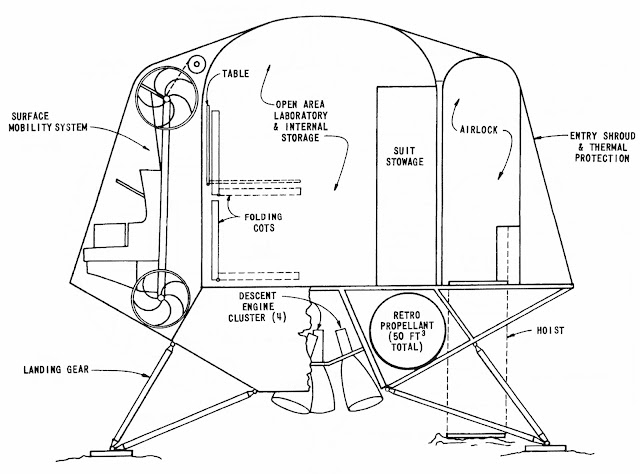
Cutaway view of MSSR-derived Mars surface shelter. Image credit: Bellcomm/NASA.
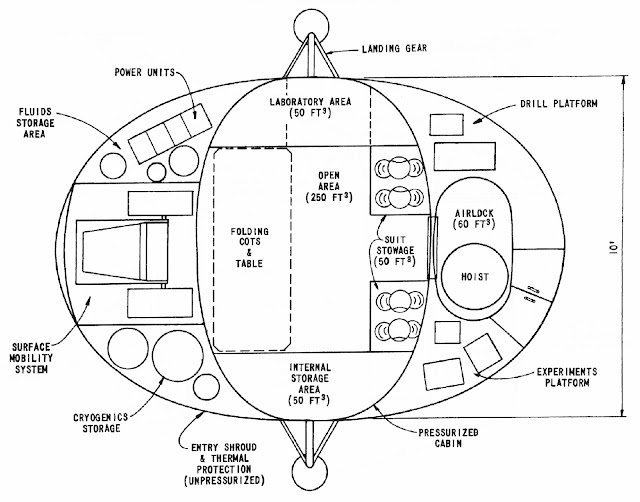
Plan view of MSSR-derived Mars surface shelter. Image credit: Bellcomm/NASA.
The 575-cubic-foot shelter would include a 60-cubic-foot airlock accessed from the martian surface by a "hoist" (apparently a one-person open elevator platform). A pair of 25-cubic-foot compartments accessed from within the shelter (not from the airlock) contained four complete space suits so each crewmember could have a spare. A laboratory area accounted for 50 cubic feet of the shelter's volume.

Scientific exploration equipment accounted for 1460 pounds of the shelter's weight. This included a single 367-pound one-person surface rover or flyer with a total range of 420 kilometers, 77 pounds of multiband photography/radiometry equipment, a 107-pound shelter-mounted drill capable of reaching a depth of 30 meters, 100 pounds of "surveying tools," a 250-pound "Emplaced Science Station" and three "satellite science stations" (total weight 140 pounds) meant to be left behind on the martian surface, and "local sampling and environmental equipment" weighing a total of 395 pounds. The shelter's pressurized cabin would contain 50 pounds of equipment for geologic analysis. (Skeer made no reference to return of samples in the two minimum MEM vehicles; presumably sample analysis on Mars was meant to replace return of samples to Earth.)

Skeer's second follow-on study, a more detailed examination of the minimum MEM ascent stage dated 8 July 1968, sought to identify "fruitful areas of technological research and development needed for evaluation and future program planning options." He argued for development of new propulsion systems capable of burning new high-energy propellants (for example, fluorine-LOX/methane), compact and lightweight refrigeration systems for long-term storage of such propellants, and development of new lightweight materials to permit further minimum MEM weight reduction. 

He also noted that flights of MSSR probes during piloted flyby missions could be seen as test flights of minimum MSSR technology. Unfortunately, by the time Skeer completed his second follow-on study, work within the NASA Planetary JAG toward a piloted flyby with MSSR probe had been largely abandoned for nearly a year.

Sources

"MSSR/MEM Commonality - Case 233," D. E. Cassidy and H. S. London, Bellcomm, Inc., 19 July 1967.

"Preliminary Sizing of a Mars Excursion Module Ascent Capsule Based on Mercury Spacecraft Design - Case 233," M. H. Skeer, Bellcomm, Inc., 25 September 1967.

"Preliminary Mars Excursion Module Shelter Design - Case 730," M. H. Skeer, Bellcomm, Inc., 8 May 1968.

"Mars Excursion Module Ascent Propulsion Stage Design," M. H. Skeer, Bellcomm, Inc., 8 July 1968.

More Information
A New Step in Spaceflight Evolution: To Mars by Flyby-Landing Excursion Mode (1966)

NASA's Planetary Joint Action Group Piloted Flyby Study (1966)

Triple-Flyby: Venus-Mars-Venus Piloted Missions in the Late 1970s/Early 1980s (1967)

Flyby's Last Gasp: North American Rockwell's S-IIB Interplanetary Booster (1968)