Showing posts sorted by relevance for query 1978 mars. Sort by date Show all posts

Mars Airplane (1978)

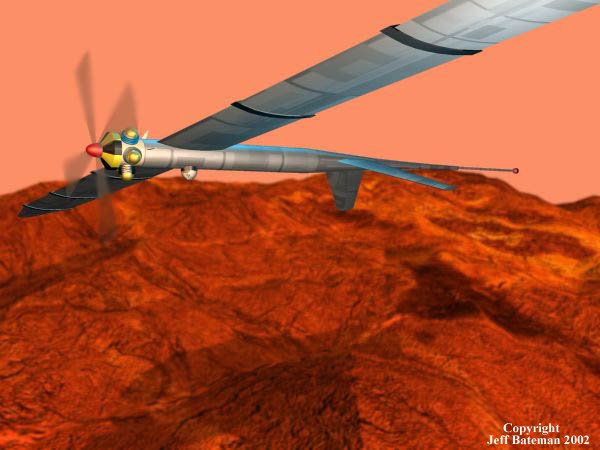
Wings over Mars: the JPL Mars airplane swoops past a martian mountain so that its camera, mounted inside a clear plastic bubble on its belly, can turn sideways to image layers on the mountain slopes. Image credit: Jeff Bateman.
In the 1970s, as U.S. piloted spaceflight retreated to low-Earth orbit, NASA planning for advanced robotic Mars exploration missions came into its own. New information on the martian environment from Mariner 9 and the twin Vikings fueled engineer imaginations.

Many concepts that became actual missions in the 1990s and 2000s first received detailed study in the 1970s. Planners also looked at concepts that have yet to yield NASA missions: Mars sample return, balloons and blimps, small lander networks, and gliders and powered fixed-wing aircraft.

Spacecraft and space mission design and development decisions are complex and influenced by many factors. Scientific efficacy is but one factor considered when planning for a new exploration mission begins, and it is not always the most important one. Nevertheless, scientists are almost always involved at the outset even when they do not originate the mission concept under consideration. Often this involvement is achieved through the establishment of a supportive science working group for the proposed mission.

The Ad Hoc Mars Airplane Science Working Group met at the Jet Propulsion Laboratory (JPL) in Pasadena, California, on 8-9 May 1978, to review mission objectives and propose a possible Mars airplane instrument payload weighing between 40 and 100 kilograms. In its report, the Group noted that a Mars Airplane designed for landings and takeoffs would be able to collect samples in places other types of vehicles might find hard to reach. The plane might also be used to deploy small payloads at scattered locations by airdrop or landing.

Mostly, however, the Ad Hoc Science Working Group limited its deliberations to use of the plane as an aerial survey platform. The Group based its planning on a Mars airplane design derived from NASA Dryden Flight Research Center's "MiniSniffer" pilotless plane, which was designed to sample Earth's stratosphere.

The 300-kilogram airplane would arrive at Mars folded in an lozenge-shaped Viking-type aeroshell. After aeroshell parachute deployment and heat shield separation, it would spread its hinged wings to their full 21-meter span and detach from the parachute and aeroshell in mid-air.

Conceptual Mars airplane design. Image credit: Jeff Bateman.
Normally, the plane would cruise one kilometer above the martian surface, though it would be capable of flying as high as 7.5 kilometers. The 4.5-meter-diameter propeller at the front of its 6.35-meter-long fuselage would pull it through the thin (less than 1% of Earth atmosphere density) martian atmosphere at a speed of between 216 and 324 kilometers per hour.

Mars airplane endurance would depend on the weight of its payload and the choice of power plant. A plane with a 13-kilogram, 15-horsepower hydrazine-fueled piston motor, 187 kilograms of hydrazine fuel, and a 100-kilogram payload could, the Group estimated, fly up to 3000 kilometers in 7.5 hours, while one with a 20-kilogram electric motor, 180 kilograms of advanced lightweight batteries, and a 40-kilogram payload could fly up to 10,000 kilometers in 31 hours.

After it depleted its fuel or batteries, the plane would crash on Mars. The Group noted that the plane's short operational lifetime would dictate that its position after atmosphere entry be determined rapidly so that it could be directed quickly to its survey targets.

The Ad Hoc Group assumed that the Mars airplane would carry an inertial guidance system, radar and atmospheric-pressure altimeters, and terrain-following sensors (laser or radar) for navigation, and that these would serve double-duty as science instruments. The Group's selected science payload was intended to characterize possible landing sites for a follow-on Mars sample return mission and also to perform "topical" studies. The latter would address specific questions about Mars: for example, "Is Valles Marineris a rift valley?"

Visual imaging would be "fundamental" to the Mars airplane mission, so would receive top priority in the instrument suite. The Group determined that the airplane would be well-suited to serve as a camera platform because it would offer image resolution intermediate between orbiter and lander cameras and would obtain valuable "oblique" (from the side) images of the surface.

A Mars airplane might fly down a sinuous martian outflow channel, for example, collecting high-resolution images of layers exposed in its walls. The Mars airplane camera might be mounted on a movable platform inside a transparent dome on the plane's belly.

Other high-priority investigations would include wind speed, air pressure, and temperature measurements at various altitudes, infrared and gamma-ray spectroscopy and multispectral imaging to determine surface composition, and measurements of local magnetic fields. For magnetic field studies, the plane would fly a grid pattern over a selected region. The magnetometer, which might be mounted on a boom or a wingtip to minimize interference from airplane electrical sources, could also be used to seek out iron-rich surface materials and buried iron-rich volcanic structures.

The 1978 Mars airplane conceptual design effort fell victim to post-Viking disenchantment with Mars. Viking, which cost more than $1 billion in 1975 dollars, had been intended to find life, but its three biology experiments did not produce an unequivocally positive result. The Mars community did not at first recognize that it would need to restore support for Mars exploration before it proposed new Mars missions; that is, that Viking had made it more difficult to sell Mars exploration, not easier.

In addition, Space Shuttle development experienced setbacks. It was difficult to justify development of a vehicle for flying in the thin atmosphere of Mars when NASA had difficulty building one to fly in the thin upper atmosphere (and thicker lower atmosphere) of Earth.

Mars missions would resume, but not until 1992, when NASA launched a sophisticated orbiter called Mars Observer. The spacecraft was meant to inaugurate a new era of Mars exploration by providing a new overview of the planet. The loss of Mars Observer as it neared its destination on 25 September 1993 was a major setback; for a time, it appeared that recriminations over the very public failure might halt NASA Mars exploration.

The Curiosity rover landed in Gale Crater on 6 August 2012 and, after a checkout period, began its slow climb up the geologically complex layered slopes of Aeolus Mons (seen here in a color-corrected montage of images captured on 9 September 2015). At this writing, six-wheeled Curiosity has traveled about 22 kilometers. A Mars airplane could provide a perspective on Aeolus Mons, Valles Marineris, and other large features of Mars intermediate between that of a rover and that of an orbiter. Image credit: NASA.
Sources

Final Report of the Ad Hoc Mars Airplane Science Working Group, JPL Publication 78-89, NASA Jet Propulsion Laboratory, 1 November 1978.

Mars Airplane Presentation Material Presented at NASA Headquarters, JPL 760-198, Part II, Jet Propulsion Laboratory, 9 March 1978.

More Information

The Russians are Roving! The Russians are Roving! A 1970 JPL Plan for a 1979 Mars Rover

After Venus: Pioneer Mars Orbiter with Penetrators (1974)

Purple Pigeon: Mars Multi-Rover Mission (1977)

Prelude to Mars Sample Return: The Mars 1984 Mission (1977)

Making Propellants from Martian Air (1978)

Making Rocket Propellants from Martian Air (1978)

Water frost on Utopia Planitia as imaged by the Viking 2 lander. The horizon appears tilted because Viking 2 alighted with one of its three foot pads on a large rock. Image credit: NASA.
In the late 1970s, through the initiative of its director, Bruce Murray, the Jet Propulsion Laboratory (JPL) studied a range of possible Mars missions, including Mars Sample Return (MSR). Murray and others at the Pasadena, California-based lab were aware that funds for new Mars missions would be hard to come by; the U.S. economy was under strain and NASA, JPL's main customer, was devoting most of its resources to developing the Space Shuttle.

In addition, equivocal data from the astrobiology experiments on the twin Vikings, the first successful Mars landers, had been interpreted as negative, helping to damp public enthusiasm for the Red Planet. Would-be Mars explorers reasoned that, if an MSR mission would stand a chance of being accepted, then they would need to find technologies and techniques that could dramatically cut its anticipated cost.

In July-August 1978, two years after the Vikings landed and looked for life on Mars, three engineers at JPL — Robert Ash, a visiting faculty fellow from Old Dominion University in Virginia, and JPL staffers William Dowler and Giulio Varsi — reported on a small study they had conducted of one such cost-saving technology: specifically, making MSR Earth-return rocket propellants from martian resources. Using Earth-return propellants made on Mars would greatly reduce the mass of the MSR spacecraft at launch from Earth, permitting it to be launched on a small, relatively cheap launch vehicle.

Earlier researchers had proposed using Mars resources to make rocket propellants, but Ash, Dowler, and Varsi were the first to base their study on data collected by spacecraft on and in orbit of Mars. The Viking landers had confirmed that martian air is made up almost entirely of carbon dioxide, and had found that the planet's rusty red dirt contains an appreciable amount of water. The Viking 2 lander, at rest on the northern plain of Utopia Planitia, had imaged water frost on the surface in winter (image at top of post). In addition, the twin Viking orbiters had imaged water ice clouds high in the atmosphere and polygonal terrain resembling that found in near-polar permafrost regions on Earth.

Ash, Dowler, and Varsi examined three propellant combinations that would exploit resources the Vikings had found on Mars. The first, carbon monoxide fuel and oxygen oxidizer, could be produced by splitting ubiquitous martian atmospheric carbon dioxide. They rejected this combination, however; while easy to produce, it could yield only mediocre performance.

Hydrogen/oxygen, on the other hand, was a high-performance propellant combination with more than three times the propulsive energy of carbon monoxide/oxygen. It could be produced by collecting and electrolyzing (splitting) martian water, but Ash, Dowler, and Varsi rejected the combination because a heavy, electricity-hungry cooling system would be needed to keep the hydrogen in usable liquid form. This requirement would, they estimated, negate the mass-savings of making Earth-return propellants on Mars.

The third combination they examined was methane/oxygen, which could be produced on Mars using a process discovered in 1897 by Nobel Prize-winning chemist Paul Sabatier. Combining a small amount of hydrogen brought from Earth with martian atmospheric carbon dioxide in the presence of a nickel or ruthenium catalyst would yield methane and water.

The methane would be pumped to the MSR Earth-return rocket stage fuel tank and the water would be split using electricity to produce oxygen and hydrogen. The oxygen would be pumped to the MSR Earth-return oxidizer tank and the hydrogen would be reacted with more martian atmospheric carbon dioxide to produce more methane and water.

Ash, Dowler, and Varsi favored methane/oxygen because it would provide 80% of hydrogen/oxygen's propulsive energy, and because methane remains in liquid form at typical martian surface temperatures. They estimated that launching a one-kilogram Mars sample directly to Earth (that is, with no stop in Mars orbit to rendezvous with and transfer the sample to a Earth-fueled Earth Return Vehicle) would require manufacture of 3780 kilograms of methane/oxygen, and calculated that a Mars surface stay-time of at least 400 days would be necessary to allow sufficient time to manufacture adequate quantities of propellants.

The 1978 JPL study would inspire many other mission designers to tap resources the twin Vikings had confirmed exist on Mars. At the 1982 AIAA/AAS Astrodynamics conference, for example, Science Applications Incorporated engineers presented a paper on use of Mars resources to make propellants for automated rocket-propelled ballistic hoppers and propeller-driven airplanes. The Mars base scenario developed at the second The Case for Mars Conference (1984) relied heavily on extraction of resources from the martian atmosphere for both life-support consumables and rocket propellants.

Conceptual design of a large system for extracting propellants and life-support consumables from martian air. Image credit: C. Emmart/Boulder Center for Science and Policy.

"Feasibility of Rocket Propellant Production on Mars," R. L. Ash, W. L. Dowler, and G. Varsi, Acta Astronautica, Vol. 5, July-August 1978, pp. 705-724.

"In Situ Propellant Production: The Key to Global Surface Exploration of Mars?" AIAA-82-1477, S. Hoffman, J. Niehoff, M. Stancati; paper presented at the AIAA/AAS Astrodynamics Conference in San Diego, California, 9-11 August 1982.

The Case for Mars: Concept Development of a Mars Research Station, JPL Publication 86-28, NASA Jet Propulsion Laboratory, 15 April 1986.

More Information

A Forgotten Pioneer of Mars Resource Utilization (1962-1963)

Gumdrops on Mars (1966)

Astronaut Sally Ride's Mission to Mars (1987)

After EMPIRE: Using Apollo Technology to Explore Mars and Venus (1965)

Skylab 1 liftoff, 14 May 1973. Image credit: NASA.
Between August 1963 and November 1964, a 13-member team at NASA's Marshall Space Flight Center (MSFC) in Huntsville, Alabama, conducted a detailed in-house study of Mars and Venus flyby missions. These would see a flyby spacecraft bearing a crew depart Earth orbit, coast past its target planet, and return to Earth. Only small course-correction maneuvers would be necessary after Earth-orbit departure.

The study, led by Harry O. Ruppe of the MSFC Future Projects Office (FPO), was a follow-on to the Early Manned Planetary-Interplanetary Roundtrip Expeditions (EMPIRE) study, which had lasted from May 1962 to February 1963. MSFC FPO had directed EMPIRE contractors Ford Aeronutronic, Lockheed, and General Dynamics to study manned Mars and Venus flyby and orbiter missions in the early 1970s as a means of justifying early development of nuclear-thermal rockets and launch vehicles more powerful than the Apollo Saturn V (see "More Information" below). MSFC FPO stressed these technologies in EMPIRE because MSFC was NASA's lead center for large rocket development and because it was involved in the joint NASA/Atomic Energy Commission nuclear propulsion program through the Reactor In-Flight Test (RIFT), which sought to launch a nuclear rocket into space in 1967.

The new manned planetary flyby study acknowledged changes in the advance planning environment within NASA. Whereas the EMPIRE contractors had been instructed to "attempt" to use Apollo hardware in their spacecraft designs — and had responded by designing all-new systems with little Apollo heritage — the MSFC in-house study adhered strictly to the rule that Apollo technology should be used everywhere possible.

This reflected increasing restrictions placed on NASA advanced technology development by President John F. Kennedy and his successor, President Lyndon Baines Johnson. Expressed succinctly, NASA planners had begun to realize that a commitment to the goal of a man on the Moon did not imply a commitment to the goal of a man on Mars.

The MSFC team declared, nevertheless, that it was "inconceivable" that the "tremendous" technology that NASA had developed for Apollo would not lead eventually to a manned Mars landing. It was simply a matter of which course NASA should follow to get there. An Earth-orbiting space station or a lunar base were 1970s goals that could use Apollo hardware and provide "training" for manned Mars landings; like Apollo, however, these would operate "within the Earth's 'sphere of activity.'" Manned Mars/Venus flybys in the mid-to-late 1970s, on the other hand, could be based on Apollo systems, yet would venture beyond the safe harbor of the Earth-Moon system.

Little was known of Mars's atmosphere or surface conditions when Ruppe's engineers performed their study. A piloted Mars flyby in the 1970s could, they argued, provide data they would need to design a 1980s Mars landing mission. They proposed that, in addition to exploring Mars closeup with remote-sensing instruments mounted on their spacecraft, flyby astronauts should serve as caretakers for a small armada of automated probes. These would include "landers, atmospheric floaters, skippers, orbiters, and possibly probes. . .to perform aerodynamic entry tests [of spacecraft] designs and materials."

Automated probes would need caretakers, the MSFC team believed, because they had had a checkered history. Mariner II had flown past Venus successfully in December 1962, near EMPIRE's end, confirming what astronomers had already begun to suspect: that the planet's dense clouds hid a hellish surface. The Ranger VII Moon probe had returned images of southeast Oceanus Procellarum as it plunged toward planned destructive impact in July 1964, providing engineers designing the Apollo Lunar Module lander with essential data on the Moon's surface.

Mariners I and III had, however, failed, as had the first six Rangers. Mariner IV had been launched toward Mars on 28 November 1964, as editing began on the Ruppe team's study report. As it saw print in February 1965, the 261-kilogram solar-powered robot remained healthy. It was, however, anyone's guess whether Mariner IV would survive until its planned Mars flyby in July 1965.

The MSFC engineers believed that "the major emphasis of the manned flyby-unmanned probe combination" should "be focused on assisting later [Mars] landing missions." Engineers who lacked data on Mars conditions would, they explained, have little choice but to design the Mars landing spacecraft for "worst conditions." This would tend to increase its mass and thus the number of costly booster rockets necessary to place its components into Earth orbit for assembly.

In the first half of 1965, this 1962 U.S. Air Force Mars map remained the best available to Mars mission planners. Image credit: U.S. Air Force/Lunar and Planetary Institute.
Conversely, adequate knowledge of Mars would enable engineers to cut costs by taking advantage of the conditions there. Of particular importance, they wrote, would be probes that would test propellant-saving aerodynamic braking maneuvers in the martian atmosphere and prospect for "usable indigenous materials. . .such as water" on Mars.

They estimated that, lacking adequate prior knowledge of Mars, the first piloted landing mission "would probably transport 2 or 3 men to the surface of Mars for a few days. . .[at a cost of] a billion dollars per man-day on Mars." If on the other hand, "the physical properties of Mars were well known, we could think. . .of the first landing as a long-duration base, reducing cost to less than 10 million dollars per man-day."

The MSFC team consulted Ruppe's previously published launch opportunity tables to determine that several Mars and Venus flyby launch windows would open in the mid-to-late 1970s. Because Venus has a nearly circular orbit around the Sun, opportunities to reach it would vary little in terms of amount of energy required, mission duration, and Earth-return velocity (all critical factors in interplanetary mission design). Mars, on the other hand, has a noticeably eccentric (elliptical) orbit, which means that these factors vary considerably from one launch opportunity to the next. For their detailed analysis, the MSFC engineers opted for a "typical" Mars flyby that would leave Earth orbit in September 1975, and a corresponding "typical" Venus flyby that would depart Earth orbit in August 1978.

An "improved" two-stage variant of the Apollo Saturn V would serve as the piloted flyby program's workhorse Earth-to-orbit booster. The first payload it would place into orbit for any flyby mission would be the 125-ton flyby spacecraft with a multipurpose "aft skirt assembly." Stacked atop the two-stage Saturn V and covered with a streamlined launch shroud, the flyby spacecraft/aft skirt assembly would outwardly resemble the Skylab Orbital Workshop, which was launched on a two-stage Saturn V in May 1973, eight years after Ruppe's team completed its study (image at top of post).

The three-stage Saturn V configured for Apollo Moon flights stood 363 feet tall, while the two-stage Saturn V with Skylab on top measured 333.6 feet tall. The two-stage Saturn V with the flyby spacecraft/aft skirt assembly combination on top would stand 332 feet tall. Skylab measured 84.5 feet long at launch, while the flyby spacecraft/aft skirt assembly would measure 89 feet long with its launch shroud (A in the drawing below) and 81.6 feet long in orbit, after its shroud completed its task and was discarded.

Cutaway drawing of the Ruppe team's piloted flyby spacecraft. Letters on the drawing are called out in italics in the post text. Please click on the image to enlarge. Image credit: NASA.
The MSFC engineers tapped as their rocket engine for course corrections the Apollo Lunar Module Descent Engine (B). It would draw hypergolic propellants (that is, fuel and oxidizer that ignite on contact with each other) from four spherical tanks (I). The tanks would be designed to hold enough propellants to change the flyby spacecraft's speed by 500 meters per second (mps). The 0.5-kilometer-per-second course change would need 26,272 pounds of propellants for the 1975 Mars flyby and 20,583 pounds for the 1978 Venus flyby.

A pair of 5000-pound "radioisotope power supply systems" would be mounted to the flyby spacecraft near the course-correction engine, well away from the spherical, 20-foot-diameter Lab/Crew Living area (M). During ascent to Earth orbit, these would remain folded inside the launch shroud (C). Some time after shroud separation, they would pivot outward to their flight positions (D) and begin to make electricity.

The flyby spacecraft's pressurized Hangar (E) would fill the space between the course-correction engine and the course-correction propellant tanks. The three-man flyby crew would reach the Hangar from their main living area via an airlock tube (J). The Hangar would contain at its center a modified Apollo Command and Service Module (CSM). The Ruppe team felt it necessary to cocoon the CSM within the Hangar to protect it from "micrometeoroids, outgassing, and other detrimental effects" of long space exposure.

The CSM warranted special protection for two reasons. First and foremost, it was the flyby crew's end-of-mission Earth-atmosphere reentry vehicle. The astronauts would ride in its conical Command Module (CM) (F) and would use the Service Propulsion System (SPS) engine (H), a part of the Service Module (SM) (G), to slow to Apollo lunar-return speed of 11 kilometers per second (kps) before they reached Earth's atmosphere. Cocooning the CSM in the Hangar would also limit the amount of costly redesign and retesting the CSM would need before it could be used for manned Mars/Venus flyby missions.

The CM for flyby missions would lack a nose-mounted docking unit, but otherwise would closely resemble the Apollo lunar CM. It would, therefore, need no new testing beyond that required for lunar missions.

For Venus flybys, the SM also could remain unchanged. The Mars flyby SM, on the other hand, would approach Earth moving fast enough that its SPS engine would need to fire for up to 536 seconds longer than the Apollo lunar SPS and would burn as much as 2790 pounds more propellants than the Apollo lunar SM could hold. The Mars flyby SM would thus need longer propellant tanks and either a redesigned SPS or a pair of conventional SPSs operating in tandem or in series. A new engine rated for a longer burn time was also a possibility, though that option would not be in keeping with the MSFC team's goal of reliance on Apollo hardware.

In addition to the Earth-atmosphere reentry CSM, the flyby spacecraft Hangar would house five tons of automated probes destined for release near the mission's target planet. As noted above, the crew's main job would be to ensure that the probes remained functional until they reached Mars or Venus. The astronauts would thus have available within the Hangar 1000 pounds of tools and supplies for servicing the probes. The MSFC engineers also placed in the Hangar an airlock for spacewalks (they doubted that it would see much use), and a stock of emergency life support provisions.

When not attending to their cargo of probes, the three flyby astronauts would live and work in the Lab/Crew Living Area, where they would breathe a half-oxygen, half-nitrogen atmosphere at a pressure of 10 pounds per square inch. The Lab/Crew Living Area and the Hangar could each be re-pressurized 12 times during a Mars flyby mission and eight times during a Venus flyby mission.

Repressurization would occur in the event that a meteoroid punctured the spacecraft hull and Lab/Crew Living Area pressure vessel or after scheduled periodic air dumps that would purge the atmosphere of toxic trace gases outgassed from furnishings and equipment and generated by experiments and cooking. Each repressurization would need 1885 pounds of gases, bringing the total breathing gas carried to 22,650 pounds for the typical Mars flyby spacecraft and 15,050 pounds for the Venus flyby spacecraft. A system for recycling air between purges would have a mass of 1800 pounds on both the Mars and Venus flyby spacecraft.

The Ruppe team's engineers cited a study by the MSFC Research Projects Laboratory (RPL) when they rejected specialized radiation shielding for the flyby spacecraft's bottle-shaped emergency shelter (K). The RPL had found that solar flares powerful enough to harm flyby crews were unlikely to occur in the mid-to-late 1970s.

In place of 1000 pounds of shielding, the MSFC team proposed a double-walled shelter with the flyby spacecraft life support water supply stored between its inner and outer walls. Equipment and food would be arranged around the shelter's exterior to provide additional radiation protection. The crew would sleep inside the shelter to minimize their exposure to cosmic rays. In the event of fire, catastrophic pressure loss, or other emergency, the shelter, which would contain a duplicate set of spacecraft controls, could be sealed off from the rest of the flyby spacecraft.

The MSFC engineers calculated that building the flyby spacecraft so that it could spin to create artificial gravity would add 69,000 pounds to its total mass. The engineers rejected this approach in favor of providing a small centrifuge (L) capable of holding two astronauts at a time (one at either end). Support arms would link the twin centrifuge gondolas to a motorized ring around the hatch leading into the emergency shelter.

The Lab/Crew Living Area would nestle in a bowl-shaped recess in the aft skirt assembly (O). At its front end, the aft skirt assembly would match the 22-foot diameter of the flyby spacecraft; at its aft end, it would match the 33-foot diameter of the S-II second stage of the Saturn V that would boost it and the flyby spacecraft into 185-kilometer-high Earth orbit. S-II separation would reveal twin RL-10 rendezvous and docking rocket motors (P) and a large socket-like docking structure (N) on the aft skirt assembly's aft end.

At its front end, the aft skirt assembly would contain a ring-shaped, 22-foot-diameter Saturn V Instrument Unit (IU) (not shown). In addition to guiding the Saturn V carrying the flyby spacecraft during its ascent to Earth orbit, the IU would provide guidance control for Earth-orbital assembly maneuvers and for flyby spacecraft Earth-orbit departure.

The number of two-stage Saturn V rockets required to place into Earth orbit the flyby spacecraft, its S-IIB Orbital Launch Vehicle (OLV), and liquid oxygen (LOX) for the S-IIB OLV would depend on the amount of energy required to place the flyby spacecraft on course for its target planet. Even in the least demanding opportunities, Mars flybys would require more energy than Venus flybys, so would need more Saturn V rockets.

The MSFC engineers described in detail the assembly campaign for the Mars flyby mission that would leave Earth orbit in September 1975, during a launch opportunity lasting 28 days. The first two-stage Saturn V in the assembly campaign would lift off from one of the two Complex 39 Saturn V launch pads at Cape Kennedy, Florida, on 28 April 1975. If the Saturn V failed and the flyby spacecraft/aft skirt assembly it carried was destroyed, then a backup would lift off on 24 June 1975.

The next Saturn V in the series would launch on 28 June 1975, bearing the first of four LOX tankers to 185-kilometer orbit. The Ruppe team's tanker could transport about 95 tons of LOX. Three more successful tanker launches would be needed; these would occur on 6 July and 7 July and 3 September 1975. A single backup tanker would stand by in case of a tanker launch failure; if it were needed, it would launch on 6 September 1975.

With a Mars flyby spacecraft/aft skirt assembly and four LOX tankers safely orbiting the Earth, the sixth and last Saturn V would launch the S-IIB OLV into a 485-kilometer-high orbit on 13 September 1975. As its name implies, the S-IIB OLV would be a derivative of the Saturn V S-II second stage.

Modifications would include deletion of two of its five J-2 engines and improved insulation to retard boil-off and escape of the roughly 80 tons of liquid hydrogen it would carry into orbit. The MSFC engineers expected that an S-IIB OLV could be developed that would retain enough liquid hydrogen for flyby spacecraft Earth-orbit departure 72 hours after its launch from Complex 39, but aimed for an Earth-orbit departure just 50 hours after S-IIB OLV launch.

Using the twin RL-10 engines in its aft skirt assembly, the unmanned flyby spacecraft would climb to a 485-kilometer circular orbit and rendezvous with the S-IIB OLV as soon as the latter was confirmed to be safely in orbit. It would then back up and dock with the S-IIB OLV. Next, the four LOX tankers would climb to 485-kilometer orbit and dock one at a time with the S-IIB OLV. Each would pump its cargo into the S-IIB OLV's LOX tank, then would undock and move away, clearing the way for the next in the series.

The astronauts would board the Mars flyby spacecraft 20 hours before planned launch from Earth orbit. If NASA had a space station in Earth orbit in 1975, they might board from that. An alternate plan would see the flyby astronauts reach their spacecraft on board an Apollo CSM launched from Earth on a Saturn IB rocket. After entering the flyby spacecraft and checking out its systems, they would cast off the CSM.

The S-IIB OLV's three J-2 engines would burn for about eight minutes on 26 September 1975 to push the flyby spacecraft/aft skirt assembly combination out of 485-kilometer Earth orbit and place it on course for Mars. The burn would add about five kps to its speed. After the flyby spacecraft/aft skirt assembly combination separated from the S-IIB, the RL-10 engines in the aft skirt assembly would be used to fine-tune the flyby spacecraft's course. The aft skirt assembly, its work done, could then be cast off or retained for at least part of the mission to provide additional radiation/meteoroid shielding for the Lab/Crew Living Area.

Image credit: NASA.
Ruppe's team provided an example heliocentric orbital plot for a manned Mars flyby mission leaving Earth on 26 September 1975. The dashed line on the plot represents the flyby spacecraft path around the Sun. Flight to Mars would require 130 days.

Halfway to Mars, on 30 November 1975, the crew would adjust their spacecraft's course using the course-correction engine. The MSFC engineers budgeted enough propellants for the first midcourse burn to change the flyby spacecraft's speed by 150 mps. The crew would eject "consumed life support" (that is, body and food waste, saturated absorbent charcoal, used filters, and other trash) shortly before the course-correction burn so that it would continue on the flyby spacecraft's original course and not intersect Mars.

Mars flyby would occur on 3 February 1976, when Mars and the flyby spacecraft were 0.86 Astronomical Units (AU) — that is, 0.86 times the Earth-Sun distance — from Earth. The flyby spacecraft would approach the day side, reaching a distance of 200,000 kilometers from the planet's center 6.5 hours before closest approach. It would pass 792 kilometers from Mars moving at about 11 kps relative to the planet, then would retreat from the night side. During approach to the planet, the astronauts would release 2.5 tons of robot probes and carry out continuous observations. Near closest approach, they would ignite the course-correction engine a second time.

During retreat from Mars, the astronauts would release the remaining 2.5 tons of probes. While the flyby spacecraft remained close to Mars, it would relay data from the probes to Earth at a high data rate. The flyby spacecraft would, however, spend only one hour within 18,250 kilometers of Mars's center. Five and a half hours after closest approach, it would pass beyond 164,000 kilometers from the planet's center, and shortly after that the Mars probes would switch to direct transmission to Earth at a low data rate. The crew would then begin a grueling 539-day journey home.

A few weeks later, the crew would become the first humans to enter the Asteroid Belt. Maximum distance from Earth (3.21 AU) would be attained on September 13, 1976, about one year into their mission. At about the same time, Earth would move behind the Sun as viewed from the flyby spacecraft. The crew would then perform the mission's final course-correction burn, changing their spacecraft's speed by up to 200 mps.

The flyby spacecraft would pass inside of Mars orbit on 31 May 1977 at a distance of 0.353 AU from Earth. Over the following two months, it would gradually catch up with the homeworld. On 19 July 1977, six days before planned Earth atmosphere reentry, the crew would transfer to the modified Apollo CSM in the Hangar and check out its systems.

Two days before reentry, the CSM would emerge from its cocoon and abandon the flyby spacecraft. On 25 July, with Earth looming outside its small windows, the crew would turn the CSM so that its engine or engines pointed in its direction of flight. A burn lasting up to 19.4 minutes would reduce the CSM's speed from up to 15.8 kps to Apollo lunar-return speed of 11 kps, then the conical CM would detach and, using small rocket motors, orient its bowl-shaped heat shield for reentry. Minutes later, the CM would deploy three parachutes and lower gently into the ocean.

Image credit: NASA.
The Ruppe team also prepared an orbital plot for the Venus flyby mission departing Earth in August 1978. A shortened S-IIB OLV would add about 3.8 kps to the Venus flyby spacecraft's speed. The mission would be of shorter duration than the Mars mission — only one year — with Venus flyby occurring low over the planet's day side on 11 December 1978. The spacecraft would attain its greatest distance from Earth — 0.674 AU — on 15 April 1979. After leaving the Hangar, the CSM's main engine would trim about 2.6 kps from its Earth-approach speed. Reentry and splashdown would occur on 16 August 1979.

The MSFC engineers outlined a hardware development schedule based (inexplicably) on a Venus flyby in late 1975 and a Mars flyby in 1978 (that is, the exact reverse of the program detailed in their report). They also estimated the probable cost of the flyby program. They assumed that no new-start funding for the program would become available in NASA's budget before Fiscal Year (FY) 1969, after the first successful Apollo lunar landing, which in 1965 was scheduled to take place during early 1968. Detailed flyby program planning would begin in mid-1968 and last a year.

LOX tanker, flyby spacecraft, and interplanetary avionics development would commence in the last quarter of 1968. LOX tanker development, at a cost of $380 million, would be completed in late 1974. A pair of LOX tanker flight tests would launch on two-stage Saturn V rockets in 1973 and mid-1974. A flyby spacecraft development test unit would reach Earth orbit on a two-stage Saturn V in 1974; among other things, it would be used for crew training. The flyby spacecraft would cost more to develop than any other hardware element ($1.563 billion). Avionics development (total cost: $325 million) would include a Saturn IB-launched flight test.

S-IIB OLV development (total cost: $425 million) would start in late 1969 and conclude in 1974. S-IIB OLV flight tests would take place in 1973-1974. Apollo SM modifications (total cost: $115 milion) would begin in mid-1970 and end in 1974, and aft skirt assembly development (total cost: $165 million) would span late 1970 through early 1975. An aft skirt assembly flight test using a Saturn IB launch vehicle would take place in 1974.

Science probe development for the 1975 Venus flyby would begin in mid-1970 and continue through the last quarter of 1975. Mars probe development would start in the last quarter of 1973 and run through 1977. Probe development would cost $220 million for each mission.

The MSFC engineers based their operational cost estimates on learning curves developed through the many Saturn V and Saturn IB launches that they expected would occur by the mid-1970s. They estimated that 62 three-stage and two-stage Saturn Vs would be launched prior to the first Venus flyby Saturn V launch, so that each Saturn V for the Venus flyby would cost $70 million. Fifty-two Saturn IB launches would take place before the first Venus flyby Saturn IB launch, leading to a cost of $22 million per Venus flyby Saturn IB. They assumed that 70 Apollo CSMs would have flown before the first Venus flyby CSM, leading to a Venus flyby CSM cost of $72 million.

For the 1978 Mars flyby, the MSFC engineers assumed that NASA would already have launched 98 three-stage and two-stage Saturn V rockets by the time the first Mars flyby Saturn V lifted off, reducing the cost per Mars flyby Saturn V to only $65 million. Seventy Saturn IB launches would have taken place, reducing the cost for each Mars flyby Saturn IB to $20 million. One hundred CSMs would have flown ahead of the first Mars flyby CSM, reducing the flyby CSM cost to $69 million.

Design and development cost would peak in FY 1972 at $895 million. Operational cost would peak at $497 million in FY 1974. The peak funding year for the program would be FY 1973, when operational and development costs would total $1.222 billion. Development costs would total $3.75 billion between FY 1969 and FY 1978. Operational costs would total $2.671 billion between FY 1971 and FY 1978. The entire piloted flyby program would thus cost $6.421 billion. The MSFC team estimated that, by providing data to engineers, the flyby program would reduce by about $4 billion the cost of a follow-on Mars landing mission.

The MSFC engineers also conducted what they called a "mission worth analysis." They first assumed an undefined "basic space program" for the 1970s and 1980s. Manned Venus flyby missions could, they calculated, be deleted from the program with only a 2% impact on total space program worth and only a 10% reduction in planetary program worth because "it is not possible to land on Venus." Leaving the Venus flybys in place but deleting the Mars flyby and landing missions would reduce total space program worth by 9% and planetary program worth by half. Deleting all piloted planetary missions and relying only on robotic probes would reduce total space program worth by 12% and planetary program worth by 63%.

Artist concept of Mariner IV at Mars. Image credit: NASA.
Mariner IV flew triumphantly past Mars on 14-15 July 1965, five months after the MSFC team's study report saw print. It returned 21 black-and-white images of the planet's cratered surface and, as it flew behind the planet, conducted a radio-diffraction experiment that indicated a martian atmospheric pressure ten times less than had been expected — about 1% of Earth sea-level pressure. Mariner IV revealed a Mars apparently inhospitable to life. The mission also showed that robots could cross the gulf between Earth and Mars and return useful data without help from astronaut caretakers.

Oddly enough, neither Mariner IV's success nor its discouraging Mars findings undermined the manned flyby concept. The flyby program goal of putting Saturn-Apollo hardware to new uses remained attractive to many in NASA.

In April 1966, NASA Associate Administrator for Manned Space Flight George Mueller launched a new piloted flyby study under the auspices of the Planetary Joint Action Group (JAG). The group, which drew members from MSFC, the Manned Spacecraft Center in Houston, Kennedy Space Center in Florida, NASA Headquarters, and NASA planning contractor Bellcomm, had been assembled in April 1965 to study piloted Mars landing missions. The new study, which emphasized the 1975 piloted Mars flyby opportunity, sought to flesh out automated probe and on-board instrument designs and to further explore the interplanetary potential of Apollo technology and techniques.

Sources

"Future Effort to Stress Apollo Hardware," Aviation Week & Space Technology, 16 November 1964, pp. 48-49, 51.

Manned Planetary Reconnaissance Mission Study: Venus/Mars Flyby, NASA TM X-53205, Harry O. Ruppe, Future Projects Office, NASA Marshall Space Flight Center, 5 February 1965.

"Photos Point to Mars Landing Difficulty," R. Pay, Missiles and Rockets, 26 July 1965, pp. 13-19.

"Manned Planetary 'Swing-Bys' Proposed," D. Fink, Aviation Week & Space Technology, 30 August 1965, p. 30.

More Information

EMPIRE Building: Ford Aeronutronic's 1962 Plan for Piloted Mars/Venus Flybys

Centaurs, Soviets, and Seltzer Seas: Mariner 2's Venusian Adventure (1962)

A Forgotten Rocket: The Saturn IB
Mars Polar Ice Sample Return (1976-1978)

This oblique view of the southern polar ice cap of Mars (bottom) includes the entire permanent cap and a portion of the adjoining seasonal temporary cap. Many features of the southern hemisphere are in view; for example, the large Hellas impact basin is visible at center left. At its fullest extent in southern hemisphere midwinter, the seasonal cap expands to touch the southern rim of Hellas. Image credit: NASA.
Mars, like its neighbor Earth, has ice caps at its north and south poles. On both worlds, the polar caps are dynamic; for example, they expand and contract with the passage of the seasons. On Earth, both the permanent and seasonal polar caps are made up entirely of water ice; on Mars, which is generally colder, temperatures fall low enough that carbon dioxide condenses out of the atmosphere at the winter pole, depositing a frost layer about a meter thick on the permanent water ice polar cap and surrounding terrain.

The three-kilometer-thick permanent caps cover a little more than 1% of the martian surface. In northern hemisphere midwinter, the seasonal carbon dioxide cap expands to about 60° north latitude. Roughly 13 Earth months later, in southern midwinter, carbon dioxide ice covers the cratered landscape to about 60° south latitude.

Confirmation that the permanent polar caps are made up mainly of water ice did not come easily. The polar caps were first glimpsed using crude telescopes during the 17th century, and were widely believed to be made of water ice by the end of the 18th. In 1965, however, data from Mariner IV, the first spacecraft to fly past Mars, indicated that the permanent caps were made of frozen carbon dioxide, an interpretation the Mariner 6 and 7 flybys (1969) and the Mariner 9 orbiter (1971-1972) did little to contradict.

In the late 1970s, however, the twin Viking Orbiters revealed that the northern permanent cap is made of water ice. Confirmation that the southern permanent cap is also made of frozen water had to wait, however, until 2003, when data from the Mars Global Surveyor and Mars Odyssey orbiters had become available.

Close-up of the southern permanent ice cap of Mars in southern hemisphere summer. In winter, the entire image would be cloaked in red dust and carbon dioxide frost and ice. Image credit: NASA.
In 1976-1977, before the composition of either of the permanent caps was known with certainty, a team of students in the Purdue University School of Aeronautics and Astronautics studied a Mars Polar Ice Sample Return (MPISR) mission. Its primary goal was to collect and return to Earth a 50-meter-long, five-millimeter-diameter ice core extracted from the planet's southern permanent cap.

The Purdue students assumed that the permanent ice caps of Mars are, as on Earth, built up of layers of snow or frost deposited annually. They anticipated that each layer would contain a sample of the dust and gases in the atmosphere at the time it was laid down, making it a record of atmospheric particulates and climate conditions. The range of materials captured in the core would enable multiple methods of age determination.

On Earth, ice cores from Greenland record lead smelting in the Roman Empire and vegetation changes in Ice Age Europe. A martian polar ice core, the students believed, might yield a planet-wide record of dust storms, asteroid impacts, volcanic eruptions, flowing surface water, and, quite possibly, the existence of microbial life.

Section of an ice core collected from deep beneath the Greenland ice cap. Image credit: Greenland Ice Sheet Project.
As the Purdue students carried out their study, the twin Viking spacecraft were en route to Mars. Viking 1 left Cape Canaveral, Florida, on 20 August 1975, and Viking 2 lifted off about three weeks later (9 September 1975). The Vikings were two-part spacecraft — each comprised a Martin Marietta-built 571-kilogram Lander and a 2336-kilogram Orbiter built by the Jet Propulsion Laboratory (JPL).

Viking 1 fired its Orbiter-mounted rocket motor on 19 June 1976 to slow down so that the red planet's gravity could capture it into orbit. The Viking 1 Lander was scheduled to land on the American Bicentennial (4 July), but the landing was postponed after Viking Orbiter images of its prime and backup landing sites, which had been selected using Mariner 9 data, showed them to be too rough. The Viking 1 Lander separated from its Orbiter and performed the first successful Mars landing in Chryse Planitia on 20 July 1976.

Viking 2 reached Mars orbit on 7 August. Its pre-selected landing sites were also found to be too rugged, so touchdown in Utopia Planitia did not take place until 3 September 1976.

Viking development cost close to a billion U.S. dollars, making it the most expensive automated exploration program of its time. For some planners — possibly unacquainted with the untimely end of the Apollo program — it seemed reasonable to assume that NASA would exploit Viking hardware to the fullest to cash in on its investment. JPL planners, for example, widely expected that a third Viking spacecraft — probably including a rover — would depart for Mars in 1979. For this reason, the Purdue students assumed that Viking hardware would continue to be manufactured into the 1980s and that their MPISR spacecraft could be derived from it.

Schematic of the Viking Orbiter with attached Viking Lander aeroshell capsule. Image credit: NASA.
Schematic of Viking lander deployed on Mars. Image credit: NASA.
The MPISR mission would employ a Mars Orbit Rendezvous (MOR) mission plan equivalent to the Lunar Orbit Rendezvous plan used to carry out Apollo Moon landings. A 5652-kilogram MPISR Orbiter would carry to Mars a 946-kilogram Lander and a 490-kilogram Earth-Return Vehicle/Earth Orbit Vehicle (ERV/EOV). The MPISR Lander would in turn carry a 327-kilogram Ascent Vehicle (AV) for launching the polar ice sample to Mars orbit.

The need for a short-duration flight from Mars to Earth and for south pole conditions safe for landing dictated the MPISR mission's Earth departure date. A long flight back to Earth would place great demands on sample refrigeration equipment, so the Purdue students sought the shortest return opportunity they could find.

Data from the Viking Orbiters had shown the south pole ice cap to be too unstable for landing and sample collection in the spring and summer, when the temperature climbs too high for carbon dioxide to remain solid. At mid-winter, on the other hand, snow and frost accumulation might bury the MPISR Lander. The team proposed, therefore, that the Lander should set down in late summer, about 75 days before southern hemisphere autumnal equinox.

Schematic of MPISR spacecraft after lander separation but before AV third stage arrival. The Earth Return Vehicle near the bottom of the image — which would carry within it the Earth Orbit Vehicle — would be based on the Pioneer Jupiter/Saturn spacecraft bus design. Image credit: Purdue University.
The MPISR spacecraft would lift off from Cape Canaveral, Florida, on 29 April 1986, in the 15-foot-by-60-foot payload bay of a delta-winged, piloted Space Shuttle Orbiter. It would reach Earth orbit attached to an expendable Tug derived from the U.S. Air Force/NASA Centaur G' upper stage. The Purdue students calculated that the proposed Tug could launch up to 9000 kilograms out of Earth orbit toward Mars during the favorable 1986 Earth-Mars transfer opportunity.

On 16 November 1986, after a flight lasting nearly seven months, the MPISR Orbiter propulsion system would slow the spacecraft so that martian gravity could capture it into a polar orbit. It would then begin a 14-month orbital survey of the martian poles.

The MPISR Orbiter would map the poles using Viking-type cameras, a Viking-type thermal mapper, and a new-design Radar Ice Sounder for determining ice depth. The sounder, which is not depicted in the MPISR Orbiter image above, would employ an 11.47-meter-diameter dish antenna that would unfold from the Orbiter soon after Mars orbit arrival. Scientists would use data from the Orbiter's instruments to select a safe and scientifically interesting south pole landing site for the MPISR Lander.

On 3 February 1988, the Lander would separate from the Orbiter, ignite solid-propellant rockets to slow down and drop from Mars orbit, then descend through the planet's thin atmosphere to the selected landing site. Because it would have nearly twice the mass of the Viking Lander from which it was derived, the MPISR Lander would lower on six parachutes and six terminal descent rocket engines (in each case, twice as many as Viking). The engines would be arranged in three clusters of two engines each.

Extra engines would complicate deployment of the Lander's most important science system, the 16.3-kilogram Ice Core Drill (ICD). Soon after touchdown, the MPISR Lander would reach out with its modified Viking sampler arm to detach one of the three descent engine clusters to clear the way for ICD deployment.

Sixty-seven times over the next 90 days, the ICD would collect a 75-centimeter-long ice core, raise it to the surface, and deposit it in an insulated 12-kilogram sample container. The final core would sample ice and dust layers hidden 50 meters below the surface.

The students did not describe ICD operation in detail. No doubt the drilling and core acquisition process would face many challenges. The slender drill might, for example, encounter a patch of compressed crystallized ice and dust at depth and need to start again at a new place within its drill site, which would measure at most two or three square meters in area.

The MPISR Lander's south pole landing site would mean that it could not transmit radio signals directly to Earth. The MPISR Orbiter, for its part, would be able to keep Lander and Earth in view simultaneously for at most 25 minutes per day, sharply restricting radio relay time. This meant that the continuous drilling operation would need to take place autonomously.

Communication limitations, combined with slowly changing, generally unfavorable polar lighting conditions, led the Purdue students to replace the twin Viking scanning facsimile cameras with a simpler vidicon camera akin to that carried on the 1960s Surveyor lunar landers. The camera package would include three strobe lights. This would, they explained, permit the MPISR Lander to capture "snapshots" of the drill site and its novel frosty surroundings for transmission to the Orbiter.

Radioisotope Thermal Generators (RTGs) would power and warm MPISR Lander systems. The Lander's three footpads and underside would be insulated to prevent heat transmitted through its structure from melting the ice, helping to ensure that it would not sink from sight during the three-month sample-collection period.

The Mars southern hemisphere autumnal equinox would occur on 17 April 1988. On 2 May 1988, with winter gradually settling in at the martian south pole, the first of the AV's three rocket stages would ignite to blast the ice core samples to Mars orbit. The AV third stage would provide refrigeration in the sample container to keep the ice core sections pristine.

The AV first stage and second stage would burn solid propellants. The liquid-propellant third stage would boost the sample container into a 2200-kilometer circular orbit about Mars, then would commence active maneuvers to perform a rendezvous with the MPISR Orbiter.

On 17 May 1988, the MPISR Orbiter would maneuver to a docking with the AV third stage. A docking collar on the ERV/EOV would dock with the third stage, then the sample container would automatically transfer to the ERV/EOV and the third stage would be cast off.

On 27 July 1988, the ERV/EOV would separate from the MPISR Orbiter and fire its engine to leave Mars orbit for Earth. To reduce the period of time during which the ice core would need refrigeration, the ERV/EOV would expend propellants to speed Earth return. A minimum-energy transfer in the 1988 Mars-Earth opportunity would last 122 days; the ERV/EOV's energetic Mars-departure burn would slash this to as little as 98 days. Arrival in Earth orbit would take place between 2 November and 14 November 1988.

Nearing Earth, the cylindrical 1.5-meter-long EOV would separate from the ERV and fire a solid-propellant rocket motor to slow down so that Earth's gravity could capture it into a 42,200-kilometer circular orbit. The ERV, meanwhile, would speed past Earth into solar orbit.

Discarding the ERV ahead of Earth-orbit capture would slash Earth-orbit insertion mass, dramatically reducing the quantity of propellants needed to place the Mars ice sample into Earth orbit. The Purdue team found that this approach would have mass-saving knock-on effects throughout the MPISR mission design, yielding a 6% reduction in total spacecraft mass at Earth launch.

The Purdue students described an EOV with enough refrigerant on board to passively cool the ice sample for up 28 days in Earth orbit, meaning that it would need to be retrieved no later than 30 November 1988 if Earth-orbit capture took place on 2 November and no later than 12 December if it occurred on 14 November. During the 28-day period, an automated Tug would climb from low-Earth orbit to retrieve the EOV.

Following retrieval, the Tug would convey the sample container to a waiting Shuttle Orbiter or to a laboratory on board an Earth-orbiting space station. Concerns about planetary protection would drive the selection. If risk of terrestrial contamination were judged to be acceptable, then the Shuttle Orbiter would deorbit and transport the sample container to Earth's surface. If, on the other hand, a more conservative approach seemed warranted, then the Mars sample would be subjected to initial examination on the Station.

Purdue's MPISR concept generated considerable interest and demonstrated surprising longevity for a student project. After a summary of the study appeared in the pages of the British Interplanetary Society publication Spaceflight, two of its authors (Staehle and Skinner) briefed JPL engineers on the concept. They discussed the possibilities of "life indigenous to polar ice" on Mars and the significance of detection of "alternate chemistries" of life.

They also adjusted some of the dates of critical MPISR mission events. Departure from Earth orbit, arrival in Mars orbit, and Mars landing would take place as in the original study, but Mars surface liftoff would take place about two weeks early (24 April 1988). Subsequent dates were adjusted accordingly: the MPISR Orbiter/ERV/EOV combination would dock with the third stage of the AV on 9 May 1988; the ERV/EOV would depart Mars orbit on 20 July 1988; the EOV would capture into Earth orbit on 8 November 1988; and 6 December 1988 was the latest sample retrieval date.

In January 1978, JPL new-hire Staehle pitched the scientific benefits of the MPISR plan at the Lunar and Planetary Institute in Houston, Texas. In his presentation, he called "reasonable" the automated acquisition of an ice core up to 200 meters long made up of segments up to 15 millimeters in diameter.

Sources

"Mars Polar Ice Sample Return Mission - 1," Robert L. Staehle, Spaceflight, November 1976, pp. 383-390

"Mars Polar Ice Sample Return Mission, Part 2," Robert L. Staehle, Sheryl A. Fine, Andrew Roberts, Carl R. Schulenburg, and David L. Skinner, Spaceflight, November 1977, pp. 399-409

"Mars Polar Ice Sample Return Mission, Part 3," Robert L. Staehle, Sheryl A. Fine, Andrew Roberts, Carl R. Schulenburg, and David L. Skinner, Spaceflight, December 1977, pp. 441-445

Mars Polar Ice Sample Return Mission, R. Staehle and D. Skinner, Jet Propulsion Laboratory, September-October 1977

Mars Polar Ice Sample Return Mission - Overview, R, Staehle, Jet Propulsion Laboratory, January 1978

More Information

Bridging the 1970s: Lunar Viking (1970)

Prelude to Mars Sample Return: the Mars 1984 Mission (1977)

Mars Airplane (1978)

Making Propellants from Martian Air (1978)

Catching Some Comet Dust: Giotto II (1985)

Safeguarding the Earth from Martians: The Antaeus Report (1978-1981)

Footsteps to Mars (1993)

The ungainly contraption pictured above is a piloted Mars lander based partly on planned Space Station Freedom hardware. Boeing proposed the design in 1990 as part of President George H. W. Bush's failed Space Exploration Initiative. Image: Boeing/NASA.
The Space Exploration Initiative (SEI), launched by President George H. W. Bush amid great fanfare on the steps of the National Air and Space Museum on the 20th anniversary of the Apollo 11 Moon landing (20 July 1989), was seen by many space supporters as a new Apollo Program. Nothing, however, could have been farther from the truth.

Apollo fulfilled a perceived national need: specifically, to assert U.S. technological primacy in the Cold War with the Soviet Union. SEI, by contrast, seemed to fulfill no purpose commensurate with its projected cost. President John F. Kennedy called for Apollo at the Cold War's height; Bush proposed SEI as the Eastern Bloc disintegrated. Though Bush, a Republican, apparently felt genuine enthusiasm for space exploration, he distanced himself from SEI by the beginning of 1991, when it had become an obvious political liability.

The initiative continued with minimal funding until Democratic President William Jefferson Clinton took office in January 1993. By May of that year, when the Case for Mars V conference convened in Boulder, Colorado, NASA's Moon and Mars exploration planning apparatus was in the process of being dismantled. The Case for Mars V became SEI's wake.

Geoffrey Landis, a NASA Lewis Research Center (now NASA Glenn Research Center) engineer and award-winning science-fiction author, presented a plan for recovery from SEI at The Case for Mars V. He subsequently published it in The Journal of the British Interplanetary Society. He began his paper by declaring that SEI was "politically dead" — it had, he wrote, come to be "viewed as an expensive Republican program with no place in the current era of deficit reduction." Landis then asked, "how can we advocate Mars exploration without appearing to be attempting to revive SEI?"

Landis's solution was a new piloted Mars program that would take into account lessons taught by Apollo ("If you accomplish your goal, your budget will be cut") and the Space Shuttle ("if you do the same thing over and over, the public will focus on your failures and forget your successes"). The Landis program was a 14-year series of incremental "footsteps" which, he said, would be in keeping with NASA Administrator Dan Goldin's "faster, better, cheaper" philosophy of spaceflight (at the time of The Case for Mars V, this philosophy was still in its infancy). The footsteps would, he argued, provide a series of interesting milestones that would maintain public enthusiasm for the program at least until a piloted Mars landing took place.

Landis's first footstep, which he optimistically asserted could occur "immediately," was a piloted Mars flyby mission based on existing U.S. and Russian launch vehicles and space station hardware. The 18-month mission would test a potential design for a piloted Mars transfer vehicle and demonstrate long-duration interplanetary flight and high-speed Earth-atmosphere reentry.

While close to Mars, the astronauts would take advantage of short radio signal travel time to teleoperate a rover on the planet. The rover would be launched to Mars on a separate launch vehicle ahead of the piloted flyby spacecraft. Teleoperations would enable planetary quarantine to be maintained until the debate over whether life exists on Mars could be resolved.

The second footstep in the Landis plan would be a piloted landing on Deimos. Landis noted that, with the possible exception of a few near-Earth asteroids, Mars's outer moon was the most accessible object beyond Earth orbit in terms of the amount of energy required to reach it. The mission would demonstrate Mars orbit insertion, Mars orbital operations, and Mars orbit departure. Deimos, Landis added, might contain water that could be split using electricity into hydrogen and oxygen, which could serve as chemical rocket propellants.

The third footstep was a piloted landing on Phobos, Mars's inner moon. "From Phobos," Landis declared, "the view of Mars will be spectacular." He proposed that an unmanned version of the piloted Mars lander be test-landed on Mars during the Phobos expedition. The lander might be used to collect a Mars surface sample and blast it back to Phobos for recovery by the astronauts and return to Earth laboratories for analysis.

Boeing design for a nuclear-thermal-propulsion piloted Mars spacecraft based on Space Station Freedom hardware heritage. The large round bowl at left is the heat shield for one of the mission's two piloted Mars landers, which nestles in the bowl. The lander is depicted on the surface of Mars in the image at the top of this post. An ascent stage from another Mars lander is about to dock. The ascent stage is shown in more detail in the image near the bottom of this post. Boeing proposed this inelegant design during 1990 for President George H. W. Bush's abortive Space Exploration Initiative. Image: Boeing/NASA.
Landis's fourth footstep would encompass several piloted Mars lander tests in Earth orbit and on the Moon (incidentally returning Americans to the Moon for the first time since Apollo 17 in December 1972). This would set the stage for the fifth footstep, a piloted landing during summer on one of Mars's polar ice caps.

Landis wrote that the martian ice caps contained readily accessible water that could be melted and split into hydrogen and oxygen propellants. In addition, the summer pole would receive continuous sunlight. Landis, a space power system engineer, noted that this would make highly efficient the use of electricity-generating solar arrays. Because the Sun would not set, the expedition would need neither batteries nor the extra solar arrays required to charge them for periods when the Sun was below the horizon.

The Mars temperate landing, the sixth footstep, would mark the culmination of Landis's program. Successfully accomplishing a landing in the martian mid-latitudes would, Landis predicted, result in budget cuts and Mars program cancellation within two years.

His seventh footstep was, thus, designed to postpone the inevitable. He argued that a landing in Valles Marineris, the equatorial "Grand Canyon" of Mars, would provide a spectacular coda exciting enough to forestall program cancellation.

Liftoff from Mars — time to slash the Mars program budget. Painted by Pat Rawlings for NASA, this image depicts the ascent stage of the Boeing-designed piloted Mars lander shown at the top of this post. Though Geoffrey Landis expected that Americans would support only two or three piloted Mars landing missions before they lost interest, this optimistic Space Exploration Initiative-era painting hints at an on-going piloted Mars program: shown on the surface are habitats, solar arrays, a tethered research balloon, and a nuclear plant.
Landis wrote that finding easily exploitable resources on Deimos, Phobos, and Mars might lower costs, enabling piloted Mars exploration to continue on "a shuttle-scale budget." He echoed science popularizer and planetary scientist Carl Sagan when he proposed that Mars replace the Cold War as a driver for Western aerospace, adding that the Soviet Union's collapse in 1991 had made available Russia — with its Energia heavy-lift rocket, Mir space station modules, and long-duration spaceflight experience — as a cooperative partner. Landis concluded by urging an immediate start to his Mars program, arguing that "despite indications, there is no better time to act."

Source

"Footsteps to Mars: An Incremental Approach to Mars Exploration," Geoffrey Landis, Journal of the British Interplanetary Society, Vol. 48, September 1995, pp. 367-372; paper presented at The Case for Mars V conference in Boulder, Colorado, 26-29 May 1993.

More Information

After EMPIRE: Using Apollo Technology to Explore Mars and Venus (1965)

Making Rocket Propellants from Martian Air (1978)

Bridging the Gap Between Space Station and Mars: The IMUSE Strategy (1985)

Things to Do During a Venus-Mars-Venus Piloted Flyby Mission (1968)

One of many contractor proposals for piloted flyby spacecraft put forward in the mid-1960s — this one by Douglas Aircraft Company, c. 1966. The small-diameter section is a modified Apollo Command and Service Module (CSM) spacecraft. Automated Mars probes depart the probe compartment in the large-diameter section. Image credit: Douglas Aircraft Company/San Diego Air & Space Museum (http://sandiegoairandspace.org/).
From 1962 to 1967, NASA and its contractors studied piloted Mars/Venus flybys as a possible interim step between Apollo lunar missions in the 1960s and piloted Mars landing missions in the 1980s. Many of the conceptual flyby spacecraft designs were based on planned or proposed Apollo and Apollo Applications Program technology.

Starting in February 1967, the flyby concept fell into disfavor following criticism by the President's Science Advisory Committee (PSAC). President Lyndon Johnson's PSAC, which had previously supported the piloted flyby concept, declared that piloted flybys made unwise use of astronauts, and that NASA should reassess its plans for using of humans and robots in space. NASA substituted the word "encounter" for "flyby" and continued to task Bellcomm, its Washington, DC-based Apollo planning contractor, with studies of various aspects of piloted flyby missions.

In August 1967, however, Congress eliminated all funds for piloted flyby studies and other advanced mission planning from the Fiscal Year 1968 NASA budget. The lethal AS-204/Apollo 1 fire (27 January 1967) was a key factor in the decision to cut funding designed to give NASA a post-Apollo future. Writing in the aftermath of these cuts, Bellcomm cautioned that its February 1968 report on experiments and observations to be conducted during a 1977 Venus-Mars-Venus encounter mission "should be considered as illustrative of feasibility rather than a plan for the future."

The four-man piloted flyby spacecraft would leave Earth orbit on 23 January 1977. During an Earth-to-Venus transfer spanning mission days one through 148, the spacecraft would pass asteroid 1566 Icarus at a distance of 4.46 million miles (11 May 1977). The astronauts would use the spacecraft's one-meter telescope to measure the asteroid's albedo (reflectivity). At opportune times throughout the mission, they would conduct other astronomical observations, including studies of fluctuations in the radiation from quasars (now known to be the active cores of galaxies), zodiacal light (sunlight reflected off interplanetary dust), faint stars, the planet Mercury, and galaxy redshifts (evidence for an expanding universe).

A piloted flyby spacecraft — this time a 1967 NASA Manned Spacecraft Center design — releases a probe as it flies past the sunlit side of Venus. Visible on the spacecraft are a rectangular radar antenna for probing through the planet's dense clouds; a one-meter optical telescope; a large dish antenna for transmissions to Earth; and a small dish antenna for receiving probe data. Image credit: NASA.
On 16 June 1977, the piloted flyby spacecraft would release a 2.88-ton orbiter for relaying to Earth radio signals from the probes it would release during its first Venus flyby. The orbiter would fire rocket motors to slow down so that Venus's gravity could capture it into a 4000-kilometer-high circular orbit.

The piloted flyby spacecraft would zip past Venus for the first time on mission day 149 (21 June 1977), releasing 10 automated probes. These would include four "rough" landers, four bomb-shaped "photo sinker" probes, and two meteorological balloon probes, each containing six balloons with small instrument packages. The automated landers would be designed to survive the planet's heat and pressure for one hour after touchdown, while the sinkers would drop through the thick Venusian atmosphere for about 30 minutes and be destroyed on impact with the surface. The balloon probes would drift among the hot clouds of Venus for one month.

The flyby astronauts, meanwhile, would study Venus using their telescope and a cloud-penetrating radar. Closest approach would occur in sunlight 680 kilometers above the southern hemisphere, at which time the astronauts would fire the flyby spacecraft's rocket motors briefly to help to bend its course toward Mars.

Flight from Venus to Mars would span mission days 150 through 344. The astronauts would measure the albedo of Mars-crossing asteroid 132 Aethra from a distance of 35.9 million miles on 5 December 1977, and would study radio emissions from Jupiter in collaboration with radio astronomers on Earth. The crew would release three 2.36-ton Mars Surface Sample Return (MSSR) landers on 30 December 1977, five days before closest Mars approach.

On 3 January 1978 (mission day 345), the flyby spacecraft would pass 3960 kilometers above the martian night hemisphere at a speed of 5.6 kilometers per second. As they approached the planet, the astronauts would photograph the martian moons Deimos and Phobos.

The MSSR landers would touch down between two and four hours before flyby spacecraft closest approach. Each would deploy a drill to collect a subsurface sample and an aerosol filter to gather airborne dust. Mortars would launch other collection devices at least 100 feet to sample beyond the zone contaminated by the MSSR probe landing rockets. Each lander would then load its samples into a "rendezvous rocket" and launch it to the passing flyby spacecraft. Geophysics and exobiology experiments on the MSSR landers would then radio data to Earth for up to two years.

The Mars-to-Venus leg of the mission would span days 346 through 573. The astronauts would use the flyby spacecraft's biology laboratory to analyze the Mars samples the MSSR landers collected. They would also measure the albedo of three asteroids: 1192 Prisma, in the Main Belt between Mars and Jupiter, at a distance of 49.5 million miles (14 April 1978); 887 Alinda at 11.5 million miles (25 April 1978); and 1566 Icarus (again) at 62.3 million miles (5 August 1978). On 15 August 1978, the flyby spacecraft would release a second Venus radio-relay orbiter.

The flyby spacecraft would pass by Venus for the second time on mission day 574 (20 August 1978), releasing the same types and number of probes as during the first Venus flyby. They would be directed to targets identified using data obtained from the first flyby. Closest approach would occur in darkness over Venus's southern hemisphere at an altitude of 700 kilometers.

The Venus-to-Earth leg would span mission days 575 through 716. The astronauts would reenter Earth's atmosphere with their cargo of samples and data in a modified Apollo Command Module on 9 January 1979.

Sources

"Experiment Payloads for Manned Encounter Missions to Mars and Venus," W. Thompson, et al., Bellcomm, 21 February 1968.

The Space Program in the Post-Apollo Period, President's Science Advisory Committee, The White House, February 1967, p. 18.

"Science Advisors Urge Balanced Program," Aviation Week & Space Technology, 6 March 1967, p. 135.

Humans to Mars: Fifty Years of Mission Planning, 1950-2000, Monographs in Aerospace History #21, NASA-SP-2001-4521, David S. F. Portree, NASA History Division, NASA Headquarters, February 2001, pp. 23-32 (https://history.nasa.gov/monograph21/Chapter%204.pdf - Accessed 28 March 2017).

More Information

EMPIRE Building: Ford Aeronutric's 1962 Plan for Piloted Mars/Venus Flybys

After EMPIRE: Using Apollo Technology to Explore Mars and Venus (1965)

Triple-Flyby: Venus-Mars-Venus Piloted Missions in the Late 1970s/Early 1980s (1967)

A New Step in Spaceflight Evolution: To Mars by Flyby-Landing Excursion Mode (1966)

The 12 images and captions that accompany this post are a post-within-a-post. R. R. Titus, author of the study discussed in the main post text, did not describe his Flyby-Landing Excursion Mode (FLEM) spacecraft, so these images constitute a plausible guess. They draw inspiration from the 1966 NASA Planetary JAG piloted Mars/Venus flyby design; the SIM Bays used to explore the Moon from lunar orbit during Apollos 15, 16, and 17; Orbital Workshop concepts; the informed imagination of their creator, artist William Black; and sundry inputs from the post author. In the image above, a stack assembled in Earth orbit from three modified Saturn S-IVB rocket stages and the FLEM spacecraft undergoes final checks before beginning Earth-departure maneuvers.
This dramatic image is 21st-century artist William Black's tribute to a very similar hand-painted NASA image of the 1960s. Earth-orbit departure would require three S-IVB stage burns at perigee over about two days. Because of this, the first and second S-IVBs (center left and lower left) would not be in view when the third S-IVB ignited its J-2 engine. After engine shutdown, the third S-IVB would detach and vent leftover propellants to nudge its course so that it would not follow the FLEM spacecraft to Mars.
During its first dozen years, NASA piloted spaceflight followed an evolutionary course, with simple missions and spacecraft leading to more complex and capable ones. Single-man Mercury suborbital missions led to Mercury orbital missions of increasing duration; then, in 1965-1966, two-man Gemini missions progressively added maneuverability, the ability to rendezvous and dock, spacewalk capability, and flight durations of up to 14 days.

Next came Apollo. NASA conducted four piloted preparatory missions in 1968-1969 ahead of the first lunar landing attempt. Apollo 7 (October 1968), launched on a two-stage Saturn IB rocket, tested the Command and Service Module (CSM) in Earth orbit. The CSM comprised a drum-shaped Service Module (SM) and the conical Command Module (CM) bearing its three-man crew.

As in biological evolution, contingency played a role in spaceflight evolution: for example, Apollo 8, intended originally as a Saturn V rocket-launched high-Earth-orbit test of the CSM and the bug-like Lunar Module (LM) moon lander, became a CSM-only lunar-orbital mission after the LM was delayed and the Soviet Union appeared close to launching a cosmonaut around the moon.

The Apollo 8 astronauts reached lunar orbit on Christmas Eve 1968. In addition to forestalling Soviet attempts to upstage the first Apollo lunar landing mission, Apollo 8's 10 lunar orbits tested upgrades made to the Manned Space Flight Network, NASA's world-wide radio communications and tracking system, and gave console operators in Mission Control early experience in supporting a piloted lunar mission. The Apollo 8 CSM left lunar orbit on Christmas Day 1968, and splashed down in the Pacific Ocean on 27 December 1968.

Apollo 9 (March 1969) saw the first Earth-orbital test of the LM and CSM together. Apollo 10 (May 1969) was a dress-rehearsal in low-lunar orbit for Apollo 11 (July 1969), the first piloted lunar landing.

Apollo 11 is perhaps best understood as an engineering mission; it was a cautious end-to-end test of the Apollo system with a single two-and-a-half-hour moonwalk and only limited science objectives. Apollo 12 (November 1969) demonstrated the pin-point landing capability required for pre-mission geologic traverse planning by setting down near a known point on the moon: specifically, the Surveyor III automated soft-lander, which had landed in April 1967. It also saw a pair of moonwalks lasting nearly four hours each and deployment of the first Apollo Lunar Scientific Experiment Package (ALSEP).

Apollo 13 (April 1970), the first science-focused mission, suffered a crippling explosion midway to the Moon, scrubbing its lunar landing, but its crew's safe return to Earth demonstrated the Apollo system's maturity and the Apollo team's experience. Apollo 14 (January-February 1971) included two moonwalks, each lasting more than four-and-a-half hours. They included a strenuous 1.3-kilometer trek through the hummocky ejecta blanket surrounding 300-meter-wide Cone Crater, a natural drill hole in the scientifically important Fra Mauro Formation.

Apollo 15 (July-August 1971), Apollo 16 (April 1972), and Apollo 17 (December 1972), designated "J" missions, featured a host of evolutionary improvements. Beefed-up LMs permitted surface stay times of up to three days at complex and challenging landing sites, heavier returned lunar samples, and more complex ALSEPs. Space suit improvements and Boeing's Lunar Roving Vehicle enabled geologic traverses ranging over kilometers of the lunar surface. Each "J" mission CSM included a suite of sensors which its pilot could turn toward the moon. Apollo 15 visited the Hadley Rille/Apennine Mountains area; Apollo 16 the central Nearside Lunar Highlands; and Apollo 17, Taurus-Littrow, on the edge of Mare Serenitatis.

Conceptual FLEM spacecraft. A black-and-white band midway along its hull marks where it will split in two as it nears Mars. To the left of the band is the Mars Orbiter (R. R. Titus called it the "excursion module"); to the right, the Flyby Spacecraft (the "parent" spacecraft). The Orbiter mission module has a single deck with living and working space for two astronauts; the Flyby Spacecraft, two decks with room for four crew.
As early as 1962, engineers foresaw two evolutionary paths for Saturn rockets and Apollo spacecraft hardware after they accomplished President John F. Kennedy's goal of a man on the Moon by 1970. The engineers were guided by President Lyndon Baines Johnson's 1964 decision that, to contain cost, NASA's piloted space program after the Moon landing should be based on hardware developed for Apollo. This marked the advent of the Apollo Applications Program (AAP).

One path would see Moon missions continue more or less indefinitely, growing ever more capable and culminating in a permanent lunar base in the 1980s. Alternately, NASA might repurpose Apollo hardware to build, launch, and maintain an evolutionary series of space stations in Earth orbit.

The space station path appeared pedestrian compared to the lunar base path, yet it offered great potential for long-term future exploration. This was because it promised to prepare astronauts and spacecraft for long-duration missions in interplanetary space. In 1965-1966, NASA advance planners envisioned a series of Earth-orbiting space workshops based on the Apollo LM and the Saturn IB rocket S-IVB stage. Apollo CSMs would ferry up to six astronauts at a time to the workshops for progressively longer stays.
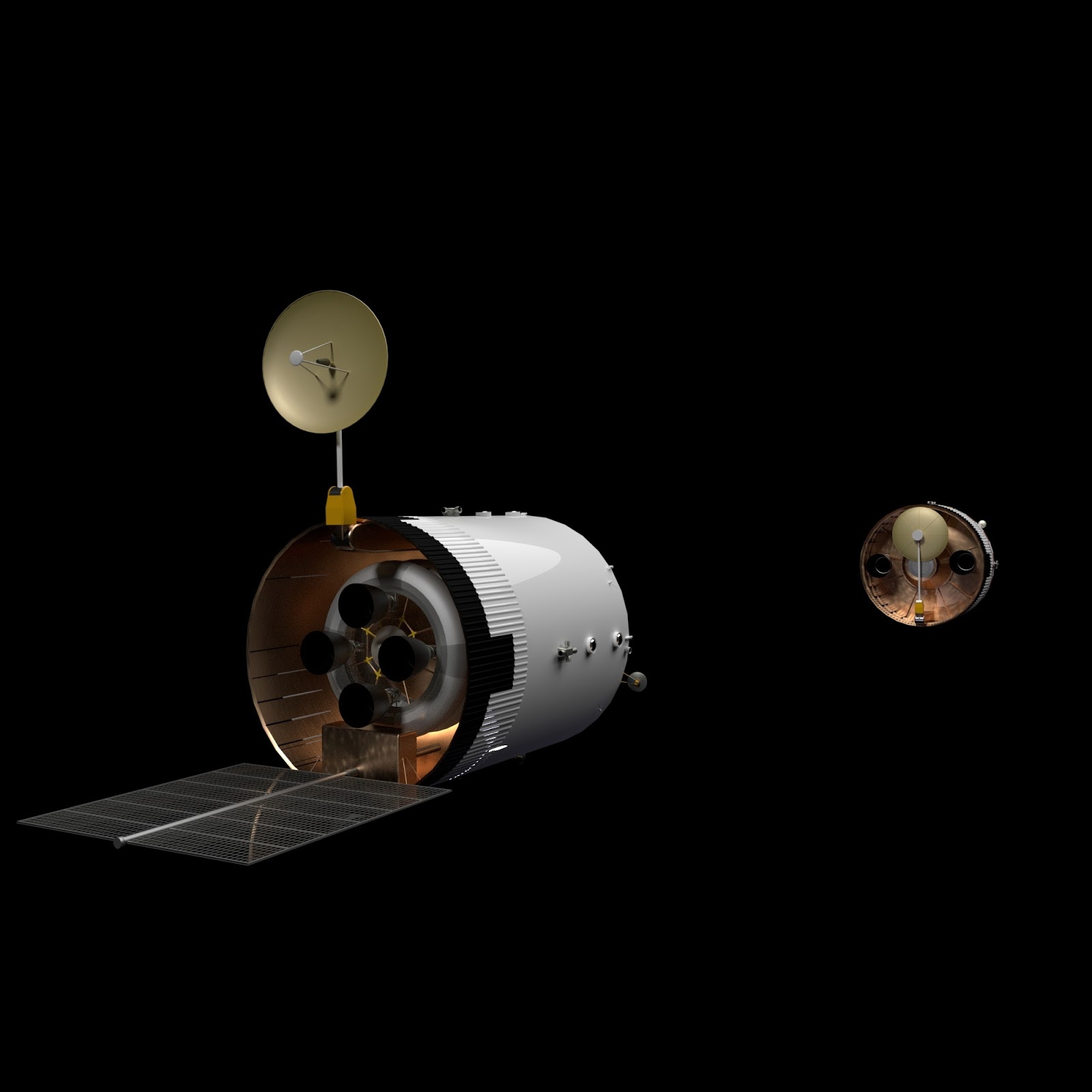
Some planners thought that NASA should jump straight from the early space workshops to piloted Mars landing missions using nuclear-thermal propulsion, but others called for a conservative continuation of the evolutionary approach. If the latter had won the day, the mid-1970s might have seen a new-design space station climb to Earth orbit atop an improved Saturn V rocket. Derived from Apollo hardware and new technology tested on board the orbiting workshops, the station would in fact have constituted a prototype interplanetary Mission Module. A crew might have lived on board without resupply or visitors for almost two years to help prepare NASA for its first piloted Mars voyage.

In keeping with the evolutionary approach, the first piloted voyage beyond the Moon might have been a Mars flyby with no piloted Mars landing. The piloted Mars flyby spacecraft, which would have carried a cargo of robotic Mars probes, would have been built around the Mission Module tested in Earth orbit. The mission might have commenced as early as late 1975, when an opportunity to launch a minimum-energy Mars flyby was due to occur.

As they raced past Mars in early 1976, the four flyby astronauts would have released automated probes and turned a suite of sensors mounted on their spacecraft toward Mars and its irregularly shaped moons Phobos and Deimos. They would have reached their greatest distance from the Sun in the Asteroid Belt, so asteroid encounters would have been a possibility. As their Sun-centered elliptical orbit brought them back to Earth's vicinity in 1977, they would have separated in an Apollo CM-derived Earth-return capsule and reentered Earth's atmosphere.

In addition to observing Mars close up, the astronauts would have continued the effort, begun in earnest during Gemini flights and continued on board the Earth-orbiting workshops and prototype interplanetary Mission Module, to determine whether extended piloted missions were medically feasible. The flyby crew might have confirmed, for example, that artificial gravity is a must during years-long interplanetary voyages. Their results would have shaped the next interplanetary mission, which might have taken the form of a piloted Mars orbiter in the spirit of Apollo 8 and Apollo 10, or, if the space agency felt sufficiently confident in its abilities, a Mars orbital mission with a short piloted excursion to the martian surface in the spirit of Apollo 11.

Sixty days from Mars: two of the FLEM mission's astronauts transfer to the Orbiter. After exhaustive systems checks, they fire explosive bolts to cast off the two-part "spacer" linking their spacecraft and the drum-shaped Flyby Spacecraft. A docking mechanism retracts, then small thrusters push the two spacecraft apart.
The Orbiter backs away from the Flyby Spacecraft. The two astronauts on the Flyby Spacecraft inspect the Orbiter's exterior and transmit television of its departure to Mission Control on Earth.
Using its Apollo-type thruster quads, the Orbiter turns away from the Flyby Spacecraft, positioning itself for the separation burn that will cause it to reach Mars 16 days ahead of the Flyby Spacecraft. Visible on both are engines based on the Apollo Lunar Module descent engine design. The four engines on the Flyby Spacecraft are part of the Earth Return Module (ERM) braking stage. The ERM, an Apollo CM with seating for four astronauts, is linked by its nose-mounted docking unit to the aft deck of the Flyby Spacecraft Mission Module. Life support gas and liquid tanks supplying the Mission Module surround the CM; these act as radiation shielding, allowing the CM to serve double-duty as a solar storm shelter.
In January 1966, United Aircraft Research Laboratories engineer R. R. Titus unveiled a proposal for a new intermediate step in spaceflight evolution. He dubbed it FLEM, which stood for "Flyby-Landing Excursion Mode." FLEM missions would, Titus wrote, have a natural place in the evolutionary sequence between piloted Mars flybys and piloted Mars orbiters. A FLEM mission might even have become the basis for an early, very brief, piloted Mars landing.

Titus explained that, in the "standard stopover mode," a label that encompassed Mars orbital and landing missions, all major maneuvers would involve the entire Mars spacecraft. This meant that the Mars spacecraft would need a large mass of propellants, which in turn meant that many expensive heavy-lift rockets would be required to launch the spacecraft, its propellants, and its Earth-orbit departure stages into Earth orbit for assembly.

Propellant mass required would vary greatly from one Earth-Mars transfer opportunity to the next over a roughly 15-year cycle because Mars has a decidedly elliptical orbit. Because of this, the Mars spacecraft and the sequence of launches needed to boost its components and propellants into Earth orbit would have to be redesigned for each standard stopover mode Mars mission.

The United Aircraft engineer added that errors or malfunctions during standard stopover mode "high-risk" Mars capture and escape maneuvers could result in "complete mission failure" because the entire spacecraft would be involved. Because the Mars spacecraft would be very massive already, it would be difficult and costly to include extra propellants that would enable a mission abort that could save the crew.

Titus noted that required propellant mass might be reduced and made to vary less over multiple Earth-Mars transfer opportunities if the spacecraft skimmed through the martian upper atmosphere to slow down and capture into Mars orbit (that is, if it performed aerocapture). If, however, artificial gravity were found to be necessary for crew health, then stowing a spinning artificial-gravity system of sufficient radius behind an aerocapture heat shield would probably prove infeasible. The mission would then have to rely entirely on propulsive braking.

Titus explained that his FLEM concept, in addition to forming a natural evolutionary extension of piloted Mars flybys, would address many inherent problems of the standard stopover mode. One part of the FLEM spacecraft, the "parent" spacecraft, would not capture into Mars orbit. It could include a spinning artificial-gravity system. The other part, the "excursion module," would capture into Mars orbit using chemical rockets or, perhaps, by skimming through the martian atmosphere behind an aerocapture heat shield.

Orbiter alone: immediately following the separation burn, the two astronauts aboard the Orbiter deploy and orient its solar array and high-gain dish antenna; they are identical to those on the Flyby Spacecraft. The array points at the Sun, out of view beyond the upper left corner of the image, while the antenna aims at the bright blue-white dot that is Earth. Just above the Orbiter, half-lit Mars is visible. Also in view are the Orbiter's four science pallets (covered by white rectangular panels), gray airlock hatch, and yellow spacewalk handholds. The airlock, partly surrounded by propellant tanks, serves as the Orbiter's solar storm shelter.
He noted that Earth-Mars transfer opportunities that need less propellant for Earth departure tend to arrive at Mars moving quickly, while opportunities that require more propellant for Earth departure arrive at Mars moving slowly. In the former instance, the excursion module would need a large quantity of propellants to slow down enough for martian gravity to capture it into orbit, so would be the most massive of the two FLEM modules. Because of this, the lower-mass parent spacecraft would ignite its rocket motors to slow down so that the excursion module could reach Mars first.

In the latter case, the excursion module would not need a large mass of propellants to capture into Mars orbit, making it the least massive of the two FLEM spacecraft. It would thus fire rockets to speed up and reach Mars ahead of the parent spacecraft.

Titus calculated that separation 60 days ahead of the Mars flyby would enable the excursion module to reach the planet 16 days ahead of the parent spacecraft; separation 30 days before flyby would enable it to reach Mars when the parent spacecraft was nine days behind it. While it awaited the arrival of its parent, the excursion module might remain in Mars orbit or all or part of it might land on Mars for a stay of several days.

In Mars orbit: during the Mars orbit capture burn, the Orbiter crew stowed the solar array and high-gain antenna to protect them from deceleration damage. Soon after achieving Mars orbit, they re-deployed both, then ejected the panels covering the Orbiter's instrument pallets. The two forward pallets include identical suites of high-resolution film cameras; the aft pair, identical suites of spectrometers. Identical pallets provide redundancy if instruments fail. As the Orbiter circles Mars, passing in and out of daylight, its solar array can temporarily lose lock on the Sun; in the image above, this has occurred, so the array reflects a crater under scrutiny by the Orbiter's instruments.
The Orbiter crew is not inactive as the Mars-facing instrument pallets record images and other data. In addition to maintaining Orbiter systems, they use handheld and porthole-mounted cameras to capture images of "variable phenomena." These include clouds, dust storms, morning fogs and frosts, and the retreating or expanding edges of the seasonally variable polar ice caps. The Orbiter's single-deck Mission Module has eight portholes.
FLEM, Titus noted, offered a "partial success capability" which, he opined, "may be very attractive." If the excursion module were lost, then the astronauts remaining on board the parent spacecraft could still return safely to Earth. If the excursion module were found during pre-separation checkout to be incapable of accomplishing its mission, it would not undock from the parent spacecraft, and the FLEM mission could still achieve some of its goals while settling for a Mars flyby.

Assuming that the mission took place as planned, the excursion module would ignite its rocket motors as the parent spacecraft passed Mars to depart Mars orbit and catch up with it. Following rendezvous, docking, and crew transfer, the excursion module would be cast off.

Sixteen days after Orbiter capture into Mars orbit, the Flyby Spacecraft raced past Mars. The Orbiter crew ejected their spacecraft's solar array and ignited its engines to catch up with their ride home. In this image, the two astronauts on board the Flyby Spacecraft (left) have turned on rendezvous lights. The Orbiter engines glow red after the "chase" maneuver. Its antenna is positioned so it can serve as a handrail should an emergency spacewalk to the Flyby Spacecraft be needed. The Orbiter halts near the Flyby Spacecraft, then its crew steps outside to collect film cassettes from the four pallets. The Flyby Spacecraft crew records the spacewalk and inspects the Orbiter exterior for damage that might interfere with docking. The Orbiter astronauts stow the recovered cassettes inside their spacecraft, then dock with the Flyby Spacecraft. The reunited FLEM astronauts then transfer film cassettes to the Flyby Spacecraft and discard the Orbiter.
To squeeze even more benefit from FLEM, Titus proposed a variant of the standard ballistic flyby (that is, one in which the only major propulsive maneuver would occur at the start of the mission, when the spacecraft departed Earth orbit). His "powered flyby" would include an optional propulsive maneuver near Mars that would dramatically reduce FLEM spacecraft mass during unfavorable Earth-Mars transfer opportunities, limit the wide swings in propellant mass required from one Earth-Mars transfer opportunity to the next, and slash total trip time.

The maneuver would be optional in the sense that, if it could not occur, the FLEM spacecraft's Sun-centered orbit would return it to Earth, though after a longer than expected trip. During return to Earth after a powered flyby, the FLEM spacecraft would pass as close to the Sun as orbits the planet Mercury.

Titus determined that a powered-flyby maneuver in 1971 would have almost no effect on spacecraft mass at Earth-orbit departure — both the standard ballistic and powered-flyby FLEM spacecraft would have a mass of about 400,000 pounds — but would slash trip time from 510 to 430 days. The most dramatic improvement would occur in 1978, when the ballistic-flyby FLEM spacecraft's mass would total nearly two million pounds and its mission would last 540 days. The powered-flyby FLEM spacecraft would have a mass of just 800,000 pounds at the start of Earth-orbit departure and its mission would last only 455 days.

The FLEM concept apparently influenced NASA piloted flyby studies that occurred under the auspices of the Planetary Joint Action Group (JAG). The NASA Headquarters-led Planetary JAG, which met between 1965 and 1968, included representatives from NASA Marshall Space Flight Center, NASA Kennedy Space Center, and the NASA Manned Spacecraft Center, as well as Washington, DC-based planning contractor Bellcomm. The Planetary JAG's work will be described in detail in subsequent posts.

FLEM was a mission mode without a spacecraft for accomplishing it — but no longer. For this post, artist William Black worked with the author to create a plausible FLEM spacecraft based on flown and conceptual 1960s space hardware. In keeping with the post's overriding theme, we put FLEM into an evolutionary program. We assumed at first that NASA would launch a piloted Mars flyby in 1975 and follow it in 1978 with a FLEM mission that would include a powered Mars flyby. As explained in the post text, a powered flyby would reduce mission duration and, in 1978, cut by more than half the quantity of propellants needed to reach Mars. It would, however, also cause the FLEM Flyby Spacecraft to pass as near the Sun as the orbit of Mercury. Closest approach to the Sun would occur in 1979, during a period of maximum solar activity. Because of this, we rejected both 1978 flyby opportunity and the powered flyby. We chose instead a Mars flyby launched in 1981 for our FLEM mission, when solar activity would be in decline. Earth-return speed would be high (about 50,000 feet per second), so we decided to employ a maneuver pioneered during the 1975 flyby: a braking burn during Earth approach to reduce reentry speed to Apollo lunar-return speed (36,000 feet per second).
The two images above show the Apollo CM-based Earth-Return Module (ERM) and its braking stage during final Earth approach. The ERM/braking stage would have backed out of its "hangar" in the Flyby Spacecraft two days before the events portrayed here. In the top image, the braking stage engines have just shut down after the braking burn; their engine bells still glow red. In the bottom image, the spent braking stage has been cast off. Below the ERM, city lights outline the Indian subcontinent; in the background, over the western Pacific, dawn glows. The ERM will soon streak through the atmosphere over China and Japan, deploy four parachutes, and descend to a mid-morning splashdown southwest of Hawaii, completing the first FLEM voyage and a new evolutionary step toward humans on Mars.
All images in this post are Copyright © 2017 by William Black (http://william-black.deviantart.com/) and are used by special arrangement with the artist.

Sources

Manned Mars and.or Venus Flyby Vehicle Systems Study — Final Briefing Brochure, SID 65-761-6, North American Aviation, 18 June 1965.

"FLEM - Flyby-Landing Excursion Mode," AIAA Paper 66-36, R. R. Titus; paper presented at the 3rd AIAA Aerospace Sciences Meeting in New York, New York, 24-26 January 1966.

Planetary Exploration Utilizing a Manned Flight System, Planetary Joint Action Group, NASA Office of Manned Space Flight, 3 October 1966.

"Manned Expeditions to Mars and Venus," E. Z. Gray and F. Dixon, Voyage to the Planets, Proceedings of the Fifth Goddard Memorial Symposium, 14-15 March 1967, pp. 107-135.

Wonderful Life: The Burgess Shale and the Nature of History, Stephen Jay Gould, W. W. Norton & Co., 1990.

More Information

After EMPIRE: Using Apollo Technology to Explore Mars and Venus (1965)

Relighting the FIRE: A 1966 Proposal for Piloted Interplanetary Mission Reentry Tests

To Mars by Way of Eros (1966)

Apollo Ends at Venus: A 1967 Proposal for Single-Launch Piloted Venus Flybys in 1972, 1973, and 1975

Triple-Flyby: Venus-Mars-Venus Piloted Missions in the Late 1970s/Early 1980 (1967)