Showing posts with label Preparing for Halley. Show all posts

An Unfortunate Condition: A 1967-1968 Pitch to Launch a Comet Halley Rendezvous Mission in the Late 1970s

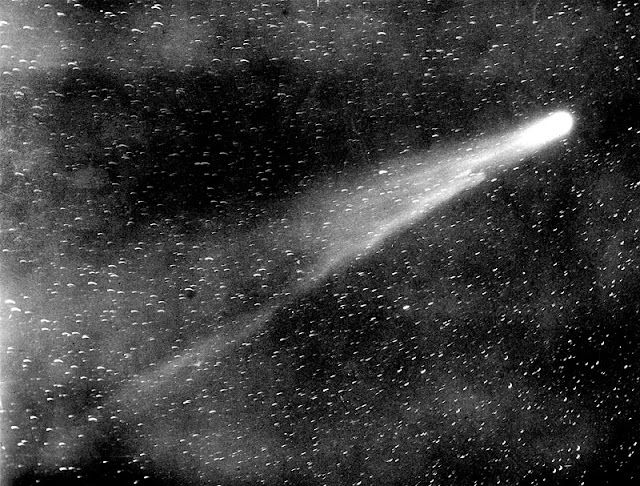
Comet Halley's last visit before the space age: a photographic plate captured at Yerkes Observatory on 6 June 1910. Image credit: Yerkes Observatory.

Herman Michielsen was a Senior Staff Scientist at Lockheed Missiles & Space Company's Palo Alto Research Laboratory in California in August 1967, when he presented a paper on possible missions to Comet Halley to an American Institute of Aeronautics and Astronautics (AIAA) conference in Huntsville, Alabama. His paper was the earliest oft-cited work describing options for exploring Comet Halley using spacecraft during its 1985-1986 apparition, the first that would take place since the advent of spaceflight in 1957. 

Lockheed funded Michielsen's Comet Halley research under its Independent Research Program, which gave its scientific staff opportunities to perform studies on company time outside their normal range of work. At the time he presented his Comet Halley paper, much of Michielsen's work had focused on calculating lunar and planetary ephemerides using advanced computers and on Earth satellite tracking. He was an important figure in the Independent Tracking Coordination Program, which aimed to supplement the limited number of professional Earth satellite visual observations with those of skilled amateurs around the world. 

Comet Halley requires little introduction; it is the one recurrent comet the name of which is widely known to non-astronomers. Observations of Comet Halley were recorded in China as early as 240 BC. Not until the 18th century, however, was it understood that Comet Halley follows an elliptical Sun-centered path that brings it to a perihelion (closest point in its orbit about the Sun) between the orbits of Venus and Mercury about every 76 years. 

The comet is named for Edmond Halley, the English astronomer who wrote in 1705 that comets observed in 1531, 1607, and 1682 were in fact a single comet. Halley successfully predicted that the comet would return in 1758, though he did not live to see its return.

Michielsen noted that short-period comets — that is, any comet with a period of 200 years or less — are typically visible only using telescopes and barely show a tail. Comet Halley is a short-period comet but bucks this tendency, making it an object of interest for future exploration using robot probes. The Lockheed scientist predicted that its return in 1985-1986 would become "a culmination point in the field of cometary probes."

Comet Halley is, however, not an ideal target for a spacecraft because it follows a retrograde path around the Sun. The great majority of Solar System bodies orbit their primary — the Sun, a planet, or any of the various categories of small body — in a prograde direction, which is to say counterclockwise. For its part, Comet Halley orbits the Sun clockwise. Michielsen called this "an unfortunate condition."

Michielsen calculated that spacecraft on a prograde intercept path would encounter Comet Halley at Earth's distance from the Sun (one Astronomical Unit, or AU) moving at about 60 kilometers per second (km/sec) relative to the comet; at Comet Halley's perihelion distance, 0.59 AU from the Sun, the relative intercept speed would exceed 90 km/sec. High encounter speeds near and at perihelion would mean that a probe could view the comet's nucleus, which was expected to measure at most a few tens of kilometers across, for only a very short time, making impossible any in-depth observations when the comet was most active.

At the time Michielsen presented his work, most comet scientists favored astronomer Fred Whipple's "dirty snowball" model of the structure of the comet nucleus. It should be noted, however, that in 1967-1968 rival models had supporters. Confirming the nature of the nucleus was among the most important justifications for comet exploration until the 1980s.

Michielsen proposed that an effort be made in time for the 1985-1986 apparition to place a robot probe into a retrograde Sun-centered orbit that would enable it to rendezvous with and travel beside Comet Halley for weeks or months. He wrote that a rendezvous mission would permit "a return of useful data many orders of magnitude greater than that from even a number of high-speed intercepts." A rendezvous would, however, be extremely challenging in terms of propulsive energy required.

A Comet Halley rendezvous might approach feasibility, he wrote, if the rendezvous probe were first launched into an elliptical Sun-centered orbit with an aphelion (farthest point in its orbit about the Sun) at about seven AU (that is, between the orbits of Jupiter and Saturn, which orbit the Sun at 5.2 AU and 9.5 AU, respectively). He proposed a launch in 1978, with the probe approaching aphelion in 1982. 

Near aphelion, the spacecraft would move relatively slowly, so could place itself into a retrograde orbit using a propulsive maneuver (an "aphelion pulse") that changed its speed by only about 9.3 km/sec. Combined with Earth-departure and fine-targeting maneuvers, the total propulsive velocity change required to carry out a Comet Halley rendezvous in 1985 would amount to about 31 km/sec.
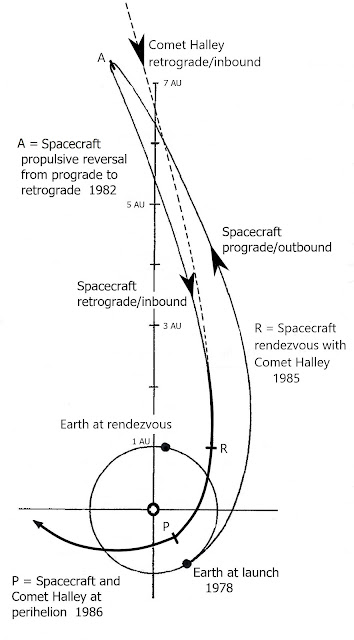
Diagram of Comet Halley and rendezvous spacecraft paths during Michielsen's aphelion-pulse mission. Please click on image to enlarge. Image credit: DSFPortree.

Other options would enable a Halley rendezvous with even less propulsive velocity change, Michielsen added. Departing Earth in 1973 would, for example, trim the aphelion pulse velocity change by 2.5 km/sec. The 12-year flight time from Earth launch to Halley rendezvous might, however, be seen as excessive.

In the early-to-mid-1960s, many planners considered the possibilities of propellant-saving gravity-assist maneuvers. Michielsen explained that a spacecraft launched on 13 September 1977 that passed in front of Jupiter on 16 September 1978 would be slowed and its course bent onto a retrograde path that would permit a rendezvous with Comet Halley on 27 May 1985, 254 days before its predicted perihelion on 5 February 1986. He also described a mission launched from Earth on 16 October 1978 that would encounter Jupiter on 14 October 1979 and rendezvous with Comet Halley on 10 September 1985, 148 days ahead of predicted perihelion. 

Jupiter would be better positioned for the gravity-assist flyby in the 1977 opportunity, Michielsen added, thus reducing the required Earth-departure velocity and the velocity at which the spacecraft would approach Comet Halley. The propulsive velocity change from Earth departure through Halley rendezvous would total 24.6 km/sec for the mission launched in 1977 and 25.6 km/sec for the 1978 mission. 

Michielsen then briefly explored the possibility of a Saturn gravity-assist flyby, which he said was suggested at the August 1967 AIAA meeting by Maxwell Hunter, who was a National Space Council member from 1962 until he joined Lockheed in 1965. A Saturn flyby Comet Halley rendezvous mission launched from Earth on 30 August 1973 would require a total propulsive velocity change of 22.2 km/sec; one launched on 14 September 1974 would need 22.9 km/sec. Saturn flyby would occur on 19 January 1976 for the 1973 launch and on 14 January 1977 for the 1974 launch; Comet Halley rendezvous would take place on 18 April 1985 or 21 June 1985, respectively.

In the second half of his paper, Michielsen gave close attention to the problem of precise prediction of Comet Halley's return, and it is in this context that his work is most often cited today. He noted that digital computers had enabled researchers to confirm that the gravity of the planets — in particular, Jupiter, Earth, and Venus — had caused Comet Halley's orbital period to vary by up to 1000 days over the centuries. In addition, a non-gravitational effect — the explanation of which he declared was beyond the scope of his paper — caused a shift in the perihelion date of about four days during each of the six apparitions spanning the period from 1456 to 1835. 

The non-gravitational effect Michielsen was loath to explain had been attributed to jets of gas and dust that form when a comet nucleus is heated by the Sun. These jets would, it was believed, behave like natural rocket motors. This hypothesis would eventually be confirmed, but the Lockheed scientist was probably wise to treat the potentially controversial problem as an unnecessary distraction when he presented his study of Comet Halley rendezvous methods.

The shift in perihelion date meant that a Comet Halley probe launched in the late 1970s would need to perform additional propulsive maneuvers to ensure a close rendezvous. The magnitude of the maneuvers required would begin to become apparent, he predicted, in November 1983, when Earth's largest telescopes would begin to photograph Comet Halley between the orbits of Saturn and Jupiter at a distance of 8.5 AU from the Sun. Michielsen expected that, if reacquisition took place at that time, then a sufficient number of observations could occur to ensure that maneuvers requiring a total propulsive velocity change of just 1.2 kilometers per second would yield a "worthwhile rendezvous mission." Later reacquisition might demand a greater propulsive velocity change.

As it turned out, the advent of CCD technology enabled reacquisition of Comet Halley more than a year ahead of Michielsen's predicted date. On 16 October 1982, observers using the 200-inch Hale Telescope at Mount Palomar in California became the first humans to glimpse Comet Halley since 1911. The comet, which had yet to show a tail, lay beyond the orbit of Saturn when it was reacquired.

Advances in astronomy technology mean that Comet Halley has remained visible since its 16 October 1982 reacquisition. When it reaches perihelion in July 2061, it will have been visually tracked for 79 years.

This post is the first in a new series called "Preparing for Halley." It aims to describe U.S. efforts to launch a spacecraft to Comet Halley in 1985-1986. The series is timed to coincide with Comet Halley's aphelion passage late in 2023, after which it will be inbound for its 2061 apparition. Other posts on comet exploration relevant to Comet Halley missions in 1985-1986 can be found by following the "More Information" links below. 
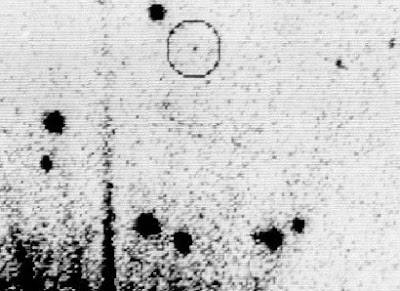
Comet Halley reacquired: CCD image captured at Palomar Observatory on 16 October 1982. The circle was added to make faint Comet Halley stand out among the background stars. Image credit: D. Jewitt & D. Edward Danielson, California Institute of Technology.

Source

"A Rendezvous with Halley's Comet in 1985-1986," H. F. Michielsen, Journal of Spacecraft and Rockets, Volume 5, Number 3, March 1968, pp. 328-334; paper presented at the AIAA Guidance, Control, and Flight Dynamics Conference in Huntsville, Alabama, 14 August 1967.

More Information

Missions to Comet d'Arrest & Asteroid Eros in the 1970s (1966)

Cometary Explorer (1973)

A 1974 Plan for a Slow Flyby of Comet Encke

Catching Some Comet Dust: Giotto II (1985)

The Challenge of the Planets, Part Three: Gravity

A 1974 Plan for a Slow Flyby of Comet Encke

So close: the CONTOUR spacecraft. Image credit: NASA.
Comet Halley is often called "Humankind's Comet" because it has appeared throughout much of recorded human history and because its orbital period of about 76 years is roughly equivalent to a human lifespan. Given the often frustrating nature of spaceflight planning, Comet Encke could be nicknamed "Spaceflight's Comet."

It has made the short list of targets for comet-exploring spacecraft for half a century. With one of the shortest orbital periods of any comet — just 3.3 years — and an inclination relative to the plane of the Solar System of only about 10°, Encke is among the comets most easily accessible to spacecraft. Yet despite being named the target of many proposed comet missions, Encke has never received a visitor from Earth.

Humans came closest to exploring Comet Encke nearly two decades ago. Following its launch on 3 July 2002, NASA's 775-kilogram COmet Nucleus TOUR (CONTOUR) spacecraft moved through a series of elliptical phasing orbits about the Earth designed to position it for a solid-propellant rocket motor burn on 15 August 2002. The burn would have launched it into solar orbit near the Earth. CONTOUR would then have re-encountered Earth in August 2003. The gravity-assist kick it was meant to receive from our planet would have put it on course for a Comet Encke close flyby on 12 November 2003.

Instead, the CONTOUR spacecraft disintegrated during its Earth-departure burn. Observers visually tracked three objects where there should have been one CONTOUR.

The CONTOUR Mishap Investigation Board determined that the most likely cause of the failure was an obvious-seeming design flaw: that the spacecraft's solid-propellant rocket motor, embedded at its center, produced enough heat that it weakened CONTOUR's structure, causing the spacecraft to break apart under acceleration. The Board cautioned, however, that lack of telemetry during the Earth-departure burn left open the possibility of several other causes, including rocket motor casing rupture, meteoroid or human-made space debris collision, or attitude-control failure leading to a destructive tumble.

If engineers and scientists at NASA Goddard Space Flight Center (GSFC) had gotten their way, Comet Encke would have received its first visitor as early as 3 December 1980. In fact, it would have received two visitors at the same time, for they envisioned launching two spacecraft to Comet Encke on a single rocket. The Encke probes, near twins, would have flown by the comet at a relatively slow speed compared with other proposed comet spacecraft; hence, in the November 1974 NASA Technical Note they wrote to describe it, they dubbed their mission a "ballistic slow flyby."

The twin Comet Encke ballistic slow flyby spacecraft stacked within their streamlined Centaur launch shroud. The adapter would join with the top of the Centaur upper stage. Image credit: NASA.
The Comet Encke probes were meant to depart Earth between 16 and 30 August 1980 atop a Titan rocket with a Centaur upper stage. Ironically, given CONTOUR's fate, the NASA GSFC team rejected an additional solid-propellant "kick" rocket motor as too risky. The probes would travel on a curving ballistic path directly from Earth to Encke; hence the term "ballistic" in the mission's description.

Robert Farquhar led the four-person GSFC team. In 1972-1973, he had participated in NASA GSFC's 35-member Cometary Explorer Study Group, which aimed to explore Comet Grigg-Skjellerup in April 1977 and Comet Giacobini-Zinner in February 1979 using a single 450-kilogram spinning spacecraft. The NASA-appointed Comet and Asteroid Science Advisory Committee had endorsed Cometary Explorer as the first step in a logical program of comet exploration leading to a NASA Comet Halley mission in 1985-1986.

Unfortunately, the U.S. civilian space agency, faced with rapidly declining budgets and bearing the heavy burden of Space Shuttle development, had been unable to fund Cometary Explorer. The 1980 Encke slow flyby mission would, it was hoped, put NASA comet exploration back on track to Halley.

Technicians at Cape Canaveral lower the launch shroud over the West German-U.S. Helios B solar probe spacecraft. Image credit: NASA.
Farquhar's team modeled its Comet Encke mission on the German-U.S. Helios A/Helios B Sun probe missions. Helios A left Earth in late 1974 (about a month after the NASA GSFC group published its Technical Note, in fact). The Helios probes were designed to survive an approach to 0.3 times the Earth-Sun distance, which is inside the orbit of the planet Mercury. The Encke probes, for their part, would pass their cometary target as it neared perihelion (the point in its orbit where it was nearest the Sun) at 0.34 times the Earth-Sun distance. The Helios probes would orbit in the plane of the Solar System; the Encke probes would match their target's modest orbital tilt.

The NASA GSFC team's Encke probes, which would spin to create gyroscopic stability, would move apart immediately after they separated from their launch vehicle's Centaur stage. Farquhar's team dubbed them the "tail probe" and the "coma probe." Each would resemble the lower half of a hourglass-shaped Helios spacecraft. Solar cells on their sides would power spacecraft systems and a suite of science instruments.

If necessary, a course-correction rocket burn would take place 10 days after launch. A second burn 50 days after launch would aim the tail probe at a point in the Comet Encke's wan tail about 10,000 kilometers behind the nucleus and would aim the coma probe at a point immediately in front of the nucleus. A third, very modest, course-correction burn was scheduled for Launch +85 days. The two spacecraft would encounter Comet Encke at about Launch +102 days.

Depending on their launch date, the Comet Encke spacecraft would reach their target between 3 December and 8 December 1980 moving at between 7.6 and 9.03 kilometers per second. Comet Encke would reach perihelion on 6 December. The Encke flybys would occur at around 1000 hours Greenwich Mean Time on all days of their arrival window so that the 100-meter dish-shaped antenna at Effelsberg, West Germany — the same antenna used to communicate with the Helios probes — could receive data for as long as possible before the twin probes set below the local horizon.

Image credit: NASA.
Farquhar and his colleagues envisioned that their two probes would carry slightly different science payloads. The 375-kilogram coma probe, which would linger within 1000 kilometers of the sunlit side of the nucleus for nearly 42 minutes, would include a despun platform bearing its radio dish antenna, TV camera, neutral mass spectrometer, UV spectrometer, and Lyman-alpha spectrometer. The 325-kilogram tail probe would include a despun antenna, but would lack the coma probe's despun platform with its four instruments. Both probes would include on their spinning main sections an ion mass spectrometer, a DC magnetometer, an AC magnetometer, an electron analyzer, a plasma analyzer, an electric field detector, a dust detector, and a dust composition instrument.

The NASA GSFC team was not the only group in 1974 that planned a 1980 Comet Encke mission. The NASA GSFC scientists and engineers made a point of comparing their mission plan with its main rivals. They explained that, in their comparison, "the primary evaluation criteria [would] be the science value and realism of attaining mission objectives."

Their plan's leading rival, a mission design advocated mainly by the Jet Propulsion Laboratory and its contractors, was based on solar-electric propulsion. Launch would take place on 17 December 1978 and a Comet Encke flyby would occur on 6 November 1980. The NASA GSFC team noted that the mission's 30-centimeter-diameter solar-electric (ion) propulsion thruster had yet to be developed, let alone tested; nevertheless, it would be expected to operate flawlessly for 690 days.

In addition, the thruster would interfere with the spacecraft's particle-and-fields instruments. Interference would not cease when the thruster was switched off.

Assuming that its untried thruster functioned as hoped, however, the solar-electric spacecraft would pass Comet Encke moving at only four kilometers per second, which constituted an advantage over NASA GSFC's ballistic slow flyby. It would do so, however, more than a month before perihelion, when Comet Encke was still about 0.5 times the Earth-Sun distance from perihelion. At that point in its orbit, the nucleus would be relatively inactive: if past observations were any guide, Comet Encke would have almost no tail.

The ballistic slow flyby's lesser rival was a ballistic fast flyby advocated mainly by NASA Ames Research Center and its contractors. A spin-stabilized spacecraft similar to the Pioneer 10 and Pioneer 11 outer Solar System spacecraft would launch on 18 August 1980 atop a relatively cheap Atlas/Centaur rocket with a solid-propellant kick stage. After a voyage of just 92 days, the spacecraft would whiz past Comet Encke on 18 November 1980 at a blistering 20.1 kilometers per second.

Farquhar's group noted that high-speed impacts with Comet Encke dust particles could easily destroy the ballistic fast flyby spacecraft, and that its camera would likely return only motion-blurred images (assuming that it had time to locate the nucleus or any other important comet features). It would remain within 1000 kilometers of the nucleus for a mere nine minutes.

The NASA GSFC team concluded that, compared with the solar-electric and ballistic fast flybys, the ballistic slow flyby was "superior in every respect." This assertion may well have been correct; the rivalry between the slow flyby, solar-electric, and fast flyby groups split the small community of comet exploration advocates, however, helping to ensure that no spacecraft explored Comet Encke in 1980.

Comet Encke as observed by the MESSENGER Mercury orbiter on 17 November 2013. Encke passed the planet Mercury at a distance of just 3.7 million kilometers and reached perihelion four days later. Image credit: NASA/JHUAPL/Carnegie Institution of Washington.
Sources

Mission Design for a Ballistic Slow Flyby of Comet Encke 1980, NASA Technical Note D-7726, R. Farquhar, D. McCarthy, D. Muhonen, and D. Yeomans, NASA Goddard Space Flight Center, November 1974.

Comet Nucleus Tour CONTOUR Mishap Investigation Board Report, NASA, 31 May 2003.

More Information

Cometary Explorer (1973)

Missions to Comet d'Arrest and Asteroid Eros in the 1970s (1966)

Cometary Explorer (1973)

Explorer 50/Interplanetary Monitoring Platform-J (IMP-J) satellite. Image credit: NASA.
The world's longest-running spacecraft series is the Explorer series, which began with the launch of Explorer 1, the first U.S. Earth satellite, on 31 January 1958. The U.S. Army carried out Explorer missions until NASA opened its doors on 1 October 1958. NASA Headquarters tapped NASA Goddard Space Flight Center (GSFC) in Greenbelt, Maryland, to manage the Explorer Program. Explorer 6, launched 7 August 1959, was the first in the series to reach Earth orbit under NASA auspices.

The NASA Explorers were envisioned as low-cost science satellites. Explorer 6, a 142-pound spheroid with four paddle-like solar panels, carried lightweight, relatively simple radiation and micrometeoroid detectors. Simple did not, however, mean insignificant: Explorer 6 conducted the first detailed survey of the Van Allen radiation belts, which contain solar radiation particles trapped by Earth's magnetic field. Subsequent Explorers took many forms, but Sun-Earth interactions and the interplanetary environment remained major Explorer Program areas of interest.

NASA launched Explorer 50/Interplanetary Monitoring Platform-J (IMP-J) on 26 October 1973. The following month, a 35-member NASA GSFC team, the Cometary Explorer Study Group, completed a report for the Greenbelt center's Cometary Study Office which laid out a design for a low-cost dual-comet Explorer mission.

One goal of the proposed mission, which aimed to carry out ballistic (unpowered) intercepts of Comet Grigg-Skjellerup and Comet Giacobini-Zinner in 1977 and 1979, respectively, was to gain experience ahead of a Comet Halley mission. Halley, well known to the public and of significant scientific interest, was due to return to the inner Solar System in 1985-1986.

That NASA GSFC should seek a leading role in comet exploration is not surprising. Comets interact profoundly with the Sun and the interplanetary environment. The Greenbelt center staked its claim to comets as early as March/April 1970, when the NASA GSFC-managed Orbiting Astronomical Observatory-2 (OAO-2) spacecraft turned its ultraviolet telescopes toward Comet Bennett, a long-period comet discovered in December 1969.

OAO-2 revealed a large "halo" of hydrogen gas surrounding the comet, which implied that it had a nucleus made up at least partly of water ice. This helped to lend support to astronomer Fred Whipple's "dirty snowball" comet model.

Cometary Explorer spacecraft. A = solid-propellant kick motor; B = hydrazine propellant tank (one of eight); C = science instrument ring; D = solar cell ring (one of three); E = hydrazine thruster (one of six); F = main antenna reflector spin motor; G = main antenna reflector. The right side of the image shows a cutaway of the spacecraft; the left side shows its exterior appearance. Image credit: David S. F. Portree/NASA.
The Cometary Explorer Study Group based its 450-kilogram spacecraft on the drum-shaped Explorer 50/IMP-J design, which was very similar to Explorer 43/IMP-H (launched 13 March 1971) and Explorer 47/IMP-I (launched 23 September 1972). The spacecraft's 1.4-meter-wide, 1.8-meter-tall structure would be made up of four stacked 16-sided "rings." Of these, three rings would carry on their outer surfaces solar cells which together would generate 162 watts of electricity.

Within the fourth ring would be mounted most of Cometary Explorer's dozen science instruments. The instrument ring would have attached to it six appendages: four evenly spaced, 61-meter-long cable antennae for measuring interplanetary electric fields and a pair of instrument booms, each about three meters long.

Top view of Cometary Explorer spacecraft. A = cable antenna (one of four); B = instrument boom (one of two); C = counter-rotating high-gain radio antenna. Image credit: David S. F. Portree/NASA.
For stability, Cometary Explorer would spin about its long axis at least 15 times per minute. Most of its equipment would not be affected by its spin or would be aided by it; for example, acceleration ("artificial gravity") the spin would create within the spacecraft would help to move hydrazine propellant from eight small pressurized tanks in the lower solar-cell ring to six thrusters spaced around the spacecraft.

Cometary Explorer's top-mounted high-gain antenna, on the other hand, would become useless if it spun with the spacecraft. An electric motor in the antenna base would thus turn the antenna against the spin so that it would remain stationary relative to the rest of the spacecraft. This would help to keep it fixed on Earth throughout Cometary Explorer's two-and-a-half-year mission.

Cometary Explorer would lift off from Cape Canaveral, Florida, on 4 November 1976, at the start of a 10-day launch opportunity. A Delta rocket would place the spacecraft and a solid-propellant upper stage into Earth parking orbit. At the appropriate time, the solid-propellant motor would ignite to place Cometary Explorer on course for Comet Grigg-Skjellerup. Its job complete, the spent upper stage would separate; the spacecraft's small hydrazine thrusters would then tweak its Sun-centered orbital path to ensure a successful comet intercept.

Cometary Explorer inside its 2.44-meter-diameter streamlined launch shroud. A = outline of launch shroud; B = Cometary Explorer spacecraft; C = solid-propellant upper-stage motor. Image credit: David S. F. Portree/NASA.
At the time the Cometary Explorer Study Group prepared its report, Comet Grigg-Skjellerup orbited the Sun once every 5.1 years. Its elliptical orbit had a perihelion (point closest to the Sun) of 0.99 Astronomical Units (AU), and an aphelion (point farthest from the Sun) of 4.93 AU. An AU, incidentally, is equal to the mean Earth-Sun distance (149,597,871 kilometers).

Grigg-Skjellerup's orbital elements were the result of a close (0.33 AU) pass by Jupiter in early 1964; prior to that encounter, its orbital period had been 4.9 years and its perihelion distance 0.86 AU. Though Grigg-Skjellerup's orbit had been precisely determined following the Jupiter encounter, the Group advised that observatories on Earth should locate and track the comet before Cometary Explorer's launch to help to ensure a successful intercept.

Cometary Explorer would pass about 1000 kilometers from the Sun-facing side of Grigg-Skjellerup on 11 April 1977, traveling at 15.2 kilometers per second relative to its target. At time of intercept, comet and spacecraft would orbit the Sun only 0.2 AU from Earth. In addition to collecting data on the comet's interactions with the Sun and interplanetary space and the composition of its gas and dust, scientists would attempt to image Grigg-Skjellerup's nucleus.

Departure from Grigg-Skjellerup would mark the start of Cometary Explorer's "extended mission," which would last nearly two years. The spacecraft would for a time follow the initial orbit that had taken it past Grigg-Skjellerup; then, on 26 October 1977, nearly a year after its launch, it would return to Earth to perform a gravity-assist flyby at a distance of about 42,000 kilometers.

Before and after its Earth flyby, Cometary Explorer would pass through and attempt to define the limits of Earth's magnetotail, the part of its magnetosphere pushed outward by the solar wind. During the flyby, the spacecraft would ignite the solid-propellant kick motor embedded in the "thrust tube" at the center of its lower solar-cell ring. This, combined with Earth's gravity, would bend its course toward its second target, Comet Giacobini-Zinner. As Earth grew small behind it, flight controllers would use Cometary Explorer's hydrazine thrusters to refine its trajectory.

The Giacobini-Zinner intercept would take place 1.83 AU from Earth on 19 February 1979. Relative to the comet, the spacecraft would zip along at a speed of 20.8 kilometers per second.

The Cometary Explorer Study Group explained that the Grigg-Skjellerup and Giacobini-Zinner encounters would occur in "the proper order," meaning that the least perilous comet intercept would occur first. Grigg-Skjellerup, Cometary Explorer's primary target, was not a dusty comet, so the group felt that the spacecraft would not suffer crippling damage as it flew past. Giacobini-Zinner, on the other hand, was a dusty comet, so was more likely to damage or destroy Cometary Explorer.

In the foreword to its report, the Cometary Explorer Study Group warned readers that NASA had already rejected its proposed mission. The space agency had cited its rapidly shrinking budget when it turned down the NASA GSFC plan.

The Group argued, however, that its report was still worthy of publication because it had "established the framework for investigating future ballistic intercept missions to comets." In the decade that followed the Cometary Explorer study, several of the Group's members — but most notably Robert Farquhar, Mission Definition Manager for the study — would continue to plan inexpensive, pioneering missions to comets. More often than not, these would aim to prepare NASA to explore Comet Halley in 1985-1986. Several of these proposed missions will be described in future posts.

Sources

System Definition for "Cometary Explorer": A Mission to Intercept the Comets Grigg-Skjellerup (1977) and Giacobini-Zinner (1979), NASA TM X-70561, NASA Goddard Space Flight Center, November 1973.

Encyclopedia: Satellites and Sounding Rockets of Goddard Space Flight Center - 1959-1969, NASA, no date (1970).

"NASA Facts: Explorer Satellites," E-10-62, NASA, 1962.

More Information

A 1974 Plan for a Slow Flyby of Comet Encke

Missions to Comet d'Arrest and Asteroid Eros in the 1970s (1966)