Showing posts with label piloted flyby. Show all posts

A Robotic and Piloted Planetary Exploration Program for the 1970s and Early 1980s (1968)

Leaving home: Earth as viewed from Apollo 4 on 9 November 1967. Image credit: NASA.
It was the best of times. It was the worst of times. (With apologies to Charles Dickens.)

For NASA, the year 1967 began with the promise of a bold start for the Apollo Applications Program (AAP), the planned successor to the Apollo lunar program, which would see space station missions in low-Earth orbit and advanced lunar exploration missions. Top NASA officials briefed the press on their ambitious AAP plans on 26 January 1967 (see "More Information" below). 

Barely a day later, fire raged through the crew cabin of the Apollo 1 Command and Service Module (CSM) spacecraft during a test on the launch pad, killing astronauts Gus Grissom, Ed White, and Roger Chaffee. The resulting investigation angered Congress — NASA had failed to report persistent problems in its relations with North American Aviation (NAA), the CSM prime contractor. Affronted legislators, already eager to cut government expenditures because of the soaring cost of U.S. military involvement in Indochina, responded in August-September 1967 by slashing President Lyndon Baines Johnson's Fiscal Year (FY) 1968 NASA budget request by nearly half a billion dollars. 

The cuts mostly affected projects aimed at giving NASA a post-Apollo future; AAP, of course, but also the Voyager robotic Venus/Mars exploration program (see "More Information" below) and advance planning for piloted missions beyond the Moon, including piloted Mars/Venus flybys. Members of the NASA Office of Manned Space Flight (OMSF) Planetary Joint Action Group (JAG) had hoped that major funding for piloted flybys could begin in FY 1969, with the first in a series of piloted flybys — a Mars flyby with sample return — leaving Earth in late 1975 (see "More Information" below).

Even as OMSF had sought piloted flybys, the scientific community had continued its perennial quest for an expanded robotic program. In a February 1967 report to the Johnson White House, the President's Science Advisory Council (PSAC) disparaged piloted flybys and urged a 1970s program that would see robotic spacecraft begin a wide-ranging reconnaissance of the entire Solar System. Scientists were outraged when instead the FY 1968 budget cuts threatened to end U.S. robotic exploration entirely after the twin Mariner '69 Mars flybys.

In October and November 1967, NASA Administrator James Webb spoke out in favor of new robotic planetary missions in the 1970s. He urged members of Congress to take note of Soviet plans for robotic exploration beyond the Moon. Talks began with White House budget officials and Congressional leaders aimed at salvaging a 1970s planetary program from the wreckage of the FY 1968 budget process.

Meanwhile, in Florida, components of AS-501, the first flight-ready Saturn V rocket, came together with an Apollo CSM in the giant Vertical Assembly Building (VAB) at NASA Kennedy Space Center (KSC). Without the three-stage behemoth an Apollo Moon landing was impossible.  The testing and assembly process had begun months before the Apollo 1 fire with the aim of a launch in the first quarter of 1967, but preparation for the automated test mission — which NASA designated Apollo 4 — hit one snag after another. 

Following the fire, NASA subjected the CSM NAA had delivered to KSC for the Apollo 4 mission to enhanced scrutiny. The spacecraft, designated CSM-017, was found to contain more than 1400 wiring errors. Fixing them required months. Welding errors in the NAA-built Saturn V S-II second stage also needed correction. 

Troubled assembly: the Apollo 4 CSM and Saturn V rocket in the Vertical Assembly Building at NASA Kennedy Space Center, Florida. Image credit: NASA.
The giant rocket was at last rolled out to Launch Pad 39A on 26 August 1967, but its troubles were not over, for Apollo 4 was also a test of launch pad hardware and pre-launch procedures. As the launch team struggled to make pad and rocket function together, the press, the public, and the Congress became increasingly impatient.

Apollo 4 lifted off at last on 9 November 1967. Rocket, spacecraft, launch facilities, and world-wide tracking & communications network operated together almost flawlessly.

The Apollo 4 Saturn V and CSM climb toward orbit. Image credit: NASA.
About three hours after insertion into a 190-kilometer-high (118-mile-high) low-Earth orbit, the AS-501 Saturn V S-IVB third stage restarted to boost CSM-017 into an elliptical orbit. It was the first orbital restart of the stage, which would boost Apollo missions out of Earth orbit to the Moon. 

Near orbital apogee CSM-017 separated from the S-IVB. The spacecraft fired its Service Propulsion System (SPS) main engine to increase its altitude to 18,092 kilometers (11,242 miles), then fired it again for 4 minutes and 30 seconds to hurl itself at Earth at a lunar-return speed of 24,911 miles (40,090 kilometers) per hour. 

CSM-017 split into its component modules — Command Module (CM) and Service Module (SM) — then the former reoriented itself with its bowl-shaped heat shield forward so that it could withstand fiery atmosphere reentry. The SM burned up as planned. The CM's heat shield, meanwhile, reached a temperature of nearly 2760 C (5000° F). Crew cabin temperature did not exceed 21 C (70° F). Just eight and a half hours after liftoff, the Apollo 4 CM deployed three parachutes and lowered to a splashdown in the Pacific. 

The unmanned Apollo 4 Command Module (right) bobs in the Pacific Ocean near Hawaii at the end of its eight-and-a-half-hour test flight. One of its three main parachutes remains attached; it would be retrieved for analysis along with the spacecraft. Image credit: NASA.
The trade magazine Aviation Week & Space Technology reported that, ironically, on the very day of NASA's Apollo 4 triumph, NASA Marshall Space Flight Center (MSFC) in Huntsville, Alabama, had laid off workers as a result of the FY 1968 budget cuts. NASA MSFC was the home of the Saturn family of rockets. 

On 12 December 1967, a little more than a month after Apollo 4, President Lyndon Baines Johnson toured NASA's Michoud Assembly Facility near New Orleans, Louisiana, where Saturn rockets were assembled and tested. His visit was meant to reassure local and state officials and to raise worker morale. Whether he succeeded is open to interpretation. Standing before a partially complete Saturn V S-IC first stage, Johnson told the workers

. . .that man will make space his domain is inevitable. Whether America will lead mankind to that destiny does not depend on your ability, but depends on our vision, our willingness, and our national will and determination. This great pilgrimage of man — like all his adventures — costs money. Christopher Columbus spent more years trying to find money for his voyage than he spent discovering the New World. In the modern world, we can no longer depend on Queen Isabella pawning her jewels. We have to depend on taxes. We must have revenues that only Congress can grant. . . So we will advance in space to the extent that our people and their representatives are prepared for us to advance and are prepared to pay the cost of that advance. We may not always proceed at the pace we desire. I regret — I deeply regret — that there have been reductions and there will be more. There have been interruptions. . . But I do have faith and confidence in the American people.

This background may help to explain why two engineers at Bellcomm, NASA's Washington, DC-based advance planning contractor, responded as they did when NASA invited them in late November-early December 1967, to state their opinions on the course U.S. planetary exploration should take in the 1970s and early 1980s. In a report completed and distributed to relevant NASA facilities on 26 February 1968, J. P. Downs and W. B. Thompson were cautiously optimistic. 

Downs and Thompson explained that their report reflected "the authors' thinking at. . . [a] particular time" and that it was "a reflection of a long term point of view." They assumed that the deep FY 1968 budget cuts were a short-term, temporary setback, not a sign of a long-term trend. In fact, they anticipated an annual NASA budget of between $5 billion and $6 billion by FY 1971 or FY 1972, when, they expected, NASA would start development of a piloted planetary program.

At the same time, the Bellcomm engineers cautioned that "[a]s more information becomes available on technical details and resources, the program may change." They added, however, that "the rationale expressed. . . is expected to remain much as it is now."

Downs and Thompson described a NASA planetary program containing 21 missions to 11 Solar System bodies between the years 1969 and 1984. Missions would occur in three "branches." The first branch would comprise missions to Venus and Mars that would serve as precursors to at least three piloted Mars and Venus missions. Missions in the second branch would explore Mercury, Jupiter, and the other "major planets" (Saturn, Uranus, and Neptune), a task they called "the major challenge to the unmanned program." The third branch would include missions to explore two comets and two asteroids. 

Their program would begin with the twin Mariner '69 Mars flybys already on NASA's schedule and continue in 1970 with a Mariner Venus/Mercury dual flyby mission launched on an Atlas/Centaur rocket. The Atlas/Centaur was already in early 1968 the workhorse of the NASA robotic lunar and planetary program. 

The Venus/Mercury mission, which would form part of both the first and second of Downs and Thompson's three branches, would seek gaps in Venus's cloud cover in the hope of glimpsing its mysterious surface. In addition, as the spacecraft flew past the planet, it would transmit radio signals to Earth through the Venusian atmosphere in an attempt to chart its structure.

Mariner Mars '69 engineering model. Note the large steerable camera "pod" mounted below the hexagonal bus body, the high-gain dish antenna on top, and the four solar arrays. Image credit: NASA.

Space workhorse: an Atlas-Centaur rocket launches the Surveyor 1 lunar lander on 30 May 1966. Image credit: NASA.
During the flyby, Venus would give the spacecraft a gravity assist that would reduce by between 50% and 75% the amount of propulsive energy it would need to reach Mercury. Downs and Thompson explained that the innermost planet is, by dint of its proximity to the Sun, often lost in glare when viewed from Earth and hence mysterious; orbiting close to the Sun also means that its orbital speed is high, making it difficult for spacecraft to reach.

In 1971, NASA would launch on a Titan III-C rocket its first new-design Mars orbiter and surface probe. Downs and Thompson suggested that the new orbiter might be based on the Boeing Lunar Orbiter design. The Titan III-C, a U.S. Air Force rocket, was meant to replace the Saturn IB-Centaur rocket formerly emphasized in NASA planetary mission plans. Use of the Titan III-C in the Downs and Thompson program was a response to a statement by NASA Administrator James Webb that the Saturn IB would be phased out to save money. 

18 June 1965: the first Titan III-C rocket stands on the pad at Launch Complex 40, Cape Canaveral Air Force Station, Florida. Image credit: U.S. Air Force.

Boeing-built Lunar Orbiter spacecraft. Image credit: NASA.
The 159-kilogram (350-pound) battery-powered survivable surface impactor probe would include an atmosphere entry shell, a parachute, a protective impact shell carved from soft, lightweight balsa wood, and 13 pounds of science instruments. These might include a life detection device. Instruments on the entry shell would  chart atmospheric structure as it plummeted toward the surface after separation from the impactor. These data would enable engineers to design heavier, more sophisticated Mars landers. 

NASA would launch in 1972 its first new-design Venus orbiter and atmospheric probe on a Titan III-C. In addition to "a concentrated search over the entire planet for visible access to the surface," the orbiter would employ an imaging radar to chart surface topography. The probe would measure the thermodynamic properties of the atmosphere to enable design of meteorological balloon probes suited to Venusian conditions.

In 1973, NASA would ramp up the pace by launching on three Titan III-Cs a pair of Mars orbiter/impactor probe missions and a second Mariner-derived Venus/Mercury flyby spacecraft. The latter would resemble that launched in 1970 but would add a Venus survivable surface impactor probe. The prime objective of the Mars impactor probes would be to search for life. 

The 600-pound Venus impactor probe would attempt to return data on the planet's harsh surface conditions for at least an hour. The dense Venusian atmosphere would, Downs and Thompson wrote, enable a survivable landing without a parachute.

The following year, NASA would launch its first flyby mission to Jupiter on a Titan III-C augmented with a Centaur upper stage. Dubbed a "galactic Jupiter probe," it would be the first NASA spacecraft designed for an operational lifetime of up to 10 years. It would survey interplanetary particles and fields and aid future spacecraft designers by surveying the interplanetary meteoroid environment with particular emphasis on the Asteroid Belt between Mars and Jupiter. A Jupiter gravity-assist would make it the first spacecraft to escape the gravitational grip of the Sun.

NASA would ramp up the planetary exploration pace in 1975 by launching four rockets — probably Titan III-Cs with Centaur upper stages. An orbiter and surface probe would leave Earth for Mars. Two orbiters with impact lander probes would launch to Venus. The space agency would also launch a clone of the 1974 galactic Jupiter probe mission.

The year 1976 would see NASA's first mission to a comet. After launch on an Atlas/Centaur, a Mariner-derived spacecraft would race past Comet d'Arrest. Downs and Thompson explained that the small size of the comet nucleus and the rapid speed of the flyby would require NASA to develop a sophisticated new tracking system for its comet spacecraft cameras.

In 1977, the first Mariner-derived "Grand Tour" spacecraft would depart Earth on a Titan III-C/Centaur. A series of gravity-assist flybys would speed it across the outer Solar System, enabling it to explore all four planets beyond the Asteroid Belt in the space of a decade. That same year, NASA would launch on two Titan III-C/Centaur rockets a Mars orbiter with an impactor and a Venus orbiter with a pair of impactors. The Venus impactors might be targeted to land on high-elevation surface features; these might, Downs and Thompson suggested, have cooler temperatures than lower elevations, and thus be more likely to support life.

The year 1978 would see launch of NASA's first asteroid mission (a flyby of asteroid Icarus using a Mariner-derived spacecraft launched on a Atlas/Centaur) and the second "Grand Tour" mission (a clone of the 1977 mission). It would also see an significant shift in the character of the U.S. planetary program as astronauts joined the action. 

Thompson was a veteran of the NASA OMSF Planetary JAG piloted flyby studies. The NASA budget seemed unlikely to stretch far enough to support development in time to carry out the Planetary JAG's 1975 piloted Mars flyby mission, so the Bellcomm engineers opted instead to take advantage of an opportunity to launch a piloted Venus/Mars/Venus flyby mission in late 1978. 

The piloted flyby spacecraft and its Earth-orbit departure booster stack would be assembled in Earth orbit using components launched on two-stage Saturn V rockets. After leaving Earth orbit and discarding its boosters, it would follow a free-return heliocentric path that would end at Earth. Only minor course corrections would be required after Earth-orbit departure.

In 1979, the crew of the piloted flyby spacecraft would deploy automated meteorological balloons and impactor probes as they passed Venus for the first time and automated sample returners as they passed Mars. The balloons would drift the Venusian atmosphere for a long period. They would seek evidence of life in cool atmosphere layers. 

Astronauts would examine in a sealed lab the Mars dirt and air the sample returners launched to the flyby spacecraft to determine whether they could be safely returned to laboratories on Earth. The following year (1980) would see the mission carry out its second Venus flyby — a clone of the first — followed a few months later by a direct Earth-atmosphere reentry.

The years 1979 and 1980 would also see the last two Mariner-derived comet/asteroid flyby missions on the Downs and Thompson schedule. The first, the last mission launched on an Atlas/Centaur, would visit asteroid Eros, while the second, launched on a Titan III-C/Centaur, would race past Comet Encke.

A second piloted flyby mission would depart Earth in 1981. During its Venus flybys in that year and in 1983 it would deploy a pair of balloon-borne "several thousand pound" Buoyant Venus Stations of a type proposed by the Martin Company in 1967, as well as an unspecified number of long-duration Venus landers. All would look for life. The Mars flyby in 1982 would see more surface sample collection and observations tailored toward selecting sites for eventual piloted Mars landings.

Downs and Thompson expected that their 1984 piloted planetary mission, the last on their schedule, would probably take the form of a Venus orbiter. A piloted Venus mission would, they wrote, "serve to pace the development of a high energy space storable propulsion system." After proving that it could slow the piloted Venus spacecraft so that Venus's gravity could capture it into orbit and accelerate it out of Venus orbit back toward Earth, the compact, powerful, long-lived rocket stage would propel piloted Mars orbiter and landing missions and boost out of Earth orbit large new-design robotic outer planet and "deep space" spacecraft.

The Bellcomm engineers' report landed on desks across NASA in late February. Their timing could have been better — barely a month ahead of its distribution North Vietnam attacked South Vietnam on the eve of Tet, the Chinese New Year, leading to greatly expanded U.S. involvement in the Vietnam War. The Tet Offensive created new pressure on the Federal purse, helping to ensure (among other things) that NASA's budget slide would continue in FY 1969 and beyond.  

Despite the war and other national challenges, in the period covered by the Downs and Thompson plan NASA managed to fly a dozen planetary missions, of which 11 reached their targets. In large part, these were justified in terms of heading off new Soviet space victories and providing an avenue for the development of new technology with defense implications. 

All the flown missions were directed toward major planets; none would visit asteroids or comets and (of course) none would include astronauts. Italicized initial dates given below are launch years.

  • 1969: The Mariner '69 Mars flyby spacecraft were designated Mariner 6 and Mariner 7 after launch; they left Earth atop Atlas/Centaur rockets.
  • 1971: The Mariner '71 Mars orbiter spacecraft were designated Mariner 8 and Mariner 9 after launch; Mariner 8's Atlas/Centaur rocket malfunctioned but Mariner 9, the first planetary orbiter, was a great success, mapping all of Mars until late 1972.
  • 1972: Pioneer 10, launched on an Atlas/Centaur rocket with a solid-propellant kick stage, became the first spacecraft to traverse the Asteroid Belt;  in 1973, it became the first spacecraft to fly past Jupiter. The gravity-assist kick it received made it the first spacecraft placed on a path to escape the Solar System.
  • 1973: Pioneer 11 followed Pioneer 10 through the Asteroid Belt to Jupiter; in 1979 it became the first spacecraft to fly past Saturn.
  • 1973: Mariner 10 left Earth on an Atlas/Centaur rocket and flew past Venus in early 1974; later that year it became the first spacecraft to fly past Mercury. It flew past Mercury twice more in 1974-1975.
  • 1975: Viking 1 and Viking 2, each of which comprised a lander and a Mariner-derived orbiter, launched atop Titan III-E rockets, arriving in Mars orbit in June 1976 and August 1976, respectively. Viking 1, which touched down on 20 July 1976, was the first successful Mars lander; Viking 2 landed successfully on 3 September 1976. Their life detection experiments yielded equivocal results.
  • 1977: The Mariner Jupiter-Saturn '77 spacecraft were renamed Voyager 1 and Voyager 2. They left Earth atop Titan III-E rockets. Voyager 1 flew past Jupiter in 1979 and Saturn in 1980; Voyager 2 flew past Jupiter in 1979, Saturn in 1981, Uranus in 1986, and Neptune in 1989.
  • 1978: Pioneer Venus Orbiter and Pioneer Venus Multiprobe (PVM) launched atop Atlas/Centaur rockets. Though not designed to survive landing, one PVM small probe continued to operate after striking the surface, becoming the first (so far only) successful U.S. Venus lander.

The Pioneer Venus Multiprobe bus (lower right) is shown deploying three small probes (center) and one large probe (upper left). In reality the large probe was deployed on 16 November 1978 and the small probes were deployed on 20 November 1978. The bus and probes entered the Venusian atmosphere on 9 December 1978. Image credit: NASA.
In their report, Downs and Thompson anticipated that NASA would be given the go-ahead to start a new piloted planetary program in FY 1971 or  FY 1972, and after a fashion they were correct. In January 1972, President Richard Nixon called on Congress to fund the winged Earth-orbital Space Shuttle. 

Originally proposed as a low-cost fully reusable Space Station crew rotation and resupply vehicle, the Shuttle became instead a multi-purpose spacecraft after Nixon refused to fund a Space Station. It would be only semi-reusable, which lowered its development cost but dramatically increased its operations cost. Among its goals was to launch all U.S. robotic planetary spacecraft.

Downs and Thompson's NASA budget prediction — $5-6 billion annually by about FY 1972 — entirely missed the mark. In terms of buying power in an inflationary time, NASA's budget remained at about half that amount throughout the 1970s and early-to-mid 1980s. Funding scarcity adversely impacted both Shuttle development and planetary exploration. 

Shuttle development problems traceable to funding shortfalls, lack of successful new Soviet planetary missions, tight planetary science budgets, and the Challenger accident (28 January 1986) came together to create an 11-year hiatus in new U.S. planetary launches following the 1978 Pioneer launches. The stoppage ended at last with the launch of the Magellan Venus radar mapper on board the Shuttle Orbiter Atlantis on 4 May 1989. 

By the time Magellan flew, NASA had announced that it would cease Shuttle planetary launches after it launched the Galileo Jupiter orbiter and probe and Europe's Ulysses solar polar orbiter in favor of resuming planetary launches on expendable rockets. Galileo launched on board the Orbiter Atlantis on 18 October 1989 and Ulysses launched on board the Orbiter Discovery on 6 October 1990. 

Sources

The first two sentences of this post are based on the first sentence of Charles Dickens' 1859 novel A Tale of Two Cities.

The Space Program in the Post-Apollo Period: A Report of the President's Science Advisory Committee, "Prepared by the Joint Space Panels," The White House, February 1967.

"Science Advisers Urge Balanced Program," Aviation Week & Space Technology, 6 March 1967, pp. 133-137.

"Orbiters Studied for Planetary Missions," W. J. Normyle, Aviation Week & Space Technology, 23 October 1967, pp. 30-32.

"Washington Roundup: NASA Thanks You," Aviation Week & Space Technology, 20 November 1967, p. 25.

"Apollo 4 Closes Gaps to Lunar Mission," W. J. Normyle, Aviation Week & Space Technology, 20 November 1967, p. 26-27.

"NASA Pushes Planetary Program," W. J. Normyle, Aviation Week & Space Technology, 27 November 1967, pp. 16-17.

"Remarks Following an Inspection of NASA's Michoud Assembly Facility Near New Orleans," President Lyndon Baines Johnson, 12 December 1967 (https://www.presidency.ucsb.edu/documents/remarks-following-inspection-nasas-michoud-assembly-facility-near-new-orleans — accessed 30 August 2022).

"A Feasible Planetary Exploration Program Through 1980 — Case 710," J. P. Downs and W. B. Thompson, Bellcomm, Inc., 26 February 1968.

Astronautics & Aeronautics 1967, NASA SP-4008, 1968, pp. 43-45, 246, 248, 255-256, 282-284, 295-296, 314, 320, 323-324, 333, 336-343, 352-353, 373-375.

Stages to Saturn: A Technological History of the Apollo/Saturn Launch Vehicles, NASA SP-4206, Roger E. Bilstein, NASA, 1980, pp. 351-360.

More Information

"Essential Data": A 1963 Pitch to Expand NASA's Robotic Exploration Programs

NASA's Planetary Joint Action Group Piloted Mars Flyby Study (1966)

Missions to Comet d'Arrest & Asteroid Eros in the 1970s (1966)

"Assuming That Everything Goes Perfectly Well in the Apollo Program. . ." (1967)

The First Voyager (1967)

Triple Flyby: Venus-Mars-Venus Piloted Missions in the Late 1970s/Early 1980s (1967)

Things to Do During a Venus-Mars-Venus Piloted Flyby Mission (1968)

Chronology: Piloted Flybys 1.0

The crew of a piloted flyby spacecraft prepares to retrieve the upper stage of a Mars Surface Sample Returner probe. Image credit: NASA.
In the 1960s NASA expended at least as much study effort on piloted missions that would fly past Mars and Venus without stopping as it did on missions to land crews on Mars. Piloted flybys were seen as a low-cost stepping stone linking Apollo lunar landings and staffed space stations in Earth orbit with piloted planetary landing missions. It is in that context that we must judge and try to understand them today.

Chronology is a vital component of history. In this blog, however, my posts do not always appear in chronological order. Hence the need for "Chronology" posts like this one that enable the reader to access posts on a particular topic in the proper chronological order. Other posts of this type are listed under "More Information" below. 


More Information


MSSR as MEM (1967-1968)

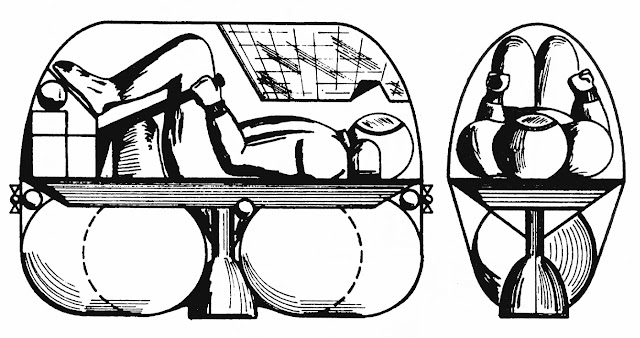
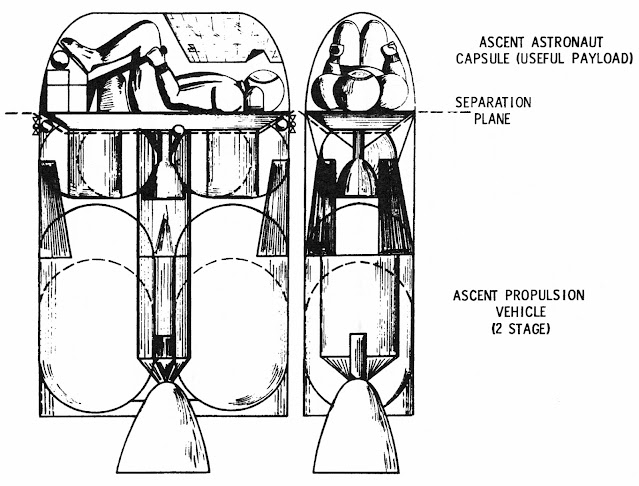
Scary ride: second stage and crew cabin of the Bellcomm minimum Mars Excursion Module (MEM) ascent vehicle. The unpressurized cabin would have included few displays and minimal communications. Image credit: Bellcomm/NASA.
The NASA Planetary Joint Action Group (JAG) saw the addition of the Mars Surface Sample Returner (MSSR) probe to the piloted Mars/Venus flyby mission scenarios it studied in 1966 as a pivotal innovation. Before the advent of the MSSR, the piloted flyby mission appeared to be increasingly threatened by successful robotic flyby missions. The MSSR, members of the Planetary JAG contended, gave the piloted flyby mission an added capability that could not be reproduced by a wholly robotic Mars mission.

The piloted flyby spacecraft would have released the MSSR perhaps 10 days before Mars close encounter. A rocket motor on the MSSR would have boosted it toward Mars, enabling it to reach the planet and land at a preselected site several hours before the piloted flyby spacecraft arrived. 

The crew on board the piloted flyby spacecraft would have used a variety of sample collectors on board the MSSR to gather about two pounds of Mars surface material and air by remote control as the planet grew ever larger in their viewports. These would have been packed into a three-stage ascent vehicle and launched to the piloted flyby spacecraft. 

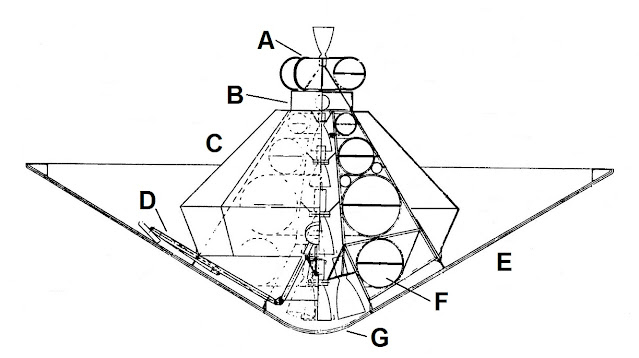
Partial cutaway of Mars Surface Sample Returner (MSSR) probe. A = Mars intersect trajectory injection stage with toroidal propellant tank; B = sample canister; C = ascent stage with three stages, each with a toroidal propellant tank; D = folded landing leg (one of four); E = aeroshell heat shield; F = toroidal descent stage propellant tank; G = descent stage engine heat shield cap. Image credit: NASA/DSFPortree.
The astronauts on board the piloted flyby spacecraft would have captured the sample canister and ascent vehicle third stage using a boom-mounted docking ring and linked them to a port leading into a hermetically sealed biological laboratory. The MSSR probe would, it was expected, enable analysis of Mars samples within an hour of their collection, helping to ensure that any martian organisms they contained would still be alive. 

Phase 1 of the Planetary JAG piloted flyby study ended with distribution of an NASA report on 3 October 1966. The group then began work on Phase 2 of its piloted flyby study. Some members of the Planetary JAG foresaw a rosy future for the concept — they anticipated that MSSR study contracts might be awarded in Fiscal Year 1968 and the piloted flyby mission might become a NASA new start project in Fiscal Year 1969.

Even before the AS-204/Apollo 1 fire (27 January 1967), however, NASA planning for missions beyond Apollo was on shaky ground. Neither the Administration of President Lyndon Baines Johnson nor the Congress supported ambitious plans for post-Apollo spaceflight — for example, a long-term lunar base or humans on Mars. By the summer months of 1967, the fire, racial and anti-war tensions across the country, concerns about the Federal budget deficit, and military setbacks in Indochina had provided opponents of an expansive U.S. future off the Earth with ample justification for curtailing NASA efforts to define its future.

Not all advance planning halted, however. Bellcomm, NASA's Washington, DC-based planning contractor, continued its work as a matter of course. Most Bellcomm studies in the 1967-1969 period aimed to define the shape of the Apollo Program after the first successful piloted lunar landing, as well as that of Apollo's planned successor, the Earth-orbital and lunar Apollo Applications Program (AAP). A modicum of work toward more ambitious goals beyond Earth orbit and the Moon also continued.

In July 1967, for example, Bellcomm planners D. Cassidy and H. London completed a short technical memorandum in which they explored how the MSSR probe might form the basis for a piloted Mars Excursion Module (MEM) lander. Their study kicked off a series of related studies at Bellcomm in the year that followed. 

Cassidy and London assumed a 15,000-pound MSSR with a two-stage ascent vehicle capable of launching 80 pounds to a passing piloted flyby spacecraft launched in 1975, 1977, or 1979 on a Mars Twilight flyby path. The "Twilight" mission owed its name to the geometry of its Mars flyby — closest approach to Mars took place over the planet's night hemisphere near the dawn terminator, the line dividing pre-dawn darkness from daylight. 

The Bellcomm engineers calculated that MSSR Mars atmosphere entry velocity would reach 32,500 feet per second (fps) in 1975, 34,500 fps in 1977, and 39,000 fps in 1979. As it passed at a shallow angle through the thin martian atmosphere, the automated MSSR would undergo deceleration equal to up to 40 times the pull of gravity on Earth's surface (that is, 40 Gs). To accomplish rendezvous with the passing piloted Mars flyby spacecraft, the MSSR ascent vehicle would have to boost an 80-pound third stage and sample container to 36,000 fps in 1975, 38,000 fps in 1977, and 42,500 fps in 1979. 

An MSSR-derived MEM released during piloted Mars orbiter approach to Mars — that is, before the orbiter fired its rocket motors to slow down so that Mars's gravity could capture it into an elliptical orbit with a one-day period — would, on the other hand, in 1978, 1982, 1984, 1985, and 1986 enter the martian atmosphere moving at between 20,000 fps and 25,000 fps. It would decelerate at about 10 Gs, which Cassidy and London judged to be acceptable for an astronaut. 

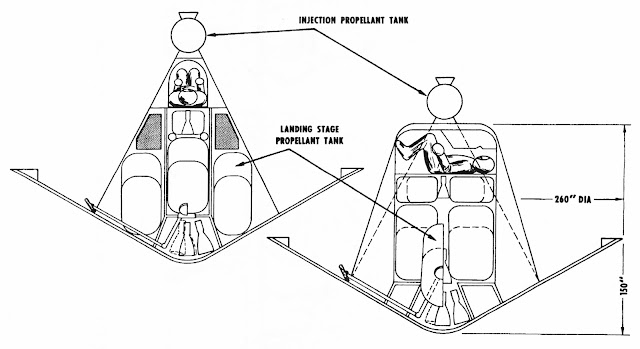
MSSR-derived minimum MEM. Image credit: Bellcomm/NASA.
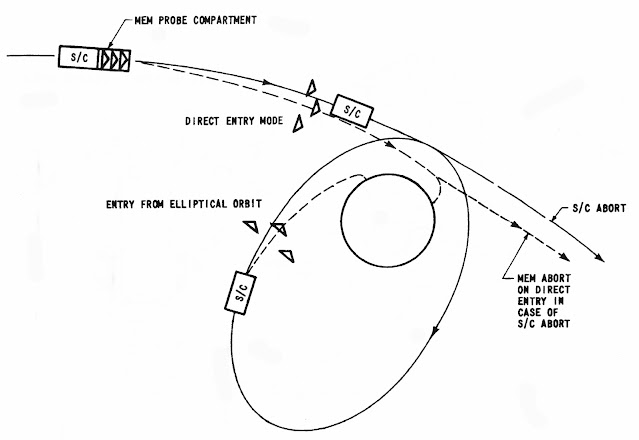
Two ways of landing on Mars: Direct Entry Mode would see a pair of minimum Mars Excursion Modules (MEMs) and a shelter deployed from a Mars orbiter (labelled "S/C") during approach to Mars. The orbiter would then fire rocket motors to capture into an elliptical Mars orbit. If the orbiter could not capture into orbit, the twin MEMs would abort their landing, fly past Mars, and rendezvous with the orbiter. Entry from Elliptical Orbit would see minimum MEM and shelter separation after the Mars orbiter captured successfully into Mars orbit. Image credit: Bellcomm/NASA.
An equivalent MEM released in Mars orbit would enter more slowly and subject its occupant to a reduced G load while also enabling more precise landing site targeting. The MSSR-derived MEM ascent stage could boost a 900-pound third stage and crew capsule containing a single astronaut to a velocity of 18,000 fps to a rendezvous with the piloted orbiter in an elliptical Mars orbit with a period of one day. 

Cassidy and London explained that a separate Bellcomm study, not yet completed when they finished their July 1967 memorandum, had determined that a minimum one-person MEM with a crew capsule weighing as little as 600 pounds without an astronaut on board might be possible. Such a MEM would carry only enough life support consumables to remain on Mars for a short time and no scientific exploration equipment. 

Anticipating that a mission so limited might not enjoy much support, they briefly examined one that employed three MSSR-derived landers: a pair of minimum MEMs carrying one astronaut each and an automated one-way cargo lander for delivering 5,500 pounds of life support supplies and science gear. The three landers would touch down near each other so that the two astronauts could meet up and make use of the cargo.

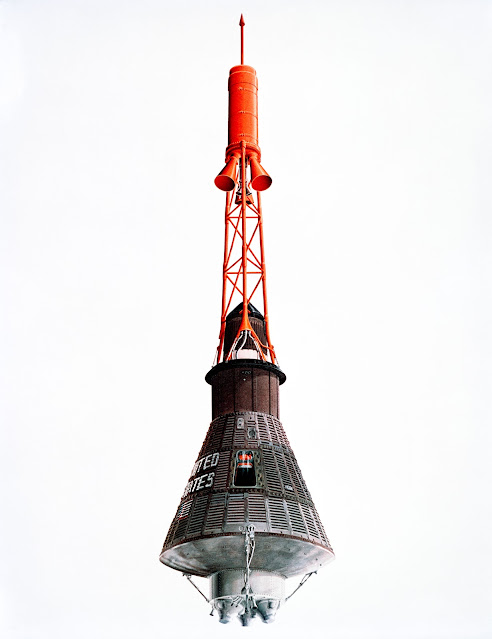
Compared with the MSSR-derived MEM ascent vehicle, the single-seat Mercury spacecraft — shown here with its retrograde propulsion system (bottom, strapped to bowl-shaped heat shield) and red launch escape tower — was large, heavy, and complex. Image credit: NASA.
The study of a 600-pound MEM crew capsule Cassidy and London referenced was performed by M. Skeer in consultation with Cassidy and unnamed McDonnell Aircraft engineers. Skeer, a newcomer to Bellcomm in 1966, summed up results of his study in a technical memo dated two months after the Cassidy and London study. 

Skeer explored whether the design of the one-man McDonnell-built Mercury capsule, which carried six astronauts on suborbital and orbital missions in 1961-1963, might contain weight-saving lessons for designers of an MSSR-derived MEM ascent vehicle. The 4600-pound Mercury capsule, he explained, was a good choice for his study because, like the minimum-mass MEM ascent vehicle, it had relatively simple mission objectives compared with the Gemini or Apollo Command and Service Module (CSM) and Lunar Module (LM) spacecraft.

The minimum MEM would descend from a spacecraft in a highly elliptical Mars orbit with a period of from 24 to 48 hours. A spacecraft in such an orbit would be bound loosely by Mars's gravity, so would require minimal propellant expenditure to depart the planet when the time came to return to Earth. Descent from the highly elliptical orbit to the surface of Mars would last about six hours and return from the surface of Mars to highly elliptical orbit would require about two hours. 

Skeer eliminated 47% of Mercury's weight immediately by deleting the 1119-pound launch escape tower, 315-pound heat shield, 317-pound retrograde propulsion system (used to deorbit the Mercury capsule), landing systems and recovery gear together weighing 343 pounds, and 51 pounds of experiments. He then treated remaining Mercury systems in detail. He wrote, for example, that McDonnell engineers had told him that the 75-pound Mercury couch could be trimmed to 15 pounds. Skeer arrived at a total MEM ascent stage weight of 738 pounds including a 170-pound astronaut. 

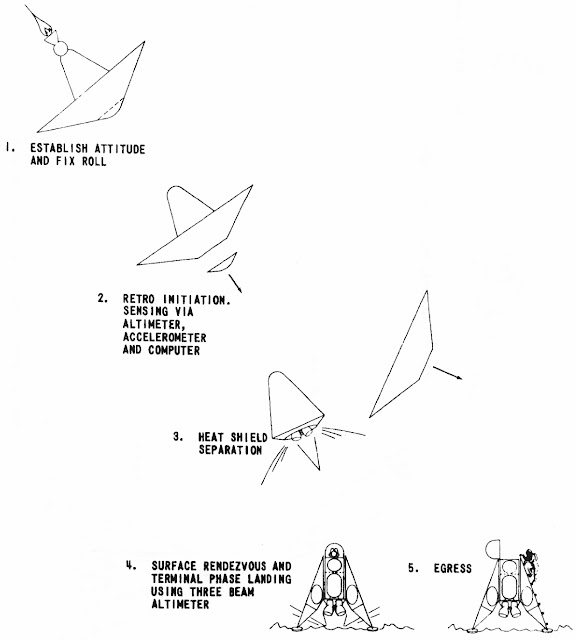
Minimum MEM entry and landing. Image credit: Bellcomm/NASA.
Useful payload: two-stage minimum MEM ascent vehicle. Image credit: Bellcomm/NASA.
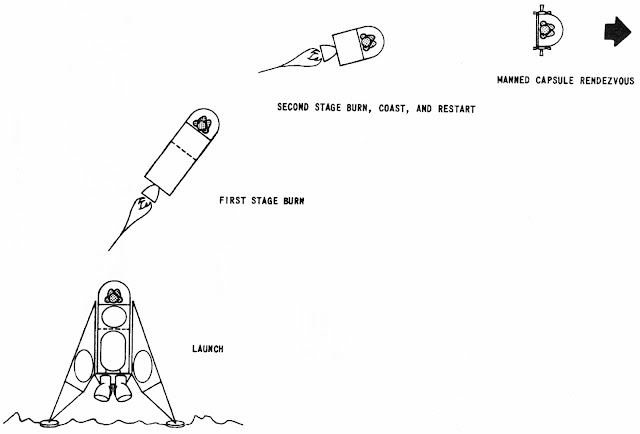
Minimum MEM liftoff, ascent, and orbital insertion. After rendezvous in Mars orbit the single astronaut would fly the capsule into a hangar on the Mars orbiter or would abandon the capsule and enter the Mars orbiter by spacewalking. Image credit: Bellcomm/NASA.
The MEM cabin would provide just 92 cubic feet of volume for the astronaut — 26 cubic feet less than the snug Mercury cabin. A "plastic shroud" measuring just 30 inches wide by 60 inches long, it would be neither pressurized nor insulated. Skeer estimated that it could weigh as little as 200 pounds, about 415 pounds less than the Mercury cabin structure. The cabin's small volume would prevent the astronaut from moving much; Skeer argued that astronaut immobility would simplify ascent stage guidance and control by avoiding center-of-gravity shifts. 

The astronaut packed into the coffin-like MEM cabin would rely for life support on a 40-pound space suit with a 100-pound life support backpack containing sufficient life support consumables for 12 hours of operations. This combination would replace a Mercury cabin life support system weighing 248 pounds. 

Skeer briefly examined a two-person minimum MEM with a descent stage not based directly on the piloted flyby MSSR. This would, he wrote, have a total weight of less than 35,000 pounds. Of this, 1360 pounds would comprise the MEM ascent stage and crew. He clearly favored the single-person minimum MEM, however. 

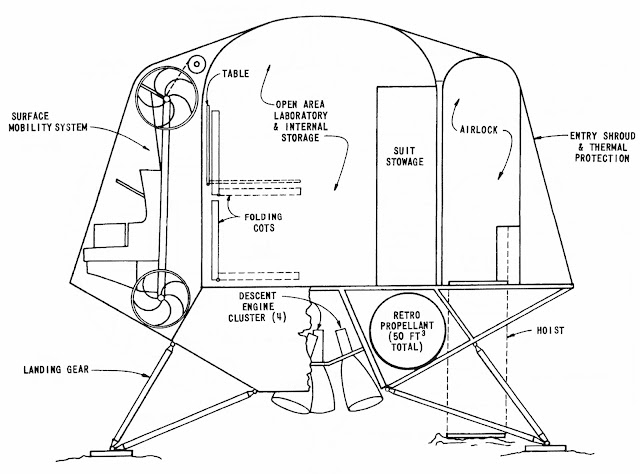
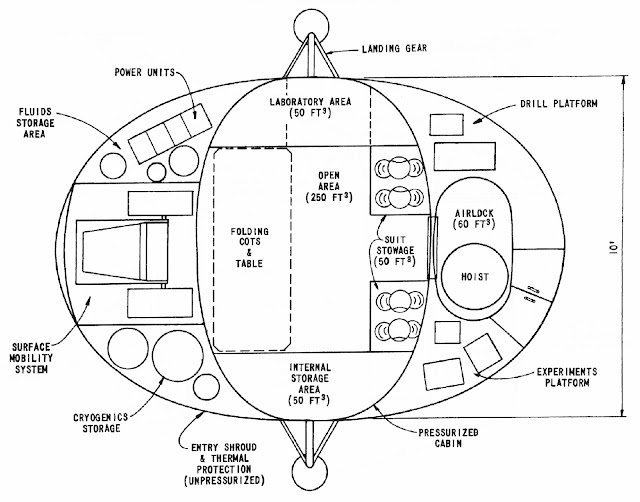
Skeer subsequently conducted a pair of follow-on studies of MSSR-derived piloted spacecraft. The first, completed on 8 May 1968, looked at a 4064-pound MSSR-derived two-person surface shelter that would enable a two-week Mars surface stay by astronauts landed separately in a pair of MSSR-derived minimum MEMs. Expendables supporting the two-week stay — mostly for life support and power generation — would account for 1053 pounds of the shelter's weight.

Cutaway view of MSSR-derived Mars surface shelter. Image credit: Bellcomm/NASA.
Plan view of MSSR-derived Mars surface shelter. Image credit: Bellcomm/NASA.
The 575-cubic-foot shelter would include a 60-cubic-foot airlock accessed from the martian surface by a "hoist" (apparently a one-person open elevator platform). A pair of 25-cubic-foot compartments accessed from within the shelter (not from the airlock) contained four complete space suits so each crewmember could have a spare. A laboratory area accounted for 50 cubic feet of the shelter's volume.

Scientific exploration equipment accounted for 1460 pounds of the shelter's weight. This included a single 367-pound one-person surface rover or flyer with a total range of 420 kilometers, 77 pounds of multiband photography/radiometry equipment, a 107-pound shelter-mounted drill capable of reaching a depth of 30 meters, 100 pounds of "surveying tools," a 250-pound "Emplaced Science Station" and three "satellite science stations" (total weight 140 pounds) meant to be left behind on the martian surface, and "local sampling and environmental equipment" weighing a total of 395 pounds. The shelter's pressurized cabin would contain 50 pounds of equipment for geologic analysis. (Skeer made no reference to return of samples in the two minimum MEM vehicles; presumably sample analysis on Mars was meant to replace return of samples to Earth.)

Skeer's second follow-on study, a more detailed examination of the minimum MEM ascent stage dated 8 July 1968, sought to identify "fruitful areas of technological research and development needed for evaluation and future program planning options." He argued for development of new propulsion systems capable of burning new high-energy propellants (for example, fluorine-LOX/methane), compact and lightweight refrigeration systems for long-term storage of such propellants, and development of new lightweight materials to permit further minimum MEM weight reduction. 

He also noted that flights of MSSR probes during piloted flyby missions could be seen as test flights of minimum MSSR technology. Unfortunately, by the time Skeer completed his second follow-on study, work within the NASA Planetary JAG toward a piloted flyby with MSSR probe had been largely abandoned for nearly a year.

Sources

"MSSR/MEM Commonality - Case 233," D. E. Cassidy and H. S. London, Bellcomm, Inc., 19 July 1967.

"Preliminary Sizing of a Mars Excursion Module Ascent Capsule Based on Mercury Spacecraft Design - Case 233," M. H. Skeer, Bellcomm, Inc., 25 September 1967.

"Preliminary Mars Excursion Module Shelter Design - Case 730," M. H. Skeer, Bellcomm, Inc., 8 May 1968.

"Mars Excursion Module Ascent Propulsion Stage Design," M. H. Skeer, Bellcomm, Inc., 8 July 1968.

More Information

A New Step in Spaceflight Evolution: To Mars by Flyby-Landing Excursion Mode (1966)

NASA's Planetary Joint Action Group Piloted Flyby Study (1966)

Triple-Flyby: Venus-Mars-Venus Piloted Missions in the Late 1970s/Early 1980s (1967)

Flyby's Last Gasp: North American Rockwell's S-IIB Interplanetary Booster (1968)

NASA's Planetary Joint Action Group Piloted Mars Flyby Study (1966)

Robotic flyby: encapsulated in a streamlined shroud, the Mars-bound Mariner IV spacecraft awaits launch from Florida atop an Atlas-Agena rocket. Image credit: NASA.
The piloted Mars/Venus flyby concept — the hallmark of which was a Sun-centered trajectory intersecting one or more planets and beginning and ending at Earth — was first proposed by Gaetano Crocco in 1956, at a time when robotic probes to other worlds were scarcely mentioned by champions of spaceflight. A decade later, when NASA performed its first high-level NASA-wide study of the piloted flyby concept, that situation had changed markedly — thanks largely to a 261-kilogram (575-pound) spacecraft called Mariner IV.

Launched on 28 November 1964, Mariner IV demonstrated for the first time that a robotic spacecraft could return useful data from the vicinity of Mars. The success of Mariner IV — it captured 21 images of the planet as it flew past on 15 July 1965, and slowly transmitted them to Earth over the following month — gave ammunition to those who called into question the utility of piloted flybys. 

The Mariner IV images revealed a cratered, arid surface, and its radio occultation experiment found an atmosphere only 1% as dense as Earth's. Mars, seemingly so promising for the development of life, suddenly appeared almost as inhospitable as Earth's barren Moon. 

Supporters of Mars exploration were quick to point out, however, that the little spacecraft had imaged only about 1% of Mars at a resolution so low that, had it flown past Earth, it would not have found life. NASA and the planetary science community persisted with plans to launch new scientific exploration missions to Mars in the Mariner and Voyager programs (the latter not to be confused with the late 1970s Voyager originally called Mariner Jupiter-Saturn — please see "More Information," below). 

Cratered planet: One of the sharpest Mariner IV images of Mars. Image credit: NASA.
In like fashion, piloted flyby proponents — such as the participants in the Planetary Joint Action Group (JAG), led by Edward Z. Gray of the NASA Headquarters Office Manned Space Flight (OMSF) — proceeded with their planning meetings in spite of Mariner IV's achievement. The first Planetary JAG meeting, held at the NASA Manned Spacecraft Center (MSC) in Houston, Texas, on 4 May 1966, gave roughly equal priority to piloted Mars/Venus flybys and a piloted Mars landing mission. 

By the Planetary JAG's second meeting, held at NASA Headquarters in Washington on 9 June 1966, piloted flybys had assumed primacy. "The object of the effort," the Group declared, "is a Mars/Venus Fly-by capability by [19]75 with a manned Mars landing in view." 

Ironically, given the negative effect of Mariner IV, a new class of robotic probe was largely responsible for the positive change in the piloted flyby concept's fortunes. The Mars Surface Sample Returner (MSSR), first discussed at the NASA Headquarters meeting, would borrow technology and experience from Mariner and Voyager. It would ride to Mars on board the piloted flyby spacecraft. After carefully checking out and servicing its systems, the crew would release it several days before the flyby. It would reach Mars hours ahead of the flyby spacecraft, land, collect samples of martian air and dirt, and launch them into space. 

The astronauts would capture the sample container minutes after their closest approach to Mars. They would analyze the sample in a lab on board the piloted flyby spacecraft within an hour of its launch from Mars, before any living things it contained could perish. 

More than 50 engineers from across NASA attended the Planetary JAG's third meeting at NASA Kennedy Space Center (KSC) on 29-30 June 1966. By then, the Group had begun work on a pair of documents: a briefing to the high-level managers of the NASA Management Council and a preliminary Program Development Plan (PDP). Bellcomm, NASA's Washington, DC-based planning contractor, provided the Group with technical assistance.

The briefing took place a month later — the Council's response is not recorded, but it was apparently favorable enough for work on the PDP to continue. The completed PDP, labelled "For Internal Use Only," bore the date 3 October 1966. 

The Planetary JAG envisioned that the 1975 Mars flyby, launched out of low-Earth orbit between 5 September and 3 October of that year, would be the first in a series of four Mars and Venus flyby missions. It would last 667 days. The other three were a 715-day Venus/Mars/Venus flyby mission launched in February 1977, a 625-day Venus/Mars flyby mission launched in December 1978, and a 686-day Mars flyby mission launched in November 1979. Regardless of the number of flybys it contained, no piloted flyby mission would require more than modest course-correction propulsion after departure from low-Earth orbit. 

Only the 1975 mission was described in detail in the PDP. It would follow a low-energy twilight trajectory that would take it past Mars and would reach aphelion — its greatest distance from the Sun — on the inner edge of the Asteroid Belt, at 2.2 times the Earth-Sun distance. The term "twilight" referred to the Mars pass geometry; flyby spacecraft Mars periapsis (closest approach) would occur over the line separating the dayside from the nightside. 

Seven years of development and testing would precede launch of the 1975 mission. The flyby program nested within a series of extant and anticipated NASA programs and missions, which the Planetary JAG stated provided "a sound base for the development of a manned flyby system." The piloted flyby spacecraft, for example, would be based on hardware and experience from Apollo and its planned follow-on, the Apollo Applications Program (AAP). Set to begin as early as 1968, AAP was envisioned primarily as an Earth-orbital space station program, but was also expected to include "limited lunar exploration" beyond the Apollo baseline.

AAP astronauts would carry out progressively longer missions on board Orbital Workshops, achieving a one-year stay in weightlessness in 1970 or 1971. The AAP Orbital Workshop would take the form of a converted S-IVB stage, which formed the second stage of the Saturn IB rocket and the third stage of the Saturn V. A third Orbital Workshop launched in 1972-1973 would test prototype piloted flyby spacecraft subsystems.

Major components of the Planetary JAG's piloted flyby spacecraft. A = Propulsion Module (PM) with toroidal propellant tanks and four engines; B = Apollo-derived Earth-Entry Module (EEM) with heat shield tunnel; C = Mission Module (MM) with tunnel to airlock/biological laboratory; D = Experiment Module (EM) with MSSR probe, airlock, telescope, and biological laboratory (probe complement illustrated differs from that described in Planetary JAG PDP); E = deployed high-gain antenna (stowed position also shown); F = deployed solar array. 
In the same timeframe, robotic precursor probes would provide important data to engineers designing piloted flyby mission systems. A Mariner spacecraft would release a probe to plumb the martian atmosphere in 1971 and possibly again in 1973 and probes would assess the meteoroid population between the orbit of Venus and the inner edge of the Asteroid Belt in 1970 or 1971. The former would aid in piloted flyby probe design and the latter might permit reduced piloted flyby spacecraft meteoroid shielding. Weight saved by reducing shielding might permit a heavier scientific payload on board the piloted flyby spacecraft.

Late 1972 would see a test of a Earth Entry Module (EEM) derived from the Apollo Command Module design but capable of withstanding Earth-atmosphere reentry at the end of the piloted flyby mission at up to 50,000 feet per second — that is, 14,000 feet per second more than the maximum planned Apollo lunar-return speed. In 1973-1974, four astronauts — the number planned for the piloted flyby spacecraft crew — would rehearse the piloted flyby mission for a year in low-Earth orbit on board a prototype 180,000-pound (81,650-kilogram) piloted flyby spacecraft. They would ride to Earth orbit and return to Earth in a 51,500-pound (23,350-kilogram) CSM launched with the flyby spacecraft.

The S-IVB stage was the third stage of the Saturn V rocket (shown in silhouette at left) and the second stage of the Saturn IB rocket. It was tapped as the structural basis of the AAP Orbital Workshop. The Planetary JAG expected that three Modified S-IVB stages launched on two-stage Saturn Vs would boost piloted flyby spacecraft out of Earth orbit toward Mars and Venus. Image credit: NASA.
The piloted flyby spacecraft and CSM would reach Earth orbit atop a two-stage "Improved" Saturn V rocket, the workhorse launch vehicle of the piloted flyby program. The Improved Saturn V would comprise an S-IC first stage stretched 20 feet (6.6 meters) to hold additional propellants for its beefed-up F-1 engines. In addition to launching the piloted flyby spacecraft and CSM, it would be used to rapidly launch a series of three 231,400-pound (105,000-kilogram) Modified S-IVB (MS-IVB) stages which would link up with the piloted flyby spacecraft in 485-kilometer (300-mile) assembly orbit to form an Orbital Launch Vehicle (OLV). 

The MS-IVB stages would each contain 195,800 pounds (88,800 kilograms) of cryogenic liquid hydrogen fuel and liquid oxygen oxidizer. Even with added insulation, the liquid hydrogen would boil and escape, so the stages would have to be used within about 50 hours of launch from NASA KSC to ensure that they would contain sufficient fuel to launch the piloted flyby spacecraft out of Earth orbit on flyby course past Mars. 

The Planetary JAG envisioned launching the three MS-IVB stages 12 hours apart. To make possible this "salvo" launch campaign, a third Launch Complex 39 Saturn V launch pad would need to be built beside the two NASA had already built for the Apollo Program. 

Orbital Launch Vehicle (OLV) assembly configurations. Image credit: NASA/DSFPortree.
OLV assembly came in for special consideration in the Planetary JAG PDP. In 1973, a crew in a CSM launched on a Saturn I-B rocket would dock with the prototype piloted flyby spacecraft after the one-year test crew returned to Earth. Shortly thereafter, NASA would launch two MS-IVB stages in rapid succession. The CSM, docked with a special docking collar at the front of the flyby spacecraft, would act as a space tug to push the piloted flyby spacecraft to a rendezvous and docking with the first MS-IVB in assembly orbit, then would push the piloted flyby spacecraft/MS-IVB combination to a rendezvous and docking with the second MS-IVB. The stages would then separate from the prototype flyby spacecraft and ignite in succession to carry out an MS-IVB flight test. The CSM crew would undock from the docking collar and return to Earth.

A full-up OLV assembly rehearsal involving a crew in a CSM, the piloted flyby spacecraft prototype, and three MS-IVB stages would follow in mid-1974. The CSM would dock with the docking collar on the front of the prototype, push it to a docking with the first MS-IVB, push the prototype and MS-IVB to a docking with the second MS-IVB, and finally push the prototype and the two MS-IVBs to a docking with the third MS-IVB. 

After docking with the piloted flyby spacecraft prototype, the crew in the CSM would have difficulty seeing the MS-IVB stages during docking maneuvers. The Planetary JAG proposed that strategically placed TV cameras and a viewscreen in the CSM could enhance visibility. In addition, an astronaut with an Astronaut Maneuvering Unit backpack might position himself where he could see the docking operation and call out directions to the crew in the CSM.

The Planetary JAG suggested that, following CSM separation, the three-stage OLV might launch the piloted flyby spacecraft prototype on an interplanetary trajectory without a crew. Alternately, the OLV might boost it into a high Earth orbit where it could serve as a space station.

The Planetary JAG assumed that the OLV for the 1975 piloted flyby mission would be ready for Earth departure on 5 September 1975, at the opening of its month-long launch window. After OLV assembly and prior to Earth departure, the flyby crew in the CSM would undock from the docking collar on the front of the piloted flyby spacecraft and redock at an airlock port on its side. After entering the flyby spacecraft's drum-shaped, two-deck Mission Module (MM), their home for the next 22 months, they would cast off the CSM and the docking collar. The MS-IVB stages would then ignite, burn to depletion, and separate in succession to commence a 130-day Earth-to-Mars transfer.

During flight to Mars, the flyby crew would operate a 40-inch astronomical telescope almost continuously. The Planetary JAG took pains to stress the value of their research program, which would include multispectral solar, stellar, planetary, and asteroid observations. Solar images were expected to contain details as small as 95 miles (150 kilometers) across. The telescope would be housed when not in use within the flyby spacecraft's tightly packed Experiment Module (EM). 

In total, at launch from Earth the EM would contain 30,190 pounds (13,690 kilograms) of experimental apparatus, including six robotic probes and the biology lab for analyzing the samples collected by the MSSR probe. In addition to the 11,692-pound (5300-kilogram) MSSR, probes would include a 1290-pound (585-kilogram) Lander for surface photography, geology/geophysics, and atmosphere studies, three 100-pound (45-kilogram) Aerodynamic Drag/Impacter probes, and a 10,130-pound (4600-kilogram) Orbiter for planet-wide mapping photography. 

The piloted flyby spacecraft would pass Mars between 23 January and 4 February 1976, the exact date and time depending on the date of Earth departure and magnitude of course corrections required. As the flyby spacecraft approached Mars, the crew would spend an increasing amount of time imaging it using the telescope and relaying the high-resolution images to Earth using the 19-foot-diameter (5.8-meter-diameter) radio dish antenna mounted on a stalk attached to the EM. The images, which would rapidly reveal new details as the piloted flyby spacecraft closed in on Mars, would be of profound scientific interest, but would also serve an operational purpose: they would be used to select targets for the robotic lander probes, which would be released between five and 10 days before piloted flyby spacecraft Mars periapsis (closest approach to the planet).

The MSSR probe would be the first of the six probes to be released. After release, the MSSR would cast off a two-part biological shield. A rocket motor would then ignite to increase the probe's speed by about 500 feet (150 meters) per second. The crew would begin careful tracking the MSSR's course. Twelve hours before landing and about 19 hours ahead of piloted flyby spacecraft periapsis, they would command the motor to perform a final course correction, after which it would be ejected.

The MSSR would enter the martian atmosphere and land in pre-dawn darkness about seven hours ahead of flyby spacecraft periapsis. Immediately after landing it would open like a flower with four fat triangular petals. The petals would contain most of the MSSR's scientific equipment, including two identical sets of four sample collectors on opposite sides of the lander. The MSSR would image the landing site using a panoramic camera and transmit the images immediately to the piloted flyby spacecraft, where the astronauts would use them to select sampling locations. The crew would seek to deploy the collectors outside the zone contaminated by the MSSR's descent rocket engines. 

Partial cutaway of the MSSR probe after biological shell separation. A = course change rocket motor with toroidal propellant tank; B = sample container attached to top of ascent vehicle third stage; C = stowed science compartment (one of four); D = folded landing leg (one of four); E = heat shield aeroshell; F = toroidal descent stage propellant tank; G = detachable heat shield cap covering descent engine bells. Image credit: NASA/DSFPortree.
MSSR descent. A = separation from the piloted flyby spacecraft and Mars targeting course changes; the course change rocket motor (1) is then ejected; B = Mars atmosphere entry and ejection of the protective cap (2) covering the descent engines shortly before ignition of the descent engine cluster; C = ejection of the aeroshell (3) and descent engine (4) operation. Image credit: NASA/DSFPortree.
MSSR after touchdown on Mars. A = sample container attached to ascent vehicle third stage; B = ascent vehicle with three rocket stages with toroidal tanks (numbered in reverse order of use); C = ascent vehicle protective cover/shield protecting deployed science compartment during ascent vehicle liftoff; D = deployed science compartment; E = descent motor cluster. Image credit: NASA/DSFPortree.
The Planetary JAG proposed four sample collectors of different designs in the hope that at least one would successfully sample the unknown surface materials of Mars, plus a single rock drill for collecting subsurface samples and a filter for sampling airborne dust. Of the four collectors, three — two with rotating cylinders intended to scrape the surface and a "vacuum cleaner" — assumed a dry and dusty Mars, while a fourth — the "sticky string" collector — would serve well if Mars turned out to be "tacky or viscous." About two pounds (0.9 kilograms) of material would be collected. A color film camera would automatically photograph the sampling sites then would transfer its film to the MSSR sample container. 

Meanwhile, the other probes would arrive at Mars. The solar-powered Orbiter, with a 200-pound (90-kilogram) camera, would use a three-stage liquid-propellant propulsion system to slow down and capture into a 185-mile (300-kilometer) near-polar orbit four hours before flyby spacecraft periapsis. The Lander would reach Mars two hours before periapsis. An hour after landing it would launch a 50-pound (23-kilogram) solid-propellant sounding rocket to an altitude of about 45 miles (70 kilometers). The three Aerodynamic Drag/Impacters would enter the martian atmosphere six minutes before periapsis. Their missions would end when they struck the martian surface.

The three-stage MSSR ascent vehicle would lift off in daylight 11.5 minutes before flyby spacecraft periapsis. Stage 1 would burn out and separate 5.5 minutes later, when the sample container was about 1540 miles (2480 kilometers) behind the flyby spacecraft. Stage 2 would then burn for 4.5 minutes, closing the distance to about 540 miles (870 kilometers). After a pause, Stage 3 would burn for about a minute, placing the sample container very near the piloted flyby spacecraft over the night side of Mars five minutes after periapsis. The astronauts would extend an arm-mounted docking ring, capture the sample container and third stage, and swing them to a linkup with a port on the biology lab located inside the EM.

Flyby spacecraft periapsis would occur about 125 miles (200 kilometers) above Mars, at which time the spacecraft would be moving at about 30,000 feet per second (9140 meters per second). At that altitude, the spacecraft's telescope would, with motion-compensation slewing, in theory be capable of discerning surface features 1.5 feet (0.5 meters) across. During the flyby, Mars's gravity would bend the spacecraft's course by only 17°.

The MSSR, Lander, and Orbiter probes would continue to explore Mars as the piloted flyby spacecraft moved outward past the planet, at first relaying data at a high rate via the flyby spacecraft and then transmitting directly to Earth at a lower rate. The authors of the PDP hoped that they could continue to return data from Mars for several years. 

Assuming Earth departure on 5 September 1975, the flyby crew would need a further 537 days to return to Earth. Early in that period, they would spend much of their time examining the Mars samples. Later, they would return to their wide-ranging astronomy studies. The Planetary JAG suggested that they could study 12-mile-wide (19.75-kilometer-wide) asteroid 149 Medusa at a distance of about 20 million miles (32 million kilometers) 170 days after Mars periapsis and 75-mile-wide (120-kilometer-wide) asteroid 156 Xanthippe at a distance of about 14 million miles (22.5 million kilometers) 150 days after that. They might also discover new asteroids and comets.

The flyby spacecraft would be on the opposite side of the Sun from the Earth when it reached aphelion at 2.2 times the Earth-Sun distance. The Planetary JAG anticipated that data the astronauts collected from their unique vantage point could be combined with data collected simultaneously on Earth to generate a full Sun portrait for the first time.

During the long flight, the crew could expect to observe many solar flares. Some would be directed toward the piloted flyby spacecraft. At such times, the crew would shelter in the thick-skinned EEM. Toroidal tanks containing PM course-correction propellants and spherical tanks containing MM life support gases and liquids would surround and provide additional radiation shielding for the EEM.

The piloted flyby spacecraft would return to Earth between 18 and 26 July 1977. The four astronauts would enter the EEM with the Mars samples and separate from the piloted flyby spacecraft. They would use the attached PM to nudge their course toward Earth, then would cast it off. The abandoned flyby spacecraft would swing past Earth and enter solar orbit; the EEM, meanwhile, would enter Earth's atmosphere at a speed of 49,100 feet per second, decelerate, and descend on parachutes to a land landing. Solid-propellant rocket motors would soften touchdown.

The Planetary JAG envisioned that its series of four piloted flybys would pave the way for piloted Mars landing and Venus orbital missions using nuclear-thermal rockets. These could begin as early as 1980 and might continue into the 1990s, when a Mars outpost might be established.

With the PDP in circulation, planning began for a new phase of Planetary JAG activity. In the minutes of a meeting held on 12 October 1966 at NASA Headquarters, Edward Z. Gray proposed spending $1.7 million of NASA's $8.45-million advance planning budget on the piloted flyby concept in Fiscal Year (FY) 1967. Of this, $250,000 would be spent to prepare for release to U.S. industry of contracts for an MSSR study in FY 1968. 

The pace of piloted flyby planning picked up in November and December 1966. On 17 November 1966, Gray called an advance planning meeting at NASA Headquarters for 6 December 1966. In a telex message dated 2 December, he explained that "the purpose of continuing activity in the manned planetary area is to be in a position to initiate a flyby project in FY 1969." He wrote that "to accomplish this end, we need to prepare a project proposal by mid-April 1967, in time for consideration in the FY 1969 budget cycle." 

The next Planetary JAG meeting was held at NASA MSC on 17 January 1967. In the early afternoon on 27 January, in response to issues raised during that meeting, Gray dispatched a telex in which he called on participants in the Planetary JAG to address "soft areas" in the 3 October 1966 report by mid-April. He called "experiment return from a flyby mission. . .one of its major attractions and an area which has received many searching questions." A little more than five hours after Gray sent out his message, fire raged through the AS-204/Apollo 1 spacecraft at Cape Kennedy, Florida, killing astronauts Virgil "Gus" Grissom, Edward White, and Roger Chaffee.

Piloted flyby planning became a casualty of Congressional backlash from the fire, which generated searching questions for NASA more pressing and immediate than any associated with the piloted flyby mission. Planetary JAG work did not, however, end immediately. In fact, in March 1967, Edward Z. Gray and his deputy Franklin Dixon felt confident enough to go public with the piloted flyby mission at the 5th Goddard Memorial Symposium in Washington, DC. They called for the 1975 piloted Mars flyby to be made a formal new start program in NASA's FY 1969 budget. 

Gray and Dixon eschewed the term "flyby," which had become closely associated with robotic probes after Mariner IV, in favor of calling the proposed mission a "retriever" or an "encounter." Whatever it was called, the piloted flyby concept — and, indeed, all NASA planning designed to give the space agency a future beyond Apollo — was in deep trouble by the summer of 1967. In September 1967, goaded by a Request For Proposals (RFP) NASA MSC distributed to industry aimed at selecting contractors for the MSSR study, Congress zeroed out all funding for NASA advance planning in FY 1968. NASA MSC collected RFP responses from industry but awarded no contracts.

Meanwhile, the Jet Propulsion Laboratory (JPL), with assistance from the Illinois Institute of Technology Research Institute (IITRI), completed a study of an all-robotic Automated Mars Surface Sample Return (AMSSR) mission. The small study team had begun work toward their 15 March 1967 report, a direct response to the Planetary JAG's 3 October 1966 PDP, on 26 October 1966. The team argued that an AMSSR mission based on Voyager technology and requiring but a single Saturn V launch could be much cheaper than a piloted flyby with MSSR. It was the first U.S. study of an robotic Mars Sample Return (MSR) mission.

If an AMSSR probe ever flew, however, it would not be derived from Voyager, for that program had come to be seen as an expensive foot in the door leading to an even more expensive piloted Mars mission. Congress cancelled Voyager in August 1967, just before it slashed NASA advance planning funding.

In large part because the Soviet Union had declared that it would explore the Solar System with robots, U.S. robotic Mars exploration fared better than did piloted flybys. Negotiations with Congress in September 1967 led to a promise of funding in FY 1969 for a pair of Mariner Mars orbiter missions in 1971 and a pair of reduced-cost Mars lander/orbiter missions in 1973 in a new program dubbed Viking. 

Sources

Memorandum, J. West, AD/Chief, Advanced Spacecraft Planning to Distribution, "Planetary Exploration Program Study — request for review and comments on systems parameters," NASA Manned Spacecraft Center, 9 May 1966.

Memorandum, R. Hock, DP/Chief, Advanced Programs Office (PPR-2) to Distribution, "Minutes of Joint Action Group Meeting on June 29 and 30, 1966," NASA Kennedy Space Center, 8 July 1966.

Planetary Exploration Utilizing a Manned Flight System, NASA Office of Manned Space Flight, 3 October 1966.

Memorandum, MT/Director, Advanced Manned Missions Program to NASA George C. Marshall Space Center, NASA Manned Spacecraft Center, and NASA John F. Kennedy Space Center, "FY 1967 Advanced Studies Planning," 27 October 1966.

Telex, Edward Z. Gray, Dir, Advanced Manned Missions Program, NASA Office of Manned Space Flight, to NASA MSFC Huntsville, NASA MSC Houston, and NASA KSC FLA, 2 December 1966.

Telex [Priority], E. Z. Gray, Director Advanced Manned Missions Program to NASA MSFC Huntsville ALA, Kennedy Space Center FLA, and MSC Houston TEX, 27 January 1967.

Humans to Mars: Fifty Years of Mission Planning,1950-2000, NASA SP-2001-4521, Monographs in Aerospace History #21, David S. F. Portree, NASA Headquarters History Office, February 2001, pp. 23-32. 

More Information